


Nominally Hedged is Kalibr Partners’ briefing on what oil and gas actually costs: every category, CAPEX to OPEX, proprietary data systems, interpreted through a commercial lens. Whichever side of the negotiating table you sit on, you are the intended reader.
Changes to Nominally Hedged Cadence
We have simplified our publishing structure moving forward. Nominally Hedged commentary will be posted for free on Thursdays at 6 am MTN. Kalibr’s Iron Report Counterparty Read are transitioning to our new Iron Flow compression intelligence platform. Check the video out below to learn more:
I spend a lot of my time reading the capital structures of oil and gas companies and of the service companies that work for them. What they’re worth is someone else’s problem; I read them for what they say about operations, because everything in this business is relative. The capital structure tells you who needs cost out of the system more than the next operator does, and what they will need to hear before they buy anything from you. Compressed to one sentence, the state of energy finance in September 2026 is that demand for risky(ish) debt is high and demand for risky(ish) equity is low.
That makes sense from the money manager’s chair. Low-teens returns on senior secured energy debt, first in line, paid quarterly, and nobody asking you to defend a mark on an illiquid equity position in a reservoir you have never seen. Or a private equity commitment, seven years, and an argument about the mark. The first job is a good job.
You don’t have to take my word for it. We spent a whole issue on PDP securitizations, the risky(ish)-debt trade in its purest form, and the last one on a $9 billion equity investment that pays 7.0%, never votes, and can be bought out at par, which is the risky-equity trade dressed up to look like the other thing. The market wants the debt-shaped claim, and everyone is manufacturing one.
Part of why is that private equity has had a hard time selling. The energy funds bifurcated by size, the big ones bought big things, and that shortens the list of later buyers. The IPO window has been mostly shut to sponsor-backed E&Ps. All of these broader forces landed in the middle of the most disciplined portfolio rationalization the public E&Ps have ever run, so in the basins where private equity deployed (the Bakken, the DJ, the Marcellus and Utica), the natural acquirers are telling their shareholders they are net sellers.
Year Seven Arrives Whether the Buyer Does or Not
A clock is running in every one of those funds. The trade an LP makes with a sponsor is return for illiquidity: put my money in things that are hard to sell and pay me more for the inconvenience. But the LP wants the money back..eventually, typically from about year seven of a ten-year life, and the clock has gotten louder.
Buyers and sellers stopped agreeing on prices. The median holding period for a US private equity exit peaked at 7.0 years in 2023 and came down only to 5.8 in 2024 as sponsors started working the backlog, which Jefferies counts at 32,000 unsold companies worth $3.8 trillion, 39% of them held more than five years.
And the LPs ran out of cash. Global private equity distributions fell to roughly 6% of assets under management by June 2025, eight points below the ten-year average of 14%, and with a denominator effect on top, 40% of North American institutional LPs were overallocated to private equity in 2025, up from 22% in 2019.
The LP response is the rational one: tighten the allocation budget and tell the GP to show distributions to paid-in capital before asking for the next fund. Scotiabank’s rule of thumb is 0.4x to 0.5x DPI on the current vintage before a successor fund clears.
So what does a sponsor do when one of the great accelerants of US energy, private equity, gets squeezed between a captive-buyer M&A market and a financial market that prefers risky debt to risky equity, while its own investors ask for the money back?
The Buyer Is Also the Seller
You sell to yourself, of course.
If I had to explain private equity economics to my kids, I would say private equity is the football fan who is sure he could run the team better than the owner, except they gets to try. You raise $500 million, buy a company, run it well, and sell it for $1 billion. Along the way you do two things:
You charge a management fee, call it 2%, on the $500 million you raised to buy it.
When you sell, to a bigger company or to the public through an IPO, you collect 20% of the value you created, another $100 million, as carried interest.
The second step has a downside. Once you sell, the management fee stops, which matters in a basin with one or two true buyers, both being paid by their shareholders to stay home. (BATNA matters even when you’re the seller.) There is, of course, a more desirable solution. Mark the company to market, raise a new fund, and sell the company from the old fund to the new one at the new mark. Now you have a fee on the $1 billion instead of the $500 million, the $100 million of carry today, and a fresh carry on whatever you create from here.
Great devices get nice names, and the industry calls this one a continuation vehicle. A continuation vehicle is a sale. Well, not quite. It is a sale in which the seller’s fiduciary picks the buyer, the buyer’s fiduciary sets the price, and both fiduciaries are the same people. Global secondary volume reached $226 billion in 2025, up 41%, and the first half of 2026 set a record at $121 billion, with GP-led deals passing LP-led deals for the first time in four years. (Jefferies counts $240 billion; the direction is the same.)
The sponsor owes fiduciary duties to the fund that is selling and to the fund that is buying, so every dollar of price is a dollar taken from one child and handed to the other. Infact, it would be a little strange if there wasn’t some bias regarding the price.
Where the bias points depends on where the sponsor stands. A high price crystallizes carry in the old fund and flatters the next raise; a low price resets the hurdle in the new fund, and if the sponsor is putting fresh money in, as EMG was, a low price is a discount on its own purchase. Smart people employ smart people to manage this (fairness opinions, advisory committee votes, the right to roll on no worse terms), and even then it goes sideways.
Ascent Resources and its sponsor, the Energy & Minerals Group, are the sideways case. In late October 2025, EMG proposed selling its Ascent stake into an EMG continuation vehicle at roughly a $5.5 billion valuation, and the Abu Dhabi Investment Council, an LP on the selling funds’ advisory boards, sued in Delaware Chancery to stop it. The complaint is public. It alleges five business days’ notice of the vote (a capital call gets ten); an October 30 vote that drew three approvals from 43 advisory board members; a sponsor rolling its own capital in and adding more, which made EMG a net buyer with an interest in a low price; and two 2025 confidential memoranda for prospective CV investors that described a longer inventory life and called an IPO the “expected case,” while the advisory boards heard the IPO was “inactionable” and inventory was short. (Ascent’s own November 2025 investor deck put inventory at 18 to 21 years.) EMG’s stated reason that the discussion should run through EMG: “we are the only ones that truly have the facts.” The only ones. On the buying side too, since both sides are the same people.
These are allegations, and EMG contested them. The court paused the closing, the arbitrator the fund documents required ruled for EMG in March, and on March 25, 2026, EMG closed a $1.5 billion Ascent continuation vehicle. Two outside bidders had reportedly come in above $5.5 billion in the interim; the board did not take them up. I don’t know who was right about the price. I do know that every continuation vehicle prices an asset that will, in hindsight, have been too cheap or too dear, and whoever lands on the wrong side of that will have a lawyer.
The Concessions Are the Incentive
The kids’ version above is the ceiling on what a sponsor can take. In practice the secondary buyers extract terms, and the terms have converged fast: 97% of continuation vehicles now charge a management fee of 1% or less, on invested capital; 49% of new vehicles step the fee down if the initial term extends; 79% use tiered carry and 60% test it on both IRR and multiple of invested capital; about 80% require the GP to commit 5% or more of the vehicle alongside the LPs. The standard term is five years plus two one-year extensions, and ILPA’s June 2026 guidance adds a “no worse off” rule for rolling LPs and asks that the GP’s crystallized carry go back into the vehicle.
Read those terms the way an operator would. The fee that paid the sponsor’s overhead has been halved and put on a timer, the carry has been reset to zero behind a hurdle, and the sponsor’s own money is in at a size that makes it a meaningful LP in its own deal. Anyone selling anything to an oil and gas company sells on value, and in 2026 value means capex and opex out. The counterparty whose fee and carry were just restructured sits, by construction, at the top of the list of people who need cost out of the asset, because that’s the only fee left the GP controls.
Who Sold to Themselves
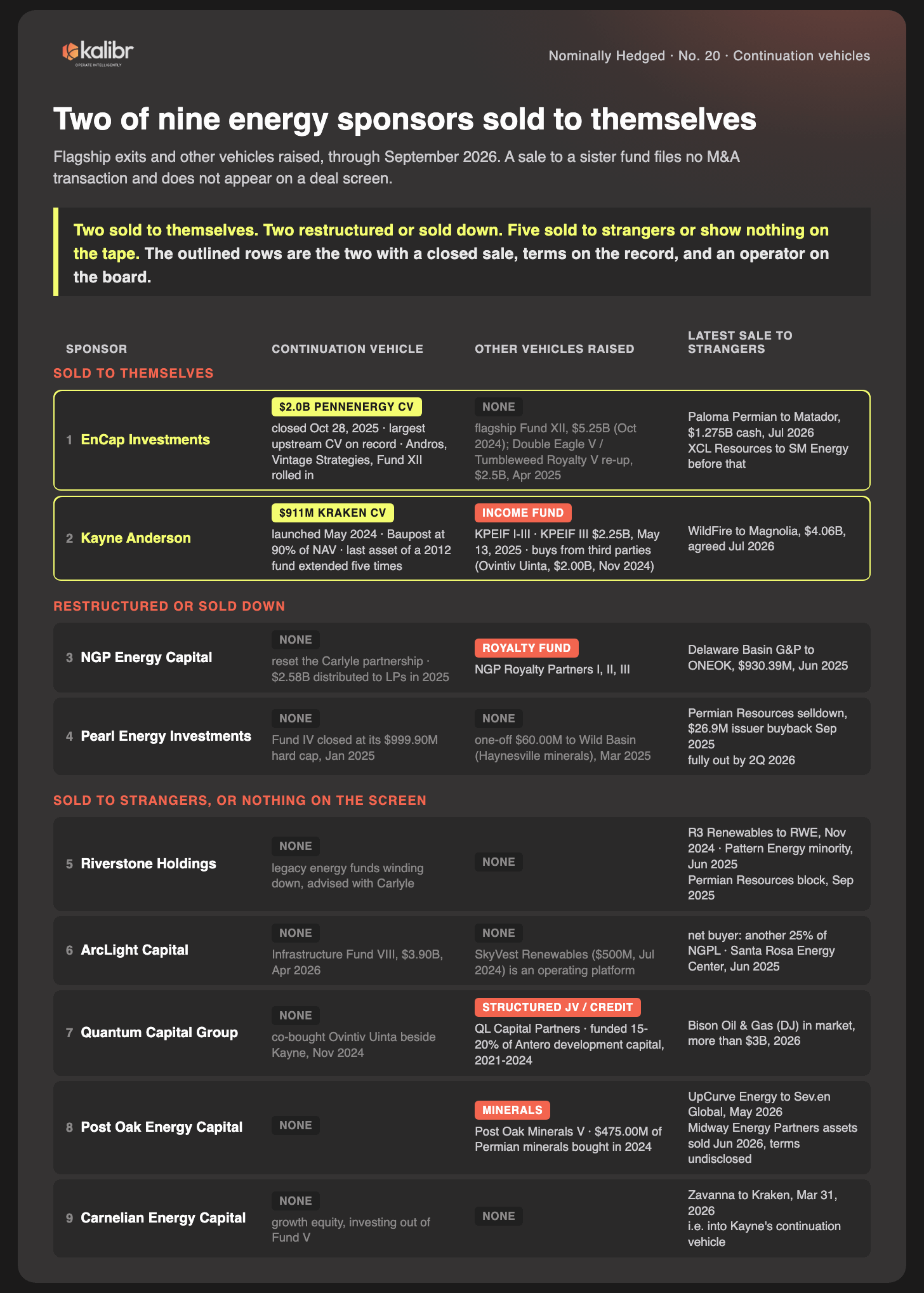
Nine energy sponsors, read from fund closings and press releases, sort into three piles by what they did when a flagship fund needed an exit. Two sold to themselves. Two restructured or sold down. Others sold to strangers. The sort is easy to get wrong from a desk, because a fund selling a company to a sister fund files no M&A transaction.
EnCap sold to itself first and biggest. Its $2.0 billion PennEnergy continuation vehicle, closed October 28, 2025, is the largest upstream CV on record, anchored by Andros Capital Partners and the Vintage Strategies team at Goldman Sachs Alternatives, with EnCap Energy Capital Fund XII, the EnCap general partner, and PennEnergy management committing alongside. The asset is a Pittsburgh gas producer with more than 180,000 net acres in Beaver, Butler, and Armstrong counties, roughly 750 mmcfepd it plans to take to 900 over five years, one rig, about 25 wells a year, and more than twenty years of inventory at that pace. EnCap still sells to strangers when a stranger will pay, Paloma Permian to Matador for $1.275 billion in cash in July 2026 being the latest, and its flagship is Fund XII, closed at $5.25 billion in October 2024.
Kayne Anderson’s vehicle reads as the defensive case, at least at the start. The continuation vehicle is Kraken Resources, $911 million, launched in May 2024, led by Baupost at 90% of NAV and built to hold the last asset in a $950 million fund raised in 2012 and extended five times past its original 2018 end date. (Secondaries buyers tend to mark such positions back up to the GP’s NAV the next day). Kraken is a 404,000-net-acre Williston operator (85,000 boe/d and 68% oil in 2025), assembled by buying Crescent Point’s Bakken assets in 2023, Iron Oil in 2024, and, on March 31, 2026, Zavanna Energy: 35,000 acres and 14,000 boe/d in Williams and McKenzie counties, bought from Carnelian. Kraken sold $400 million of 7.125% notes due 2031 in May. A continuation vehicle that borrows in the bond market to buy a competitor from another sponsor is a long way from the defensive fund extension the structure was invented for.
The other seven did something else. NGP reset its Carlyle partnership, distributed $2.58 billion to LPs in 2025, and sold its Delaware Basin gathering and processing to ONEOK for $930.39 million in June 2025. Pearl closed Fund IV at its $999.90 million hard cap in January 2025 and cleared its Permian Resources position through public selldowns and a $26.9 million issuer buyback in September 2025, fully out by the second quarter of 2026. Riverstone’s legacy energy funds, advised with Carlyle, are winding down through block sales: R3 Renewables to RWE in November 2024, a Pattern Energy minority in June 2025, the Permian Resources block in September 2025. ArcLight closed Infrastructure Fund VIII at $3.90 billion in April 2026 and has been a net buyer. Quantum, Post Oak, and Carnelian show nothing on the screen, and Carnelian’s exit turned up on the other side of the table: Zavanna, sold to Kraken on March 31, 2026, into Kayne’s vehicle.
So two of the nine have done the thing this piece is about with a company that can be scored, and the rest of it runs on them, EnCap’s PennEnergy and Kayne’s Kraken.
You can read both vehicles two ways. The offensive story is the one both sponsors tell: trophy asset, decades of inventory, constructive gas macro, why would we sell now? The defensive story is the one the LP clock tells: a 2012 fund extended five times, and a $2.0 billion vehicle that raised the fee base and reset the carry in a year when the IPO window was shut. I can see both.
Six Wrappers for One Well
The continuation vehicle is the loudest of the new wrappers, and it isn’t arriving alone. Energy sponsors have spent the last two years raising vehicles that hold producing cash flow in shapes public equity never offered, and the equity fund is only one of them.
Income funds: Kayne’s Private Energy Income Fund III closed on May 13, 2025 at $2.25 billion, $2.80 billion with co-investment, and buys producing assets for cash yield the way it bought Ovintiv’s Uinta position with Quantum and FourPoint for $2.00 billion in November 2024; Lime Rock Resources and Formentera Partners run nothing but this model, and Formentera Operations sits at 47 on the Bakken board below.
Royalty funds: NGP Royalty Partners is on its third, Tailwater Royalties Fund II closed at roughly $170.00 million on July 16, 2026, and Post Oak Minerals V bought more than $475.00 million of Permian minerals in 2024.
Structured drilling partnerships: Quantum’s QL Capital Partners funded 15% to 20% of Antero’s development capital from 2021 through 2024 for a preferred return, with Antero earning a carry once a tranche cleared its hurdle.
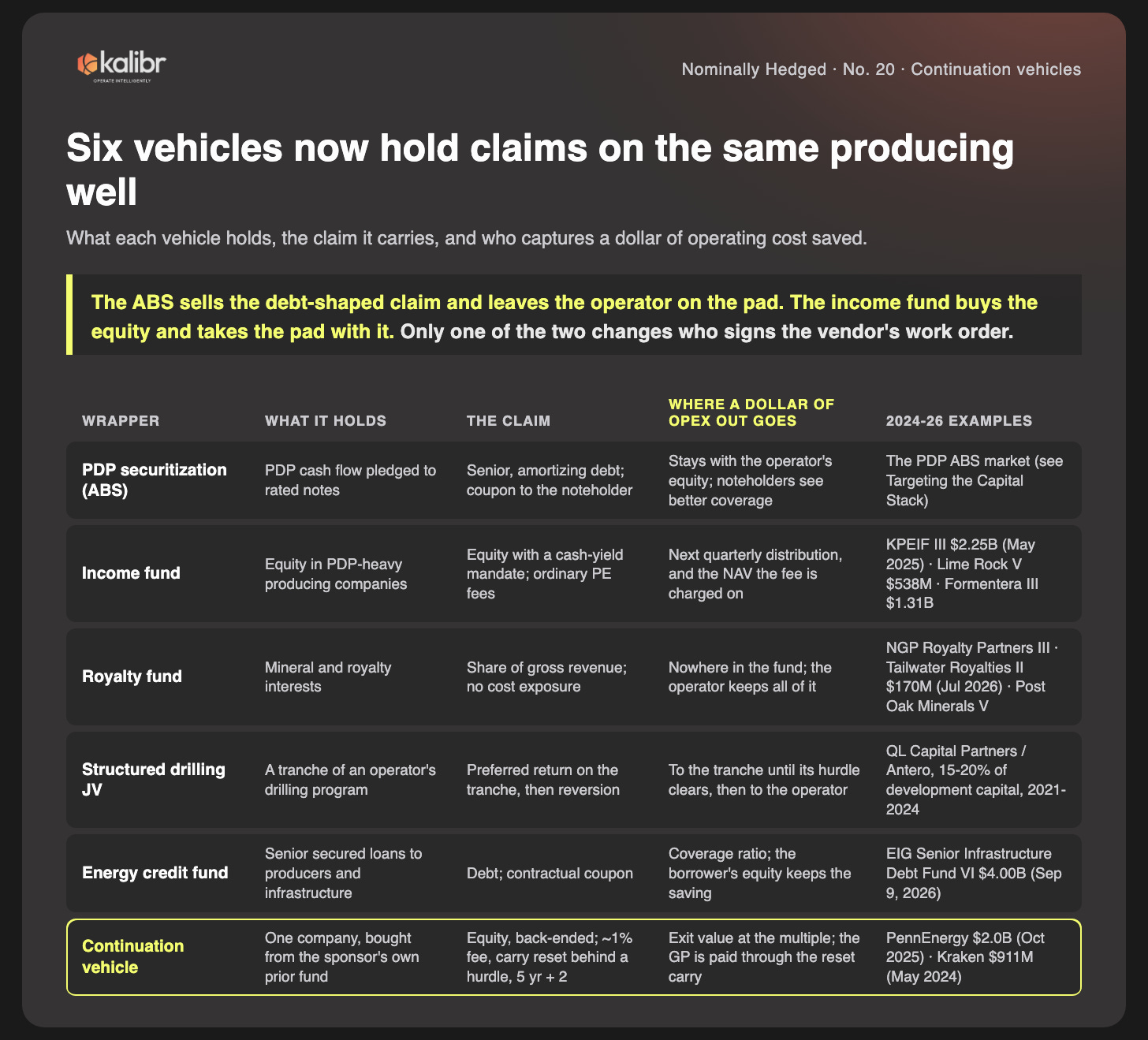
And credit: EIG closed Senior Infrastructure Debt Fund VI at $4.00 billion on September 9, 2026, senior secured lending to energy infrastructure, midstream, and power. Add the continuation vehicle and the PDP securitization from the earlier issue, and that’s six ways to hold a claim on one well.
The income fund and the securitization are the pair worth setting side by side, because they hold the same asset, PDP-heavy production with a known decline, and sell it to opposite ends of the market. The ABS carves the debt-shaped claim off the top, rated, amortizing notes secured by the wells’ cash flow, a coupon to the noteholder, and the operator keeps the equity, the upside, and the pad. The income fund buys the equity itself, pays its LPs a distribution built to look like a coupon, and takes the pad with it. One cash flow, two wrappers, one for each side of a market where demand for risky debt is high and demand for risky equity is low, and for the vendor on the pad only one of the two changes who signs the work order.
Each wrapper answers the question this piece cares about differently, which is who gets paid when a dollar of cost comes out of the well, and the table below holds the answers. The continuation vehicle’s answer is the one the next section prices, at Kraken and at PennEnergy.
A Dollar of LOE Is Worth $0.90 to Kayne and $1.00 to EnCap
Neither company files, so the arithmetic runs on basin proxies, which I will name. For Kraken, Chord’s $9.73 per boe of LOE and $1.00 of G&A make a $10.50 baseline on 80,000 boe/d (Devon runs $6.27 across a blended portfolio). For PennEnergy, an EQT-class cash cost of $0.35 per mcfe on 750 mmcfepd (Range and Antero run $0.75 and $0.63 of LOE per boe). Multiples at 4.50x EBITDA in the Bakken and 5.00x in Appalachia. The baseline is assumed to clear the 8% preferred return, so every incremental dollar lands in the reset-carry tier and splits 80/20.
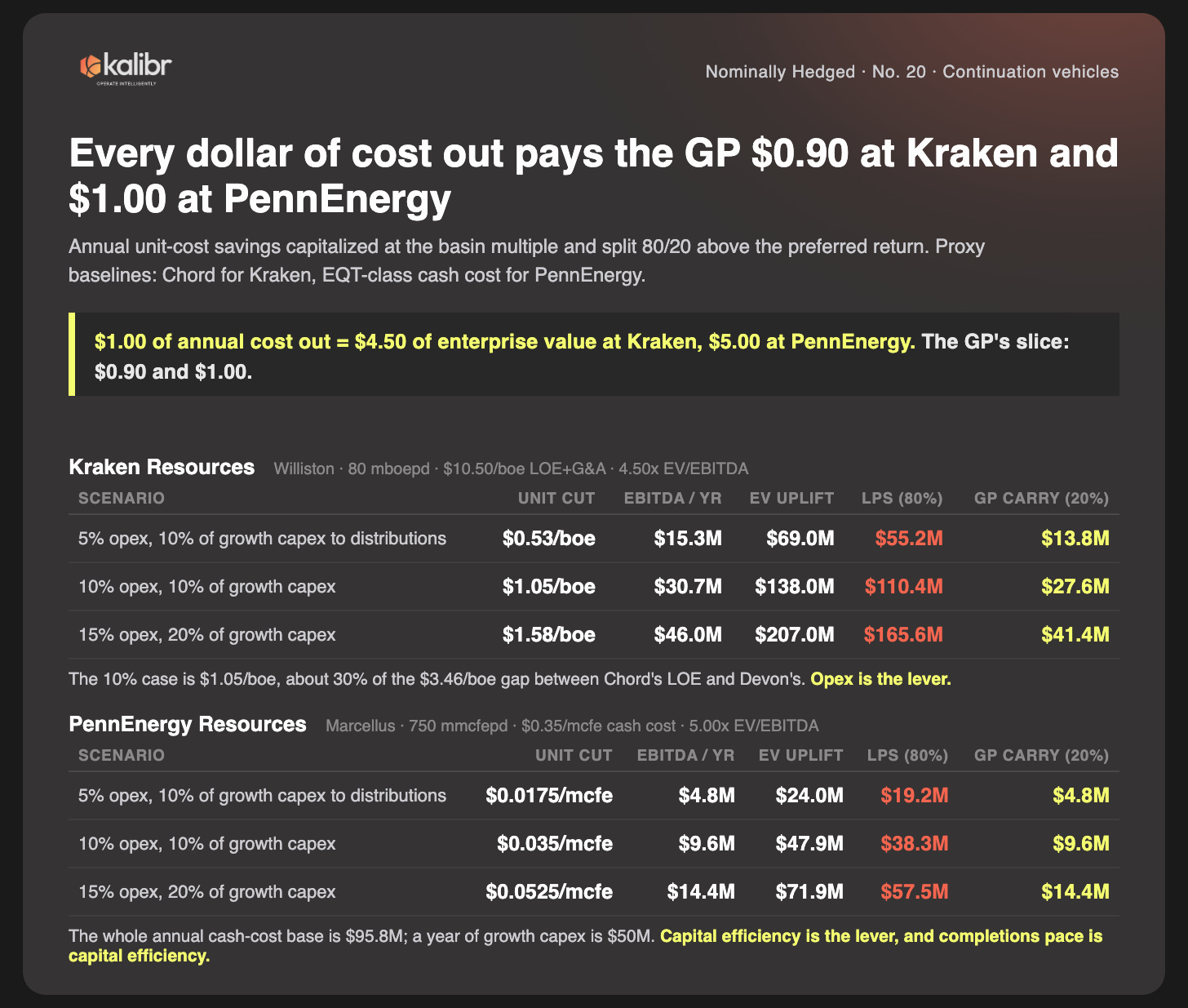
Every dollar of annual cost taken out of Kraken is $4.50 of enterprise value, of which Kayne’s carry takes $0.90 and the LPs $3.60. Every dollar out of PennEnergy is $5.00, $1.00 of it to EnCap. A 10% unit-cost cut at Kraken is $1.05 per boe, $30.7 million a year, $138.0 million of value, $27.6 million to the GP. The same 10% at PennEnergy is three and a half cents per mcfe, $9.6 million a year, $47.9 million of value, $9.6 million to the GP.
Kraken and PennEnergy pose different problems. Kraken’s cash-cost base is about $307 million a year, and a 10% cut covers 30% of the gap between Chord’s LOE and Devon’s; in an oily basin with lift and water to pay for, the money is in LOE and G&A, and the GP is now paid to find it. PennEnergy’s entire cash-cost base is $95.8 million against $200 million of annual capital, at a unit cost that is already $0.35, which leaves little opex to cut, so the model finds the capital lever dominant in Appalachia. With a corporate decline near 16% and maintenance intensity near 45% (Scotiabank’s 2021 numbers, so date them), growth capital can be dialed down and distributed without breaking the production plan. And in a one-rig, 25-wells-a-year program, the capital lever is completions pace. Every extra day a frac crew spends on a PennEnergy pad is a day of capital the continuation vehicle just underwrote at 5.00x.
What the model can’t answer is how fast Kraken and PennEnergy complete wells.
PennEnergy Scores 39 Where the Median Is 49
We benchmark completions to facilitate our Frac consulting: every job, its operator, its lateral, its proppant and fluid, and the fleet our attribution model assigns to it.
The Operational Benchmark board scores each operator’s median pace (lateral feet, proppant pounds, and fluid barrels per pad-day) against its basin peers and prints an index where 50 is the peer mean and 30 points is one standard deviation; simulfrac is excluded. Both boards below run trailing eight quarters through August 26.
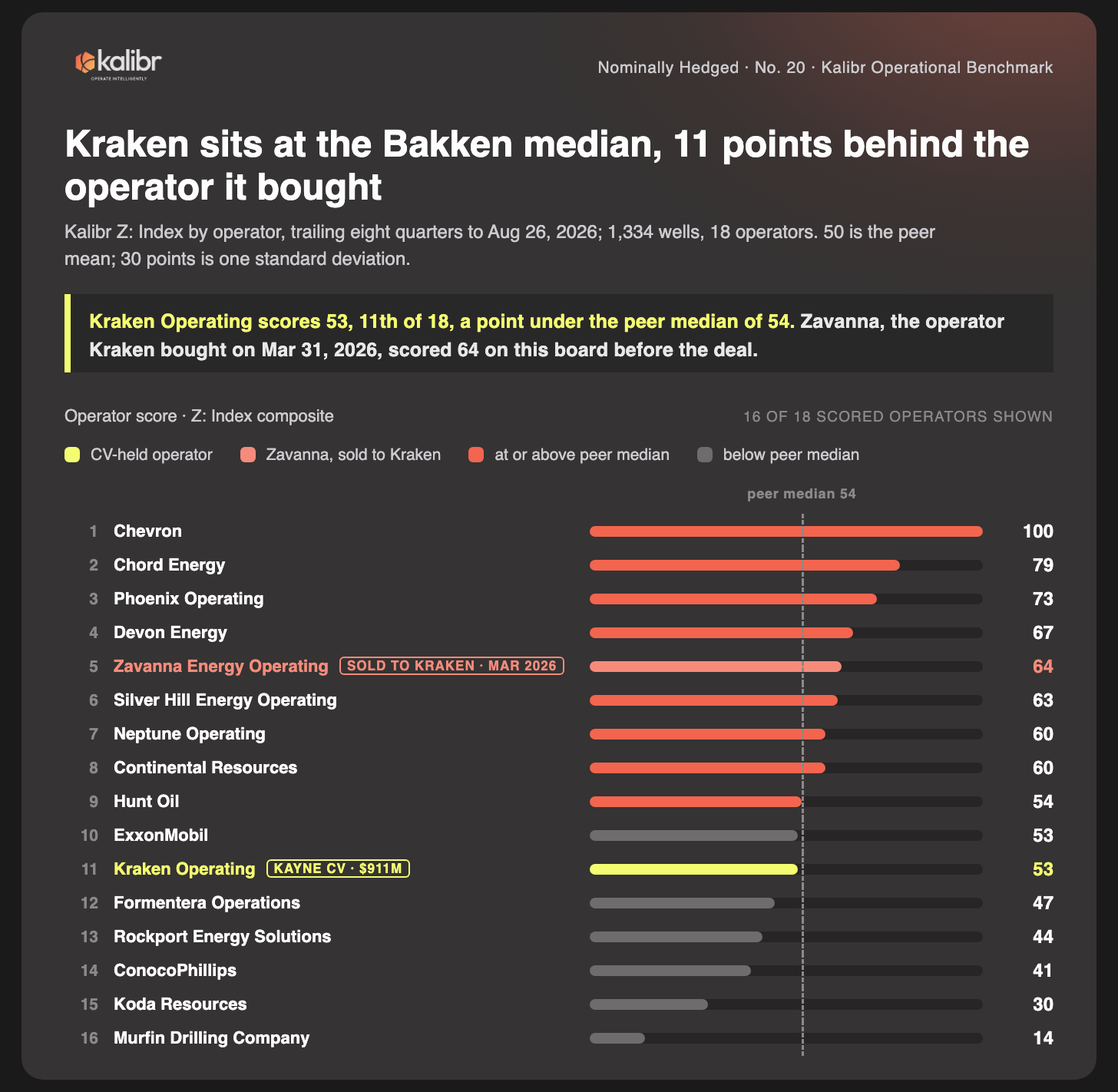
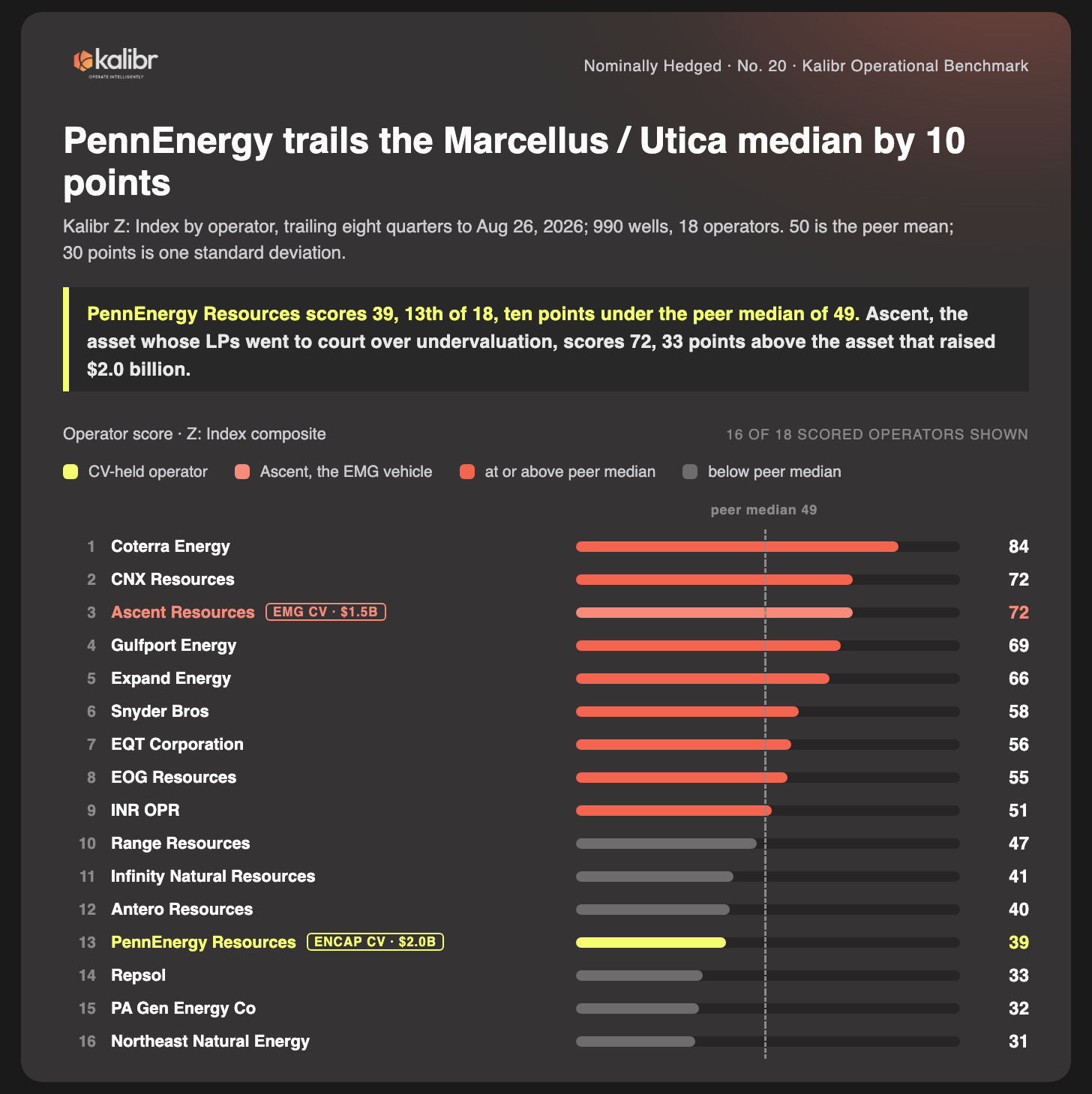
PennEnergy scores 39 in the Marcellus and Utica, thirteenth of the eighteen operators with enough jobs to score, against a peer median of 49. Coterra leads at 84, CNX and Ascent at 72, Expand at 66, EQT at 56, Range at 47, Antero at 40. (Ascent, the asset whose LPs went to court over it being undervalued, scores 33 index points above the asset that raised $2.0 billion. Somebody might have mentioned that to the arbitrator.) Kraken scores 53 in the Bakken, eleventh of eighteen, a point under a peer median of 54: Chevron 100, Chord 79, Devon 67, Continental 60, ExxonMobil 53. And Zavanna, the company Kraken bought in March, scored 64 on that board before the deal, eleven points above its buyer.
The same index run on fleet IDs puts the top Marcellus crews at 100 (a Patterson fleet, two Evolution fleets, a Liberty fleet) and the top Bakken crews at 97, 97, 90, and 86 (Patterson, Halliburton, Patterson, Liberty), against fleet medians in the low fifties. The fleets that have pumped for Kraken and PennEnergy are on that board too, by ID.
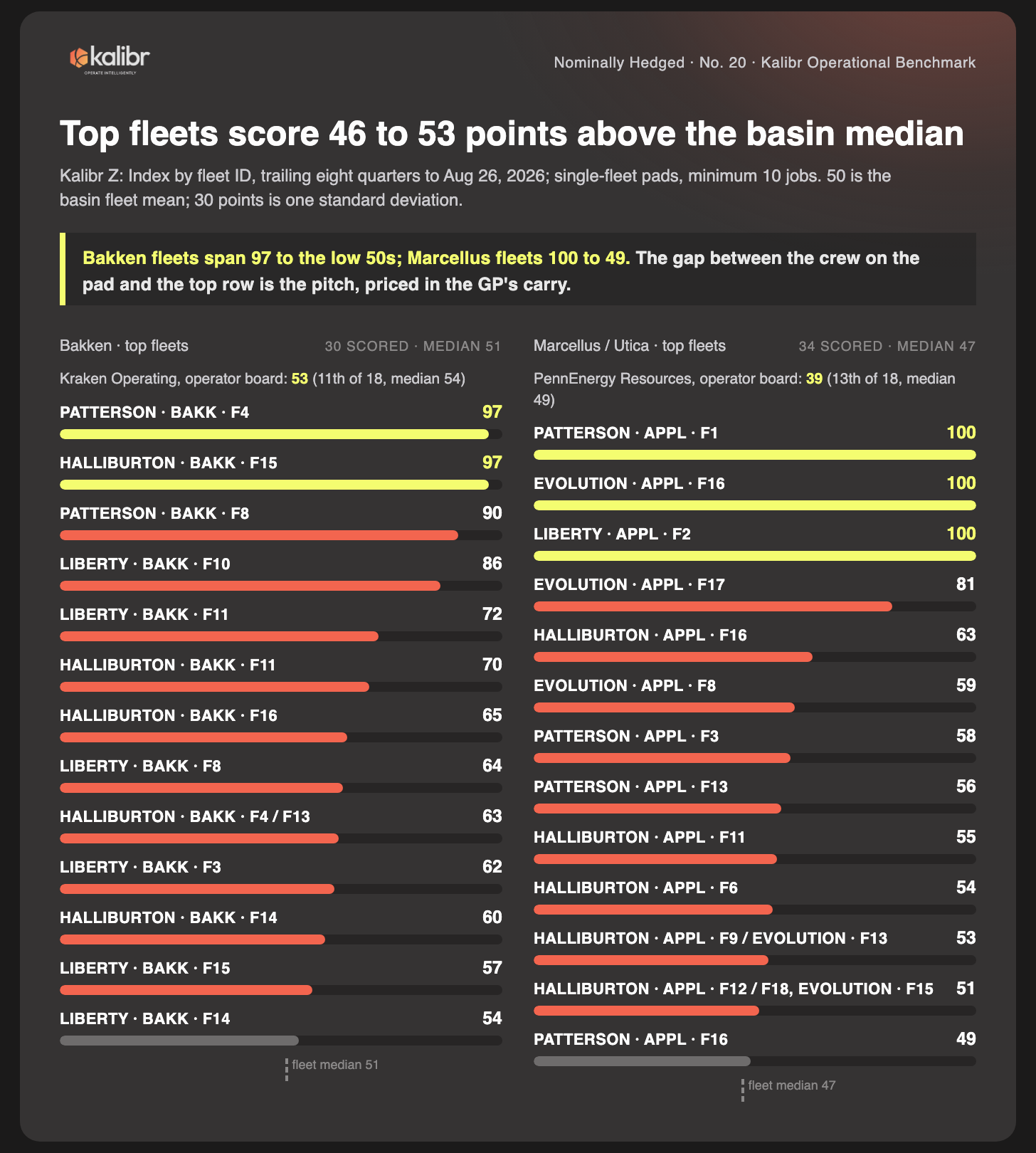
Suppose you run a fleet that scores 90 in the Bakken and the crew on Kraken’s last three pads scored 55. You are not selling day rate. You are selling the difference between two rows of one table, on an asset whose owner was just contractually re-incentivized to care about exactly that difference, and the GP’s 20% of whatever you save is the most motivated 20% in the capital structure. (Or is it? The sensitivity assumed the vehicle clears its preferred return. Below that line every dollar you save goes to the LPs and the GP’s carry on it is zero.) The carry arithmetic above is the pitch deck, for you and for the chemical vendor, the water hauler, and the lift provider.
What to Do About It
If you sell into a company held in a continuation vehicle, three things. Pull the fleet-versus-fleet board for the basin before the meeting and price the gap in the GP’s carry instead of your rate card. A 10% gain in completions pace on a one-rig Marcellus program is a capital-efficiency number, and capital efficiency is what EnCap’s new LPs are paying 1% a year to watch. Ask for the vehicle’s hurdle rate and exit window; five years plus two extensions tells you when the asset gets marked for sale, and so when your savings have to show up in the cash flow. And ask who sits on the LPAC, because the fairness opinion at the next transaction will want a cost plan with names in it. If the holder is an income fund, skip the carry math: the dollar you save is in the next quarterly distribution and in the NAV the fee is charged on, so the GP and the LPs get paid on the same day.
Inside one of these assets, the same board is the operating team’s defense. The rolling LPs elected in on a promise of better operational stewardship, and the secondaries desk that underwrote you did it on cash yield. Build the cost plan they’re going to ask for before they ask, and name the fleet.
Which leaves the question I started with, and I don’t have a clean answer to it. Private equity’s response to a market that would not buy its equity was to become the buyer, and that fixes the clock, resets the carry, and puts a hurdle in front of a GP that used to live on a 2% fee. It does nothing about how fast anyone completes a well in Butler County. Whether the sponsor that sold to itself paid too much or too little, the arithmetic between now and the exit runs through the pad, and the people on the pad were never party to the sale. I would start there.
Where is the frac data coming from?
Nominally Hedged is published by Kalibr Partners. Reply, or message us directly, and we will point you to the board built for your side of the table: the Operational Benchmark for oilfield service providers, the should-cost and vendor views for operating teams.
This newsletter is research and commentary for informational purposes only. It is not investment advice and not a solicitation to buy or sell any security. Kalibr Partners is independent and is not affiliated with, endorsed by firms discussed. Cost and valuation scenarios rest on stated proxy assumptions and are illustrative. Figures are believed reliable but not guaranteed. Company names and marks belong to their respective owners.
Sources
Secondary market, holding periods, distributions: Kroll, “Secondary Market Evolution: Continuation Funds Emerge as a Viable Alternative to Traditional Exits” (Mar 11, 2026); J.P. Morgan, “Accessing unique private equity opportunities in the small and middle market” (Jun 26, 2026); ION Analytics / Mergermarket (Jul 30, 2026); Jefferies Research, secondary-market volume and hold-period notes (2025-2026), the source of the 32,000-company / $3.8 trillion backlog and the $240 billion count; KPMG, “Pulse of Private Equity” (Jan 23, 2026); Partners Capital (Sep 3, 2026); Ropes & Gray, “2026 Global Private Equity Report” (Jul 15, 2026) and “Secondaries H1 2026 Update” (Sep 8, 2026); Scotiabank, “Key Takeaways: 26th Annual Scotiabank Financials Summit” (Sep 11, 2025); Scotiabank energy forum notes (May 2021) for the decline and maintenance-intensity figures.
Continuation-vehicle terms and mechanics: Goodwin, “Managing Economics and Conflicts in GP-Led Continuation Vehicles” (Mar 5, 2026); Mayer Brown, “Building a Defensible Process: GP-Led Continuation Fund Transactions in 2026” (Jul 30, 2026); ILPA, proposed updated continuation-fund guidance (June 2026), via ArentFox Schiff (Jul 22, 2026); Hogan Lovells, “ADIC v. EMG & new ILPA guidelines” (Jul 22, 2026); Houlihan Lokey, “2024 continuation fund and cross fund market insights” (Mar 31, 2025); Carta, “What is a continuation fund?” (Jan 5, 2026); CFRA Research, “Alternative Asset Management: Secondary Markets for Private Equity and Private Credit” (Apr 27, 2026); Vinson & Elkins, “When Regulations Meet Relationships: The Modern Private Fund” (Aug 31, 2026).
Ascent Resources and EMG: Abu Dhabi Investment Council v. The Energy & Minerals Group, Verified Complaint, redacted public version, Delaware Court of Chancery (linked in the text); Energy & Minerals Group press release on the closing of the Ascent continuation vehicle (Mar 25, 2026); Ascent Resources investor presentation (November 2025); The American Prospect, reporting on the outside bids; Matt Levine, Money Stuff, “Buy Low, Sell to Yourself” (Bloomberg, Dec 4, 2025) and “Private Equity Is on Sale” (Bloomberg, Jun 10, 2024), the latter carrying the Wall Street Journal’s 2024 Hamilton Lane quote.
EnCap and PennEnergy: EnCap Investments, “EnCap Investments Closes on $2.0 Billion PennEnergy Continuation Vehicle” (Oct 28, 2025) and “EnCap Investments Closes Fund XII at $5.25 Billion” (Oct 22, 2024); Matador Resources, Form 10-Q for the quarter ended June 30, 2026 (Aug 7, 2026); Double Eagle Energy and Tumbleweed Royalty press release (Apr 2, 2025).
Kayne Anderson and Kraken: Mergers & Acquisitions, “Kayne Rolls Oil Drilling Asset Into Continuation Fund” (Jan 29, 2025); Kraken Resources press release on the Zavanna acquisition and the 7.125% notes (May 11, 2026); Kayne Anderson, “Kayne Anderson Announces $2.25 Billion Final Close on Its Largest Ever Energy Private Equity Fund” (May 13, 2025); Terra Energy Partners press release (Jun 25, 2015); Magnolia Oil & Gas, “Warburg Pincus and Kayne Anderson to Sell WildFire Energy to Magnolia Oil & Gas for $4.06 Billion” (Jul 21, 2026); FourPoint Energy press release on the Ovintiv Uinta acquisition (Nov 14, 2024); Kayne Anderson BDC, Form 10-K for 2025 (Mar 2, 2026).
The other sponsors and vehicles: Tailwater Capital, “Tailwater Royalties Announces Fund II Final Close” (Jul 16, 2026); EIG, “EIG Announces Final Close of Senior Infrastructure Debt Fund VI With $4.0 Billion Raised Across Its Direct Lending Platform” (Sep 9, 2026); Wall Street Journal Pro, “NGP Looks to Boost Investments After Exits and a Reset of Its Carlyle Partnership” (Jan 23, 2026); The Carlyle Group, Form 10-Q for the first quarter of 2026 (May 8, 2026); Permian Resources, 2026 proxy statement (Apr 4, 2026); Capital One, energy summary (Sep 15, 2025); Pearl Energy Investments, fourth-fund close (Feb 5, 2025); Wild Basin Investments (Mar 10, 2025); ArcLight, “ArcLight Announces Final Fund VIII Close of $3.9 Billion” (Apr 7, 2026) and the SkyVest Renewables announcement (Jul 29, 2024); Post Oak Energy Capital, “Post Oak Minerals Acquires $475 Million of Permian Basin Focused Minerals & Royalties” (Jul 29, 2024); MarketLine on the UpCurve sale to Sev.en Global (May 21, 2026); Midland Reporter-Telegram on the Midway Energy Partners sale (Jun 13, 2026); Roth Capital Partners on Bison Oil & Gas (May 26, 2026); Antero Resources, 2025 annual report (Apr 21, 2026) and GERDES Energy Research (Oct 31, 2024) on QL Capital Partners; Lime Rock Resources, fifth-fund close (Mar 14, 2022); Eaton Partners / Stifel on Formentera Partners Fund III (Oct 29, 2025); Formentera Partners, Form ADV Part 2A (Mar 31, 2026); FactSet M&A screener, for what it does and does not file.
Cost proxies and the benchmark: Texas Capital Bank, initiation of coverage on Range Resources (Jan 8, 2025), for the Chord, Devon, Range, and Antero unit-cost proxies; EQT, second-quarter 2026 results (Jul 21, 2026); Roth Capital Partners on Antero (Apr 29 and Jul 30, 2026); Chord Energy and Devon Energy filings; Kalibr Operational Benchmark, trailing eight quarters to Aug 26, 2026.