


There are, classically, two ways to pay for a $4.425 billion pipeline system. You can borrow the money. Debt has a maturity, a coupon, and a seat above you in the capital structure, and because the lender’s upside is capped at getting paid back, it is cheap. Or you can sell ownership. Equity is permanent, it votes, its upside is uncapped, and because the buyer eats every bad quarter with you, it is expensive. That is the whole taxonomy. Corporate finance departments exist to blend the two, and rating agencies exist to decide which blend you actually made, and the entire $9 trillion investment-grade bond market rests on everyone agreeing about the difference.
On Sunday, ONEOK announced it would buy Brazos Midstream’s Permian Midland Basin assets for $4.425 billion in cash, funded by a $9.0 billion investment from Apollo. So run the checklist on the $9 billion. Does it mature? No. Does it vote? No. Is the upside uncapped? The opposite: the return is capped at a 7.0% IRR for nine years, stepping to 7.35% in year ten and 7.85% by year fifteen. Does it dilute the shareholders? Not one share. Can ONEOK make it go away? Yes, starting at year eight, at a price that works out to, once again, 7.0%.
Is it equity?
GAAP says yes: it sits on the balance sheet as a noncontrolling interest inside permanent equity. The rating agencies say yes. Well, not quite: ONEOK says all three of them say yes, after preliminary reviews, and not one agency has published a word of its own. Those are the only two audiences that keep a leverage scoreboard, so the official answer is yes, twice, pending the referees filing their scorecards. The cash flows, meanwhile, describe an amortizing, capped-return, senior-to-common claim on 15% of the company’s operating cash flow, with a call option. I used to know a word for that.
This publication is called Nominally Hedged, so you can guess how much affection I have for instruments whose defining property is what they are called. But I want to drill in on why this one matters, and “accounting is fake” is the lazy version of why. The label is doing real economic work here, and the work it does tells you who sets the price of Permian midstream assets now: whoever can manufacture the cheapest capital the scoreboard-keepers will bless, and in August 2026 that is an insurance balance sheet wearing a private equity firm’s name. Once you see the deal that way, the second- and third-order consequences start falling out on their own: for every PE sponsor marking an exit, for every producer paying a gathering fee into what is now partly an annuity, and, two rungs down, for anyone selling services to a company that just promised 15% of its till to Apollo.
First, though, the deal itself, because you can’t grade the financing until you know what it bought.
The Banker Read: At Market, If You Spot Them the Synergies
This is the second time Brazos Midstream has been sold this year. The Delaware Basin half went to Western Midstream for $1.6 billion, closed June 11. What ONEOK is buying is the other half, the Midland system: roughly 700 miles of gathering once the Cassidy II plant is done, 1.2 Bcf/d of processing by the third quarter of 2027, sixteen compressor stations, and about 600,000 dedicated acres across seven counties, all of it on long-term fixed-fee contracts with a weighted average remaining term above twelve years. Fourteen rigs run on that acreage today, drilled by ExxonMobil, Diamondback, and others, with roughly 4,000 locations behind them. EnCap Flatrock, the sponsor, sold the company in two pieces to two buyers inside three months, which tells you something about how the auction went before you read a single multiple.
The tape, in the order a banker would pin it up:
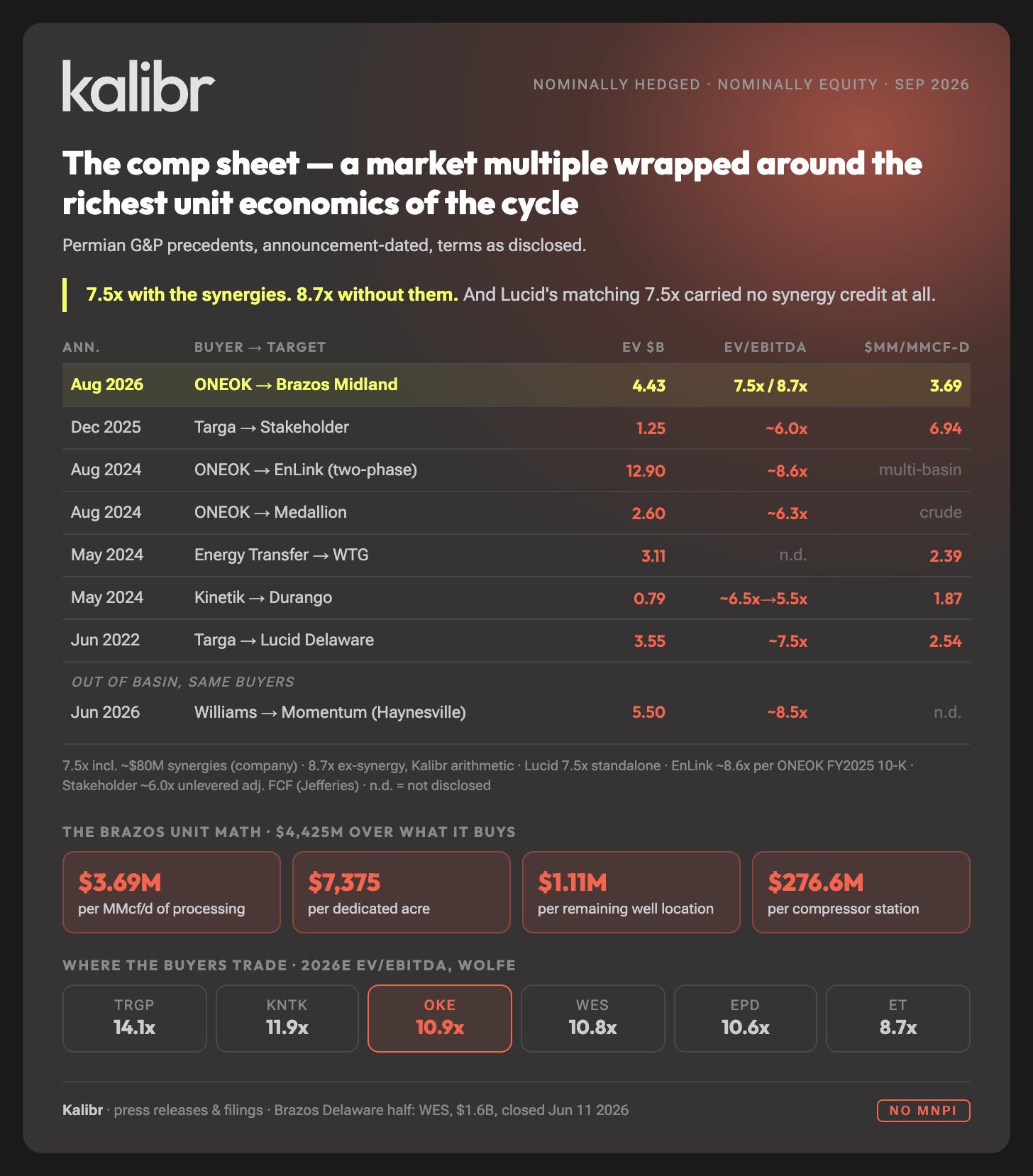
The headline says ONEOK paid market. At approximately 7.5x estimated 2027 EBITDA, the print matches what Targa paid for Lucid in 2022, the standing benchmark for a scaled, sponsor-built Permian G&P system, and it sits comfortably under ONEOK’s own EnLink consolidation at roughly 8.6x. Cheaper than EnLink, richer than Medallion at 6.3x, and Medallion was a crude system, so the comparison is polite fiction anyway.
But do the arithmetic the press release invites you to skip. The 7.5x is “inclusive of approximately $80 million of full-year synergies.” $4,425 million divided by 7.5 implies about $590 million of 2027 EBITDA, of which $80 million doesn’t exist yet: ONEOK has to build it, by routing Brazos y-grade onto its own West Texas NGL pipeline into the Medford fractionator it is still finishing. Strip the synergies and the asset that changes hands earns about $510 million, which is 8.7x. The much-advertised glide to 6.0x by 2028 requires implied EBITDA of $737.5 million, a 25% jump in one year, off a base that already banks every synergy dollar. It’s probably achievable, because Cassidy I fills in late 2026 and Cassidy II lands in the summer of 2027 and the Brazos plants have a habit of filling fast, and I will get to that habit. But “we paid 7.5x” and “we paid 8.7x for the thing that exists, plus a construction project” are different sentences describing the same wire transfer, and only one of them made the deck.
There is a second asterisk on the headline match. Targa’s Lucid multiple was a standalone number, per its own filings, with no synergy credit in it. So the two 7.5x prints on the tape are not the same 7.5x: one priced the asset as it stood, the other borrows $80 million from a fractionator that is still being welded. Like for like, the tape reads Lucid 7.5x, Brazos 8.7x.
The per-unit math says the same thing louder. $4.425 billion for 1.2 Bcf/d is $3.69 million per MMcf/d of processing capacity. Targa paid $2.54 million per MMcf/d for Lucid. Energy Transfer paid about $2.39 million for WTG’s in-service capacity. Kinetik, counting the Kings Landing plant, got Durango for $1.87 million, at a disclosed multiple of roughly 6.5x stepping toward 5.5x. On dedicated acreage, Brazos went for roughly $7,375 an acre against at most $5,917 for Lucid’s. Per remaining drilling location it is $1.11 million each. Per compressor station, and I promise this denominator becomes relevant later, it is $276.6 million.
So: the most expensive Permian G&P deal of the cycle on unit economics, at a headline multiple engineered to read as median. What closes the gap is real, to be fair. The contracts are 100% fixed-fee with no commodity exposure, the acreage is contiguous and drilled by the most creditworthy operators in the basin, and ONEOK is the one buyer for whom the y-grade is worth an extra turn, because it owns every mile between the plant inlet and the water at Mont Belvieu. Wolfe has ONEOK trading at 10.9x 2026 EBITDA; the large-cap group averages 10.3x on 2027. Buying at 7.5x-call-it-8.7x with your own stock at 10.9x is accretive arithmetic under any label.
Everyone can see the accretion. The reason ONEOK could pay a full price, close all cash, and have its leverage go down is the machine in the next section, and the machine is the part of this deal that other people are going to copy.
Apollo Lends ONEOK Some Equity
The acquisition is the smaller half of its own financing. ONEOK raised $9.425 billion: $9.0 billion from Apollo, $264 million of commercial paper, $161 million of cash on hand. It is spending $4.425 billion on Brazos and $5.0 billion retiring its own debt: a $1.2 billion term loan, make-whole calls on selected notes, and a cash tender offer of up to $2 billion across twenty separate series. Because several of those series trade well below par, ONEOK expects to retire roughly $300 million more face value than the cash it spends, a one-time gain it’s politely excluding from the accretion math. Pro forma leverage lands at approximately 3.25x against a 3.5x target, and the $2 billion buyback that management had been pacing while it waited for that number is now unpaced.
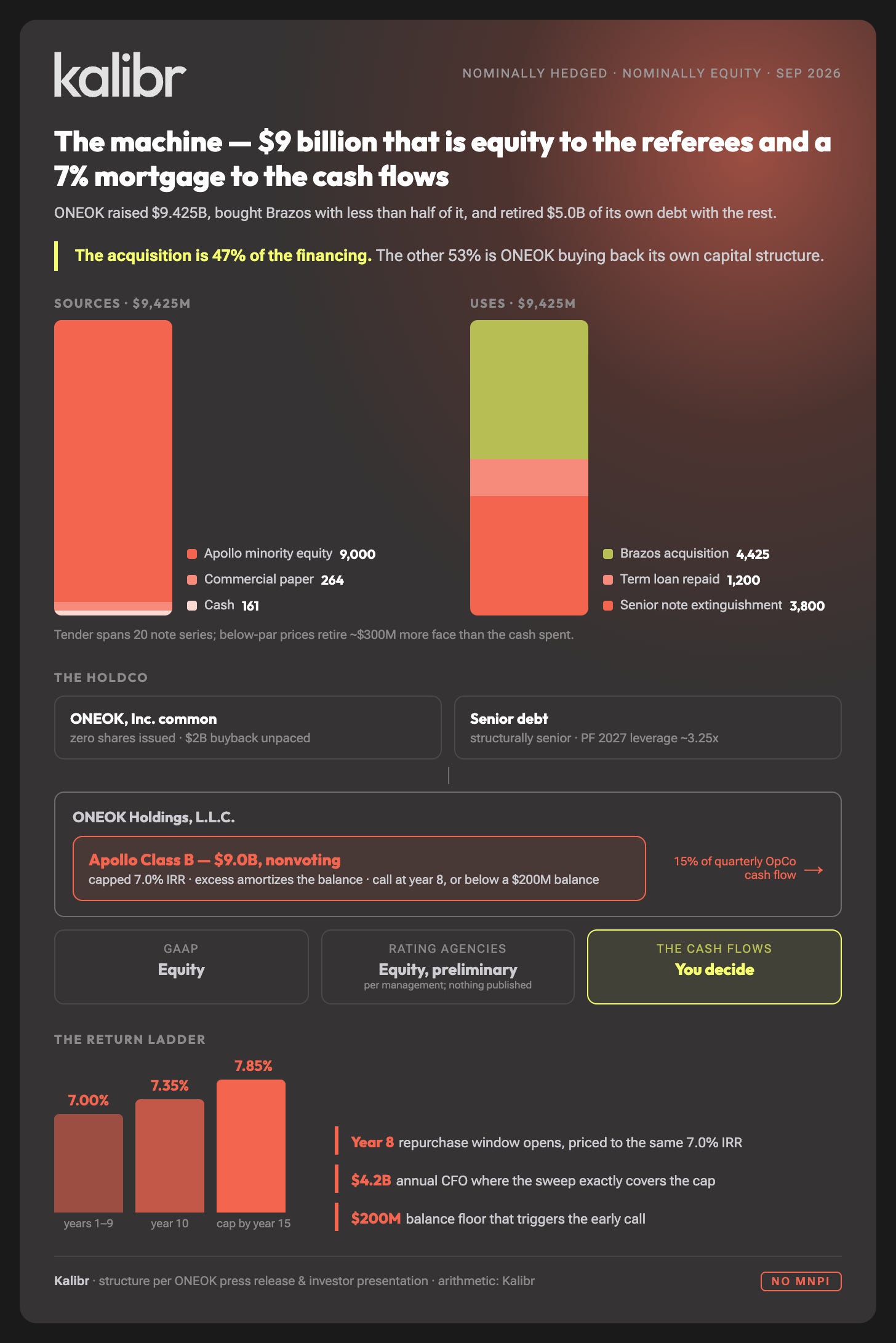
ONEOK describes the Apollo money as a “nonvoting minority equity investment,” a Class B interest in a newly formed subsidiary, ONEOK Holdings, L.L.C., that is “structurally subordinate to the company’s debt.” That is how ONEOK would put it. Here is how I would put it: ONEOK sold Apollo 15% of its quarterly operating cash flow, with the meter capped at a 7.0% IRR, a balance that pays itself down out of the excess, and a repurchase option that lets ONEOK end the whole arrangement at year eight for whatever amount gets Apollo to its 7.0%. There are no penalty rates. If a bad quarter leaves the distribution short of the cap, nothing compounds contractually; the make-whole arithmetic just waits. A mortgage where the bank can never foreclose, sized at $9 billion, blessed as equity.
Both descriptions are true. The difference between them is worth walking through slowly.
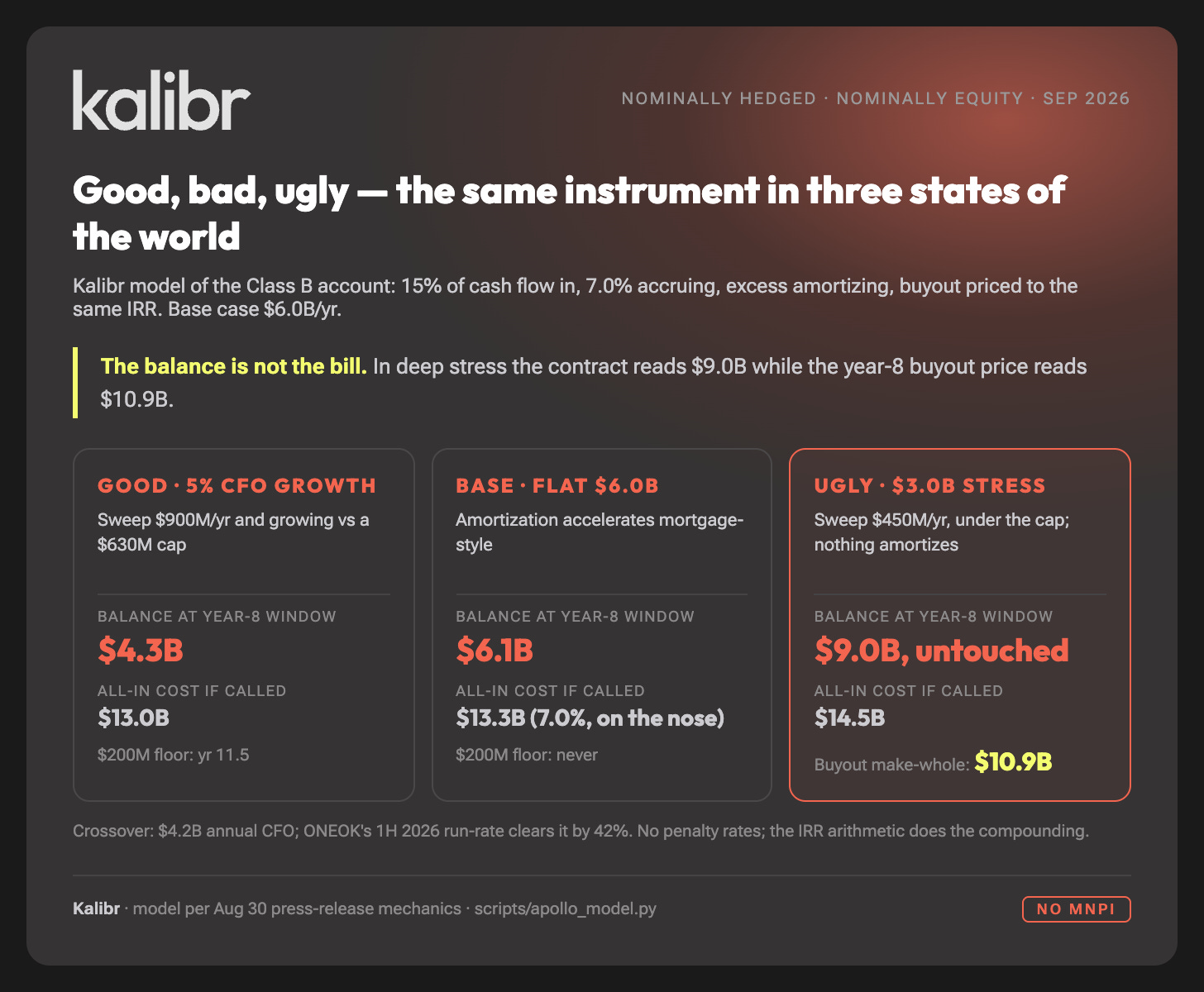
ONEOK generated $2.99 billion of operating cash flow in the first half of 2026, call the run-rate $6.0 billion a year. Fifteen percent of that is about $900 million a year flowing to Apollo. The capped return on the full $9 billion is $630 million a year, 1.75% a quarter on the remaining balance. So in a flat world Apollo receives $900 million, keeps $630 million as return, and hands $270 million back as amortization, and the next year the cap requirement is smaller, so the amortization is bigger, and so on, mortgage-style. (Should the balance ever grind below $200 million on its own, the sweep shuts off and the Class B drops to a fixed $3.25 million a quarter, a stipend whose main job is to keep the instrument technically alive.) Roll the base case forward and the Class B balance stands near $6.1 billion when the year-8 window opens. Total cost to ONEOK if it calls: roughly $7.2 billion of distributions plus a $6.1 billion buyout, $13.3 billion all-in on $9 billion over eight years. That is 7.0% a year, which is the whole point: the structure is built so that in nearly every state of the world, Apollo earns exactly the cap, no more, and ONEOK keeps everything above it.
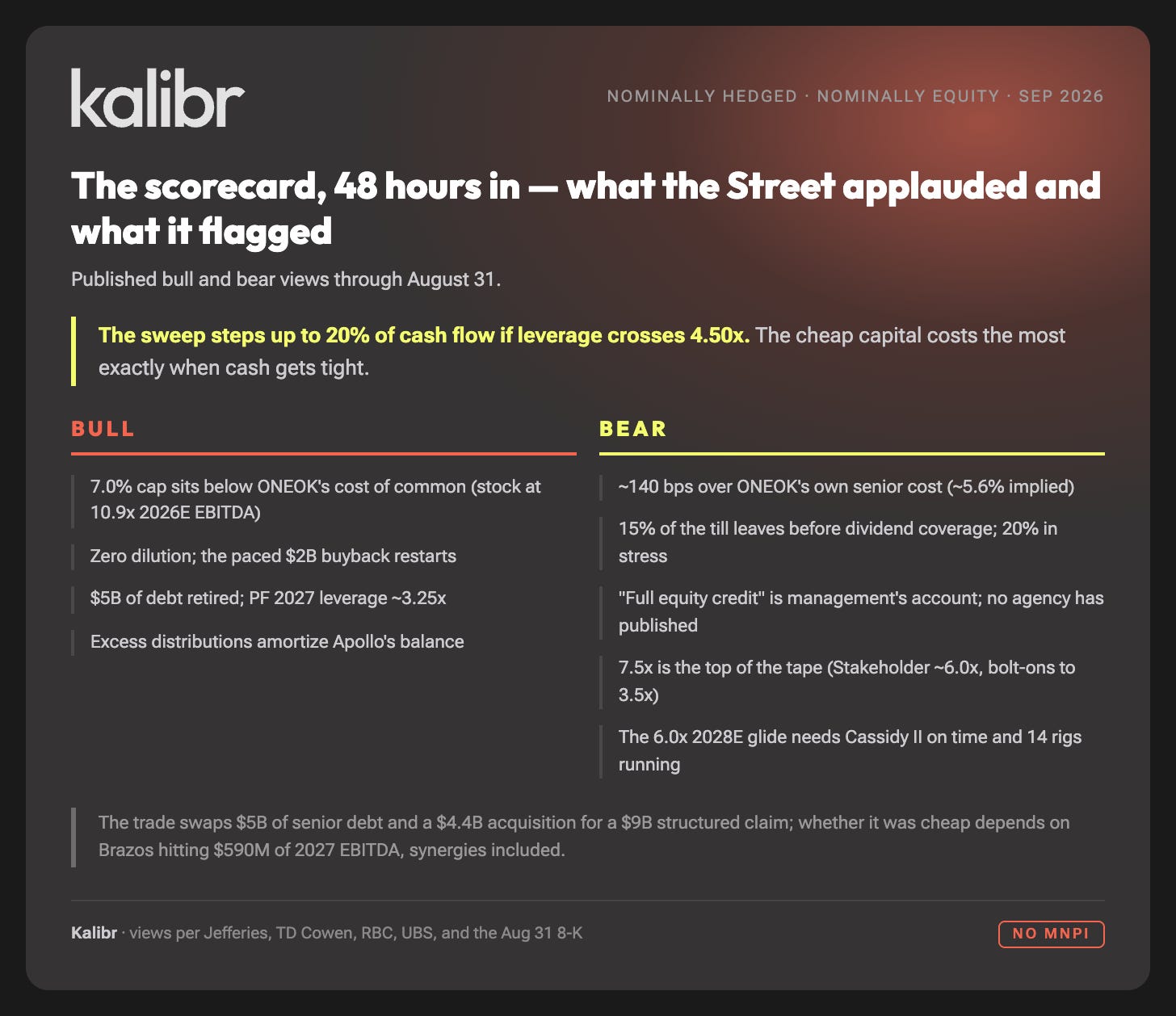
There is a threshold, though, because there is always a threshold: the sweep covers the cap only while 15% of cash flow exceeds 7% of the balance, and on the full $9 billion that crossover sits at $4.2 billion of annual operating cash flow. Above it, the balance shrinks and the instrument gets cheaper to kill. Below it, the balance sits there, whole, while the make-whole clock runs at 7% regardless. The contract has already imagined the bad states, and its answer is to take more: if ONEOK’s leverage ratio crosses 4.50x, the sweep steps up automatically from 15% of cash flow to 20%. Model a real stress, $3.0 billion of annual cash flow, and by year eight ONEOK has paid out only $3.6 billion while the buyout price has compounded to $10.9 billion, on a contractual balance still reading $9.0 billion. In the good states this instrument amortizes itself out of existence; in the bad states it extends its own duration and presents the tab at the worst possible time. ONEOK’s first-half cash flow clears the threshold with 42% to spare, so call this a tail scenario. But when someone tells you capital is cheap, the honest question is “cheap in which states of the world,” and the answer here is: cheap in the ones where ONEOK didn’t need the help.
So much for what it is. The better questions are what it tells you, and I count three answers, one per participant.
What it tells you about Apollo: the desk on the other side is an annuity desk. No private equity fund accepts a hard 7.0% cap on $9 billion; a fund needs the right tail. An insurance balance sheet needs the opposite: enormous, predictable, long-duration cash flows that clear its cost of liabilities, in a size the public bond market couldn’t print in one name without repricing it. The cap is not a concession Apollo swallowed. The cap is the product spec. A $9 billion capped perpetual does not occur in nature; somebody has to need one, and the somebody is Athene’s actuarial table. Which means the marginal price of Midland Basin infrastructure is now being set by the spread between Permian fixed-fee cash flow and the cost of an annuity in Des Moines. EnCap’s exit price was determined two rungs upstream of any midstream comp sheet.
What it tells you about ONEOK: management ran three trades at once, and together they are a mispricing map of its own capital structure. It sold $9 billion of nominal equity at a capped 7%. It is buying back up to $2 billion of actual equity that costs, at a 10.9x EBITDA multiple with high-single-digit growth attached, meaningfully more than 7%. And it is tendering for its own bonds below par, collecting $300 million of face value for free on the way through. Sell the overpriced claim and buy back the underpriced ones. The Brazos assets almost read as the excuse; the balance-sheet rotation is the trade. I am being somewhat unfair, ONEOK does want the assets, has wanted the basin since Medallion, and the wellhead-to-water synergy case is the one part of the deck I believe without adjustment. But no company assembles this particular machine just to buy a gathering system. You assemble it because you have concluded your own equity is too expensive to issue and your own debt is too cheap to leave outstanding, and you need $9 billion that the agencies will wave through. Which brings us to the third participant.
What it tells you about the referees: the instrument is reverse-engineered from the equity-credit criteria, and you can find the tooling marks. Permanent, check. Nonvoting, check. No maturity, no default events, no coupon obligation, deeply subordinated, check, check, check, check. My favorite mark is the ladder itself. Fitch’s hybrid criteria strip equity credit from any instrument whose cumulative rate step-ups exceed 101 basis points; ONEOK’s ladder climbs from 7.00% to a terminal 7.85%, a cumulative step of 85. That ladder wasn’t priced to a market. It was priced to a rulebook, with 16 basis points of margin. And the classification it protects is worth real money: ONEOK pays $434 million of quarterly interest on roughly $30.8 billion of debt, an average cost of about 5.6%, so the 7.0% cap is a premium of roughly 140 basis points a year, on $9 billion, paid for the right to call the money equity. Worth repeating, since the market has skipped past it: the agencies have confirmed none of this yet. What exists is management’s account of preliminary reviews with S&P, Moody’s, and Fitch, and if any of the three lands on its 50% hybrid bucket instead of full credit, half the point of the structure evaporates and the pro forma 3.25x becomes a different number. The deepest read of this deal is still that ONEOK found a way to rent its investment-grade rating out to its own balance sheet. The lease just hasn’t been countersigned.
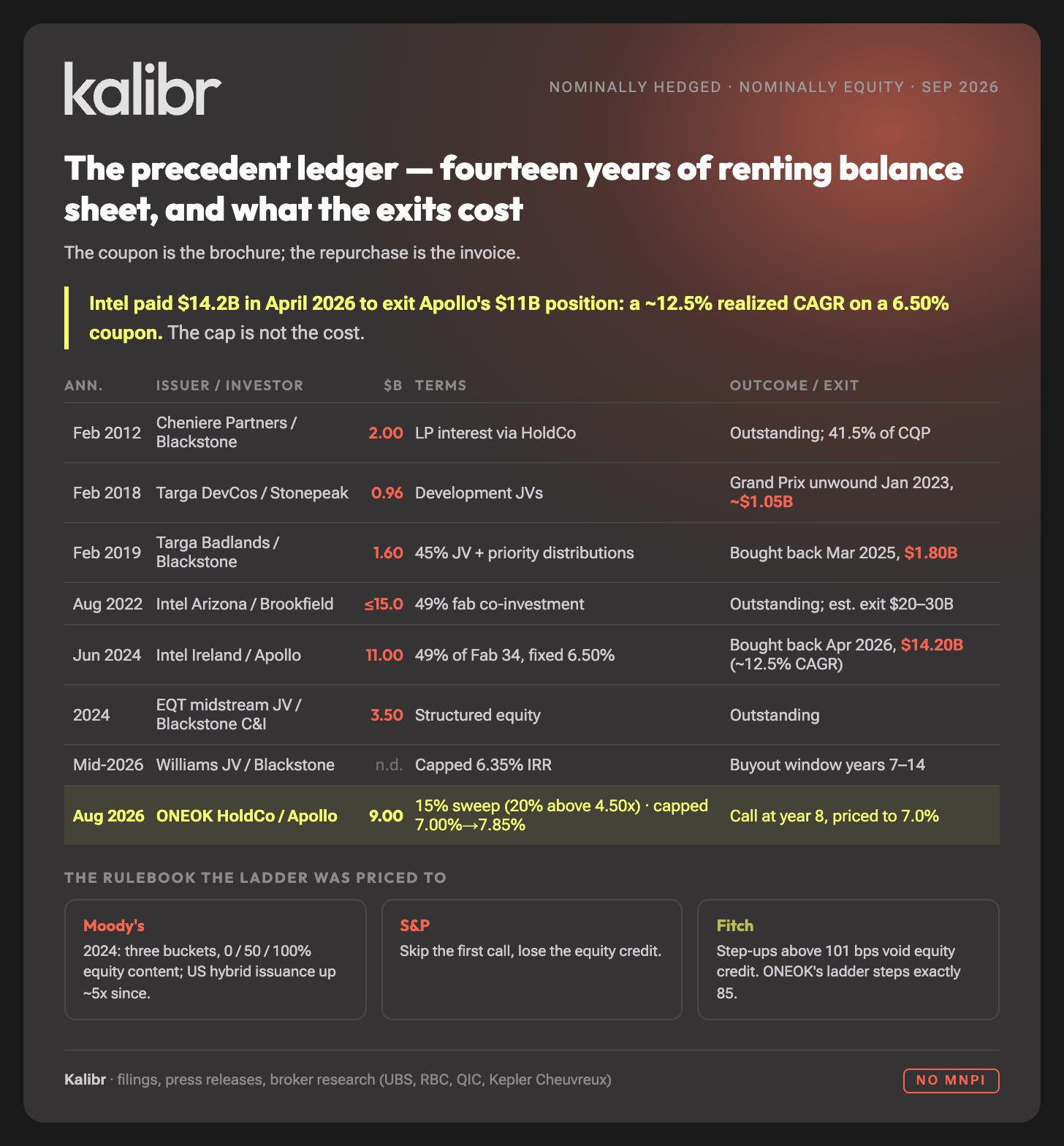
How new is any of this? None of the parts is new; the assembly is. Midstream has been renting balance sheet from alternative managers since Blackstone put $2.0 billion into Cheniere Partners in 2012, and it spent 2018 and 2019 doing a cruder version through DevCo joint ventures: Stonepeak funded Targa’s growth projects, and Blackstone bought 45% of Targa Badlands for $1.60 billion. The exits are the instructive part. Targa paid roughly $1.05 billion in January 2023 to unwind the Grand Prix joint venture, then $1.80 billion in March 2025 to take Badlands back: a stake sold for $1.60 billion going home for $1.80 billion, plus years of priority distributions along the way. The scale came from semiconductors. Brookfield committed up to $15 billion to Intel’s Arizona fabs in 2022; Apollo put $11 billion into the Leixlip, Ireland fab in 2024 at a fixed 6.50% coupon; and in April 2026 Intel repurchased Apollo’s stake for $14.20 billion, roughly a 12.5% realized annual return on money that carried a six-handle coupon, an exit Intel part-funded by issuing $6.5 billion of new senior notes. File that number away for the next time someone calls this capital cheap. Even the IRR cap is secondhand: Williams is running a Blackstone joint venture this year with the return capped at 6.35% and a buyout window in years seven through fourteen. What ONEOK added is scale, a sweep drawn on the whole company’s cash flow instead of one asset’s, and the ambition of full equity credit on the entire $9 billion. The tailwind behind all of it is regulatory plumbing: Moody’s simplified its hybrid framework in 2024 into three clean buckets, 0%, 50%, or 100% equity content, and US hybrid issuance has since grown roughly fivefold. The instrument class was already having its moment; ONEOK just gave it a record.
So what is the bear case on this kind of deal?
The cost complaint: 7.0% stepping to 7.85%, against senior paper that costs ONEOK about 5.6%, is an expensive way to borrow permanently unless the label is worth the spread.
The cash complaint: 15% of operating cash flow, 20% in the bad states, leaves through a door marked “noncontrolling interest” before dividend coverage is calculated, and the near-term drag on distributable cash flow per share is real even while GAAP earnings barely notice (the income statement subtracts only 1.75% of the balance per quarter; the till pays out the full 15%).
The price complaint: Jefferies points at Stakeholder near 6.0x and ONEOK’s own Medallion at 6.3x, and TD Cowen notes smaller Permian bolt-ons have cleared as low as 3.5x. On that tape, 7.5x-with-synergies is the ceiling.
The structural complaint is mine as much as theirs: nobody independent has yet certified the equity in the equity. All fair. My weighing: the bears are correctly pricing the instrument and mostly missing the trade around it.
The question that decides the deal is whether 7% capped-and-callable beats issuing common at a 10.9x multiple, and it does, in every state of the world where the assets perform. (You saw the states of the world where they don’t.)
The copyable part is the template, and the template now has a public price. Every investment-grade CFO with a stranded multiple and a leverage target just watched ONEOK buy a full-price asset, cash, while its leverage fell, its buyback resumed, and its share count held still. The constraint on repeating the trick is the supply of counterparties with an actuarial liability to feed, and Apollo’s is the largest but not the only one.
Behind the wall: the part of this deal nobody models because nobody else has the data. We rebuilt both companies’ Permian compression fleets from the air-permit record, unit by unit: the county where two gathering systems become one dispatcher’s problem, the one public compression vendor whose ONEOK book sits where an integrating owner swings the axe, the vendor whose sponsor relationship just turned into corporate procurement, and the fleet detail that flatters the purchase multiple. Then the second- and third-order map, and what to do about all of it from each seat at the table.