


Business school has one reliable career outcome, and it is that people call you about IPOs. The past few months my phone has been busy with SpaceX and the AI listings, and I run the same rule on all of them: if my parents are asking me about an IPO, I stay away from it and sleep fine. It is a good rule. It has cost me money exactly once that I know of, and I will get to that, right after I finish scrolling past the third fabricated business parable of the morning on LinkedIn. (Sorry, Ron. I don’t believe you happened to sit next to a CEO who was about to sell his company for eight figures, and that your one comment at the gate saved the deal. I do want to know how the post got 40,000 likes. Different article.)
The one that got away listed on June 29, 2023, at $16.00 a share, below the $19 to $22 range the bankers had marketed. The offering raised about $256 million and most of it went straight to paying down $300 million of term debt, which tells you exactly how the street read the company: a levered oilfield-services name using its own listing as a refinancing. Coverage at year one was essentially RBC, alone, with a $25 price target. No retail chatter. No calls from my parents.
Nobody called me about that one.
The stock was Kodiak Gas Services, and on June 26, 2026, almost three years to the day after the broken IPO, it closed at $76.27.
Where the 362 Percent Came From
From the first-day close through June 30, 2026, KGS returned 362.62 percent. Some context for that number, against every peer group you might reasonably file it under:
The supermajors did single and low-double digits. The oilfield services complex did roughly nothing (SLB was negative). The midstream re-rating trade, Targa and Williams, did 252 and 128 percent, and those were considered spectacular. Kodiak beat Targa by 110 points.
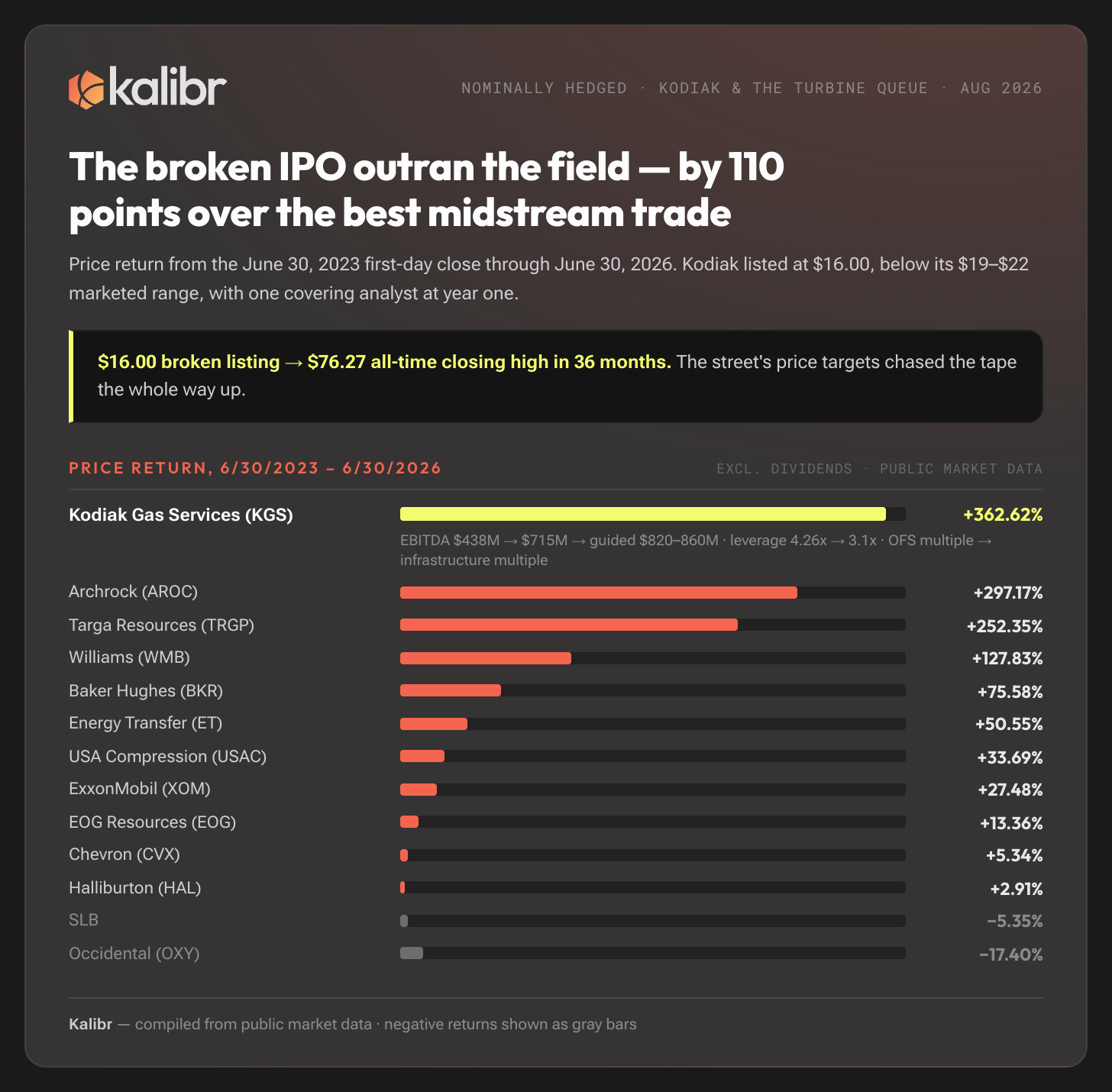
A return like that decomposes into parts, and the parts matter more than the headline. Adjusted EBITDA went from $438 million in fiscal 2023 to $610 million in 2024 to $715 million in 2025, with 2026 guided to $820 to $860 million. Call earnings a double and a half. Leverage came down from 4.26x net debt to EBITDA after the IPO to the 3.5x target by year-end 2025, so equity holders picked up the deleveraging on top. The rest, and it is the biggest single piece, was the multiple: the market re-filed the company from cyclical oilfield services to infrastructure. Mizuho’s target multiple alone walked from 7.75x to 9.5x, and William Blair now argues for 12x, for the same horsepower filed under a different heading.
Part of the move was plumbing. EQT Infrastructure owned 76 percent of the company at the listing, 59 million shares sitting on the float like a lid, and it was still working down a 35-to-40-percent stake through 2025; the overhang ground the stock to a $30.06 low that August before the block sales (10 million shares at $34.40 in September, another 10 million at $33.60 in November) and the S&P SmallCap 600 add cleared it and forced passive money in. And the sell side spent three years chasing the tape: price targets sat at $25 when the stock was $16, $40 to $55 when it was $40, and $78 to $84 when it was $74. That is not what early looks like.
You can tell a smaller story with the same numbers. A $16 print against a $19 to $22 range is an artificially low starting block, and part of this return is just a distressed multiple normalizing. And Archrock, the obvious control group, returned 297.17 percent from the same start date, or 178.35 percent over the matched three-year window from August 2023, while running a cleaner book: Archrock exited the first quarter of 2026 at 2.6x leverage against Kodiak’s 3.1x. Risk-adjusted, the gap between the two compression stories is narrower than the raw prints suggest. The sector re-rated; Kodiak re-rated hardest, with more borrowed money.
What the raw prints hide is what kind of stock this was on the way up. Compression revenue is fee-based, volume-through-infrastructure, take-or-pay in spirit. Beta to crude: 0.07. The correlation is 0.05, Archrock is statistically the same animal at 0.09, and USA Compression is the partial exception at 0.22, still under the 0.24 midstream average. A machine that compresses gas for a fixed monthly fee doesn’t care what the gas is worth, and for two and a half years the market priced KGS accordingly.
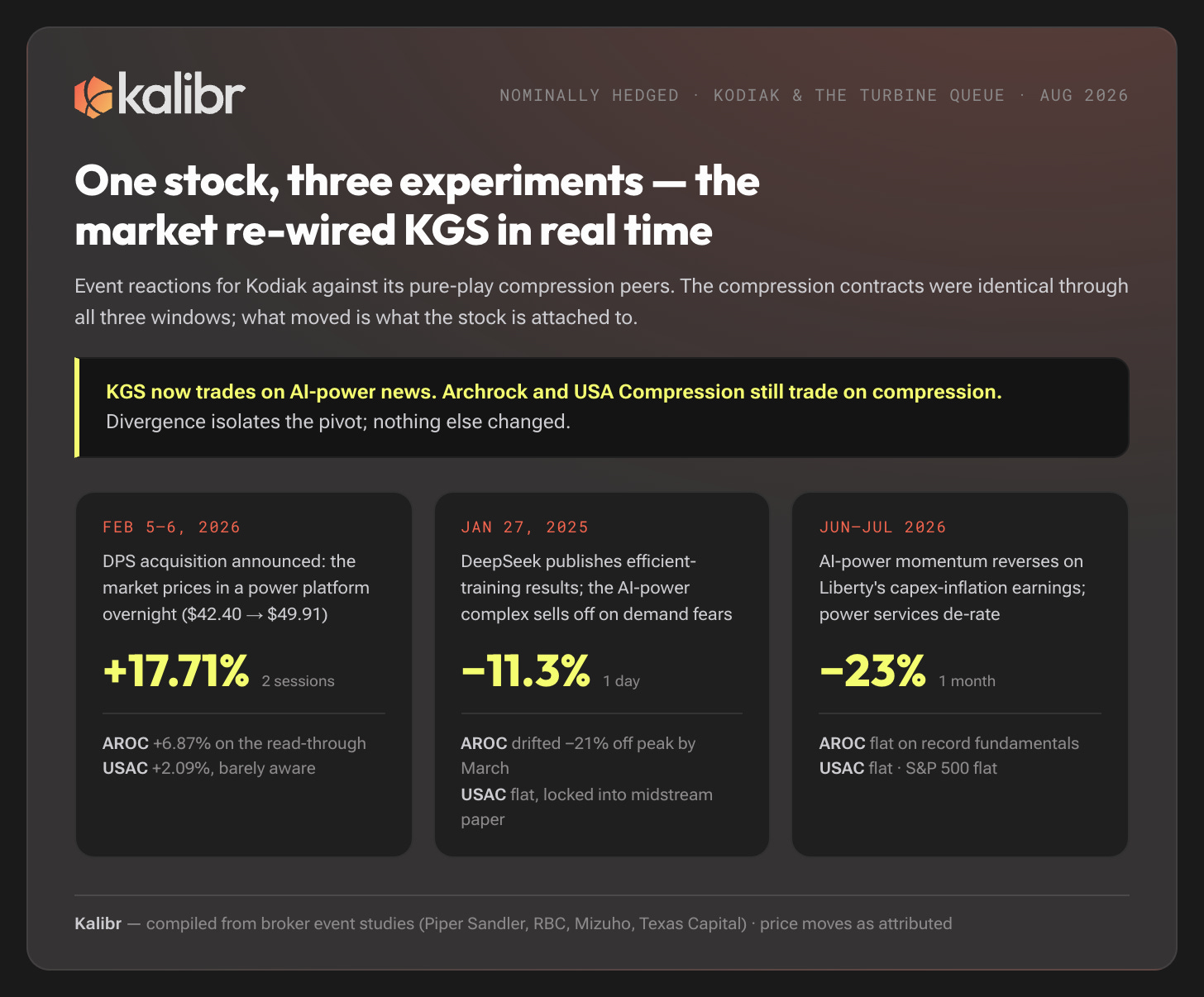
Then, on February 5, 2026, Kodiak announced the Distributed Power Solutions acquisition, and you can watch the market re-wire the stock in real time. KGS jumped 17.71 percent in two sessions, $42.40 to $49.91. Archrock rose 6.87 percent on the read-through; USA Compression moved 2.09. No compression contract changed that week; the market was repricing what the stock is attached to. It had been running the experiment for a year already. When DeepSeek published its efficiency results in January 2025 and the AI-power complex sold off, Kodiak, then still a compression company with a rumored ambition, fell 11.3 percent in a single day. And in July 2026, after Liberty Energy’s earnings disclosed heavy capex inflation on its power buildout, KGS dropped 23 percent in a month against a flat S&P 500 while Archrock and USA Compression sat still on record compression fundamentals. Three shocks, one result: the pure-plays trade on compression, and Kodiak trades on the company it keeps.
The institutions then formalized it. Piper Sandler initiated coverage by filing KGS in its Power Services universe, next to Solaris, Liberty, ProPetro, and Atlas, not next to Archrock. Jefferies builds the power segment its own 12.8 percent cost of equity (4.4 percent risk-free, a 1.4 bottoms-up beta, 6 percent equity risk premium) and tiers the discount rates: 10 percent on contracted power assets, 15 percent on the uncontracted backlog, 18 percent on anything beyond 2 gigawatts, while J.P. Morgan discounts all of Archrock at 10.5. William Blair models power at 13 percent of Kodiak’s earnings this year, 22 percent next, 27 by 2028. Even Kodiak agrees: its own investor deck now benchmarks the stock against Hess Midstream, Kinetik, and Targa instead of the compression peers it grew up with. The peer group sounds like a cosmetic choice. It is a discount rate: model KGS as a power developer and its cash flows get charged 12.8 percent; model the same machines inside Archrock and they get charged 10.5.
How it got into that company is a story about strategy, which turns out to be countable.
Count the No’s
A professor of mine had a test for whether a company has a strategy: count the things it says no to. Anyone can say yes; the org chart produces it by default. Every no is a decision someone paid for. Run the count on Kodiak and you get, by my tally, six:
No to geography. Roughly 69 percent of contract compression horsepower sits in the Permian. The street wants Permian E&P exposure; Kodiak decided to be the most critical piece of infrastructure serving exactly that customer, and nearly nothing else.
No to dry gas. Liquids-rich, associated-gas exposure on purpose. Associated gas needs 3 to 4 times the compression horsepower per unit of volume that dry gas needs, and Permian gas-oil ratios grind higher every year (about 10 percent more gas per barrel than 2020). The rock does the marketing.
No to small horsepower. Fleet average of 977 HP per revenue-generating unit, the large-frame end of the market, where units sit in centralized gathering service for years. About 129,000 horsepower of small and non-core iron was divested through the end of 2025, along with the Canadian and Mexican operations.
No to electric motor drive. Gas drive, full stop, while Archrock deliberately built a 600,000 horsepower electric-drive position through the TOPS and NGCS acquisitions. Two members of the same oligopoly, opposite sides of the same technology.
No to engine variety. Caterpillar, standardized, with 700-plus CAT-certified technicians and one parts inventory. Heterogeneous fleets are why private compression books trade at conglomerate discounts.
No to competing on price. Kodiak sells runtime. First quarter 2026 contract services adjusted gross margin was a record 70.6 percent at 98.0 percent fleet utilization, on a fleet average rate of $23.31 per horsepower per month while leading-edge new iron prices at $28 to $30. Renewals step up 10 to 15 percent and the customers pay it, because the alternative to a running compressor is deferred oil.
To be clear, every one of those no’s is a live position that can lose. Permian concentration is inventory-duration risk wearing a focus costume. No-EMD is a short position on grid buildout. These are hard calls with real downside, which is what distinguishes a strategy from a preference. And our industry keeps a museum of what happens when you say yes to everything: Axip said yes to every basin, every frame size, every customer class, and in April 2026 its 540,000 horsepower moved through an insolvency process at $161 million, which is $298.15 per horsepower, 7.32x trailing EBITDA. The public market currently carries Kodiak at $1,954 per horsepower. The spread between those two numbers, six and a half to one, is what a decade of no is worth.
The Winner’s Problem
The trouble with winning is that you are then expected to keep doing it, and the bigger you get, the more the arithmetic fights you. Kodiak will add roughly 170,000 horsepower in 2026. On a 4.48 million horsepower fleet, that is 3.8 percent growth. The path to the stated 5.2 million by 2030 needs about 150,000 a year, every year, and every unit of it now queues behind a Caterpillar 3600-series lead time that has stretched from 40-50 weeks to 190-200, at a replacement cost that has inflated from roughly $800 per horsepower to $1,250.
The queue does have a silver lining, and it is a strange one: nothing Kodiak builds is speculative anymore, because nothing anyone builds is. The entire 2026 new-build book was contracted before delivery, most of 2027 too, at those $28 to $30 leading-edge rates, which pencils to roughly a 5x EBITDA build multiple and unlevered returns around 20 percent. Supply constraint is the industry’s pricing power. But it caps volume growth at the same time, and the two obvious workarounds both have problems. Buying a private platform means buying somebody’s heterogeneous legacy fleet at 5x to 8x (the CSI Compressco deal worked, 7.8x trailing that became 5.4x pro forma once synergies passed $45 million, but CSI-sized targets don’t grow on trees). Purchase-leasebacks are surgical and gorgeous when they appear (20,700 Permian horsepower for $24 million in March, a 7-year service agreement attached, about 5.3x), but there are only so many producers willing to sell their iron, especially inside the narrow footprint your own no’s define.
And there is a problem with feeding new iron into the Permian that never makes an investor deck. Kalibr’s warehouse tracks every compression set in the basin, and on the large-frame cut (1,500 HP and up, the class Kodiak sells) 60.6 percent of units set since 2024 were redeployed machines, not new builds. The marginal compressor in the Permian is usually a used one that freed up somewhere else. If drilling pace tips, your $1,250-per-HP new build competes for the next contract against an already-depreciated unit rolling off a dead pad, and the used unit sets the price.
So: option two. Take the things the franchise is verifiably good at (uptime as religion, the Caterpillar supply relationship, the E&P and midstream rolodex, 700 CAT-certified field techs) and point them at a market that pays a better multiple for the same skill set. The street pays 9x to 10x for compression EBITDA and 10x to 11x for contracted power EBITDA, and you can build either one at roughly 5x cost. Same construction math, higher exit multiple, and the power version comes with contract tenors that have stretched from 10 years to 15, 20, sometimes 30, against compression’s 3-to-10.
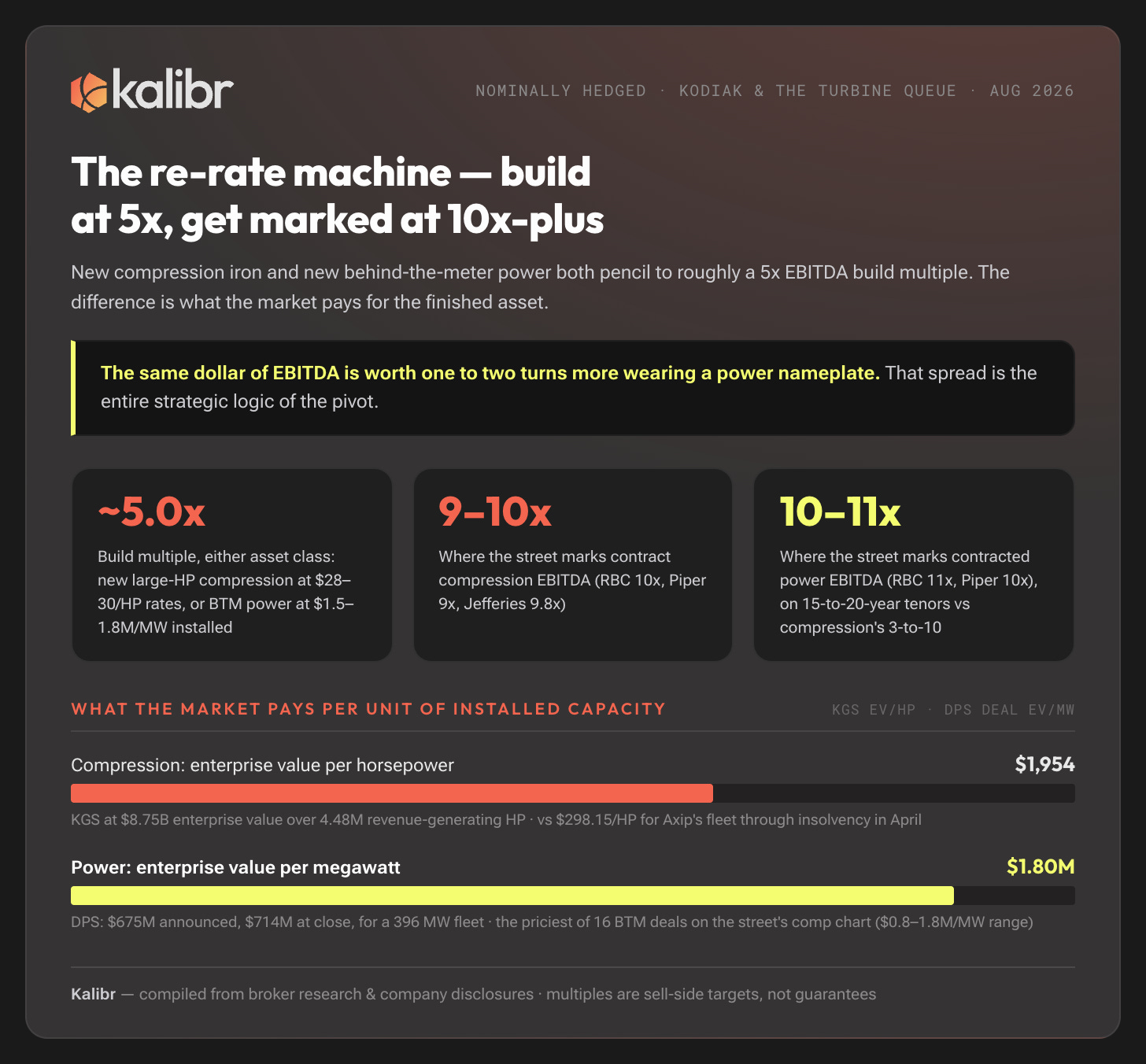
Kodiak pulled the trigger in stages this year. February: the acquisition of Distributed Power Solutions, announced at $675 million and $714 million by the time it settled at the April 1 close, roughly 7.4x DPS’s estimated $91 million of 2026 EBITDA at the announced price. That works out to $1.8 million per megawatt for a 396-megawatt fleet, the most expensive of the sixteen behind-the-meter transactions on the street’s comp chart (the range runs $0.8 million to Kodiak), which is what entering late costs. The balance sheet had been set up in advance, and that detail tells you how premeditated this was: $1 billion of 5.875 percent senior notes in February to retire the 7.25s of 2029, then a $750 million equity offering at $71.00 in May. And EQT’s final exit after third-quarter 2025 earnings cleared the register of the last constituency that might have objected to a capex super-cycle; Jefferies now models the dividend shrinking as a share of cash flow while the power build takes the capital that used to be headed for payout growth.
Look at the 2026 budget.
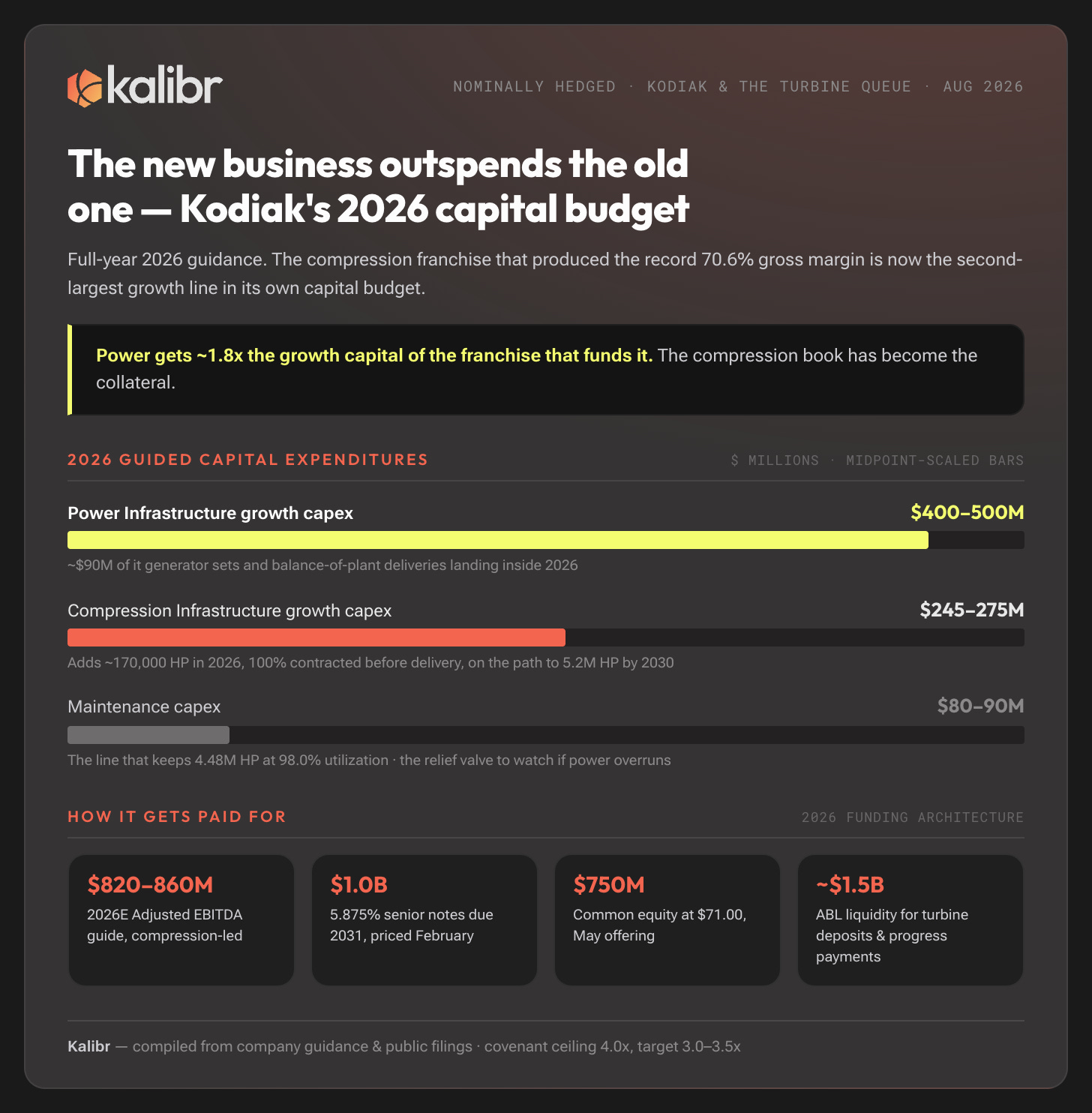
Power growth capex is guided to $400 to $500 million against compression’s $245 to $275 million, on the way to roughly $600 million a year (about $1.5 million per megawatt at the targeted 300-to-500-megawatt annual pace). The core franchise, the one with the record margins and the six no’s, is now the second-largest line in its own capital budget. Dividend coverage is comfortable today ($0.49 a quarter, covered 2.9x by discretionary cash flow), and management has been explicit that the compression book funds the power build. Which is the polite way of saying the compression book is collateral.
Buying DPS was the entry fee; the commitment that shows how far they intend to take this came five weeks ago.
One Gigawatt, Zero Signed Customers
On July 8, 2026, Kodiak signed a multi-year agreement with Baker Hughes: a binding initial equipment award of roughly one gigawatt of power generation capacity deliverable by 2030 (NovaLT16 gas turbines, Frame 5 heavy-duty turbines, BRUSH generators), wrapped in a non-binding rolling framework that extends to 1.8 gigawatts. UBS sizes the binding piece at $800 to $900 million for the turbines alone and $900 million to $1.3 billion with balance of plant; the full framework would run past $2.3 billion. Baker Hughes booked it into a record $7.1 billion quarter of Industrial & Energy Technology orders and raised its multi-year order target on the strength of it. There is also a mutual intent to sign a lifetime service agreement, which for turbomachinery historically runs 1x to 2x the initial sale price over the life of the fleet. Deliveries start in the second half of 2027.
Understand what this contract is, because it is a stranger object than the press release suggests. The Baker Hughes agreement is not an equipment order. It is the purchase of position in a queue, and the queue is currently the scarcest asset in American power. Baker Hughes has sold out NovaLT manufacturing capacity through 2028, is screening inbound buyers for secured financing and firm offtake before it will even quote them, and is doubling the production line while it sells 2029 and 2030. GE Vernova’s heavy-duty book is effectively gone through 2029-2030, Siemens through 2028-2029. Caterpillar’s Solar SMT130 lead time went from 102-106 weeks to 146-150 in seven months. A developer walking in today without a slot is quoted 36 to 60 months. Capital is available for behind-the-meter power. Land is available. West Texas gas is very available. Delivery slots are not, and whoever holds them decides which data centers get built on schedule.
DPS, for all that $714 million bought (396 megawatts of operating fleet with 364 under contract, a 100-megawatt prime-power data center contract in Virginia running above 99.9 percent delivered uptime since 2023, a real operating team), came with mostly Caterpillar reciprocating engines averaging 1.9 megawatts a unit, plus Solar turbines. It made Kodiak a participant. The Baker Hughes queue position is what makes it a contender, and the technical shape of the order shows somebody did the homework.
A NovaLT16 is a 17-megawatt industrial turbine that converts gas to electricity at 36.4 percent simple-cycle efficiency and is engineered to run 35,000 hours between hot-gas-path inspections. That is four years of continuous duty, and when the inspection comes due, the design allows a full engine swap in 24 hours. A 300-megawatt campus takes about 18 of them, versus something like 60 blocks of high-speed reciprocating engines, on a fraction of the acreage and far less water than the big rotating alternatives (a combined-cycle plant serving the same campus drinks roughly 2,000 times what an engine hall does in a year, an aeroderivative fleet 500 times, and two-thirds of planned US data centers sit in water-stressed basins). Redundancy is the other axis, and it scales with unit size: N+1 on a 300-megawatt campus strands about 210 megawatts of idle metal if you build it from 73-megawatt frame turbines, and 57 megawatts if you build it from 9-megawatt engines. The 17-megawatt NovaLT16 sits in the granular middle, a good part of why it is the SKU that sold out. What turbines give up is agility: a NovaLT16 takes under ten minutes to reach full load, a Frame 5 up to thirty, while a Caterpillar G3520K accepts load in ten seconds and Jenbachers in fifteen. AI training load swings violently, so the emerging architecture is layered: turbines carry baseload, recips and grid-forming batteries absorb the transients. Which means the company holding DPS’s recip fleet AND the Baker Hughes turbine queue AND the BRUSH generator supply can build the whole island. That combination is the real product, and almost nobody else in the oilpatch cohort has all three pieces. (The remaining gates are the unglamorous ones. SCR catalysts run up to 14 months of lead time and want replacing every 3 to 4 years at continuous duty; transformers and high-voltage switchgear run 9 to 18 months. Texas standard permits still clear in 55 to 90 days, but the old dodge of calling a trailer-mounted turbine a temporary non-road engine died in January 2026 when the EPA closed the loophole, at roughly the same moment xAI was getting sued under the Clean Air Act over 27 unpermitted turbines feeding Colossus. PJM sites need permanent permits and continuous emissions monitoring from day one. Texas first, in other words, where the gas already is.)
Now the order of operations, which is the part I would print in capital letters if Substack allowed it.
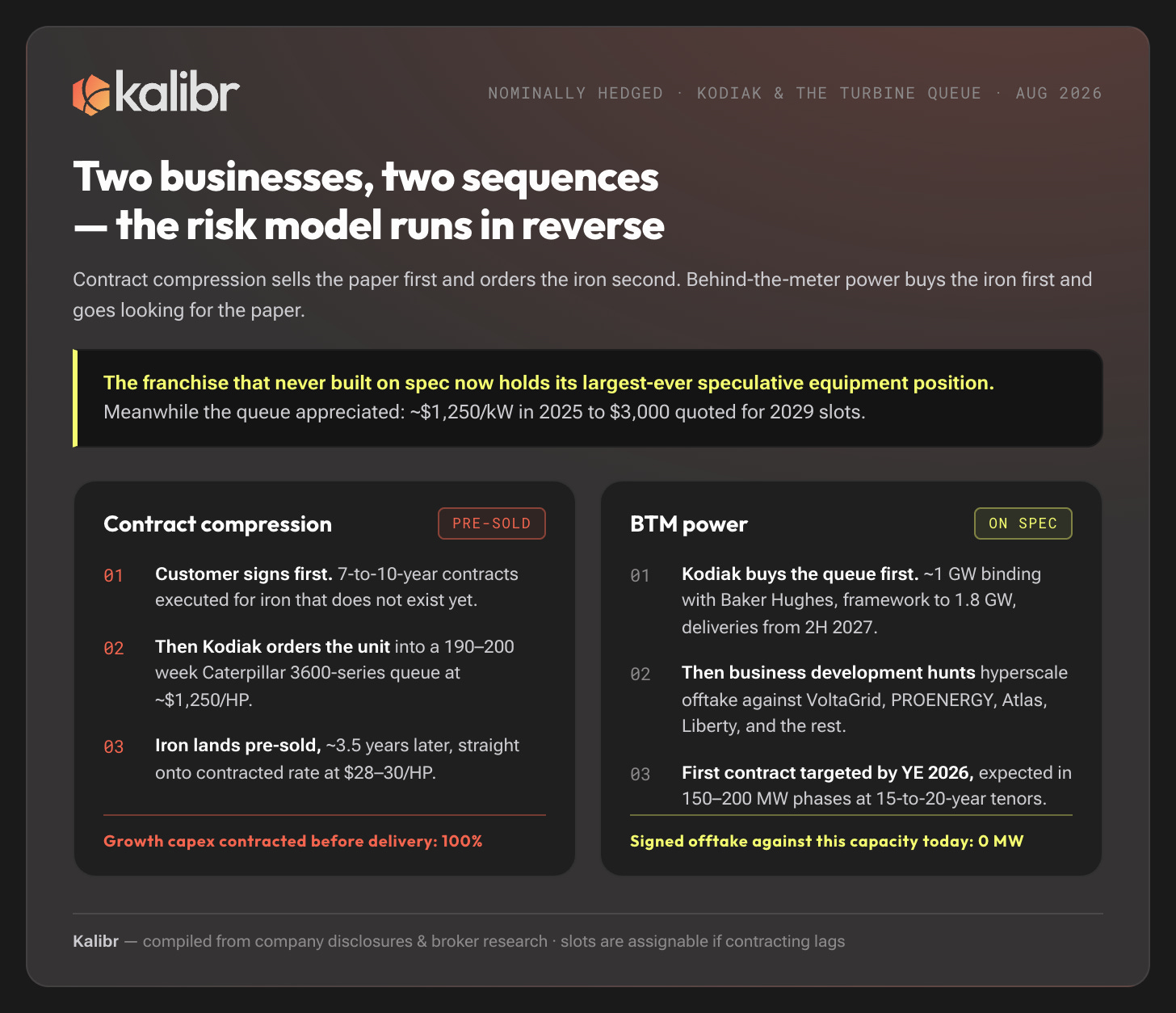
In compression, Kodiak’s entire growth book is contracted before the equipment exists. Customers sign seven-to-ten-year paper for machines that won’t ship for three and a half years, because the queue disciplines everyone. The power bet runs the sequence in reverse. Kodiak has committed roughly a billion binding dollars to slots, management describes active, advanced discussions with customers, and the number of executed offtake agreements against this specific capacity is zero. This from a company whose stated capital policy was, verbatim in spirit, never order industrial equipment on speculation. The market forced the pivot (nobody signs a behind-the-meter contract with a developer who can’t show equipment and permits, so the slot purchase is the table stakes, and RBC argues, plausibly, that it is the correct sequencing), but a forced pivot is still a pivot. Compression made Kodiak a price-setter in a three-player oligopoly controlling about 70 percent of the outsourced market. A price-setter allocates scarcity instead of hunting for buyers. Behind-the-meter power is a knife fight among VoltaGrid, PROENERGY, Atlas, Liberty, Solaris, ProPetro, ProFrac, and a dozen private developers, all selling to the same handful of hyperscalers. (Every one of those pitch meetings ends the same way, with the buyer saying some version of “we like the site, we like the iron, and we are talking to everyone else on this list.”) The muscle this requires, origination against sophisticated counterparties with alternatives, is exactly what a decade of price-setting lets atrophy.
The position is not unhedged, to be fair, because the queue itself has become a marked-to-market asset. Turbine plant capacity that cost roughly $1,250 per kilowatt in 2025 runs $2,200 to $2,500 in current ordering cycles, with $3,000 being quoted for 2029 delivery slots; new booking prices are rising about 20 percent quarter over quarter; the margin on fresh slot reservations runs 10 to 20 points above the roughly 17 percent the OEMs earned on their legacy backlog; and secondhand generator sets trade at 80 to 90 percent of new-equipment price for the simple reason that they exist now. If Kodiak’s contracting lags its deliveries, the positions can be assigned, contributed to a joint venture, or sold to a compute buyer who can’t deploy GPUs without them, probably at a gain. (I have been joking about standing up a proper secondary market for turbine slots, bid-ask and all. I am not entirely joking. The OEMs saw the same thing coming, which is why new slot contracts carry first-refusal buyback clauses and CPI escalators of 3 to 7 percent while you wait.)
Probably! But the scoreboard says Kodiak is behind, and the deal book says by how much:
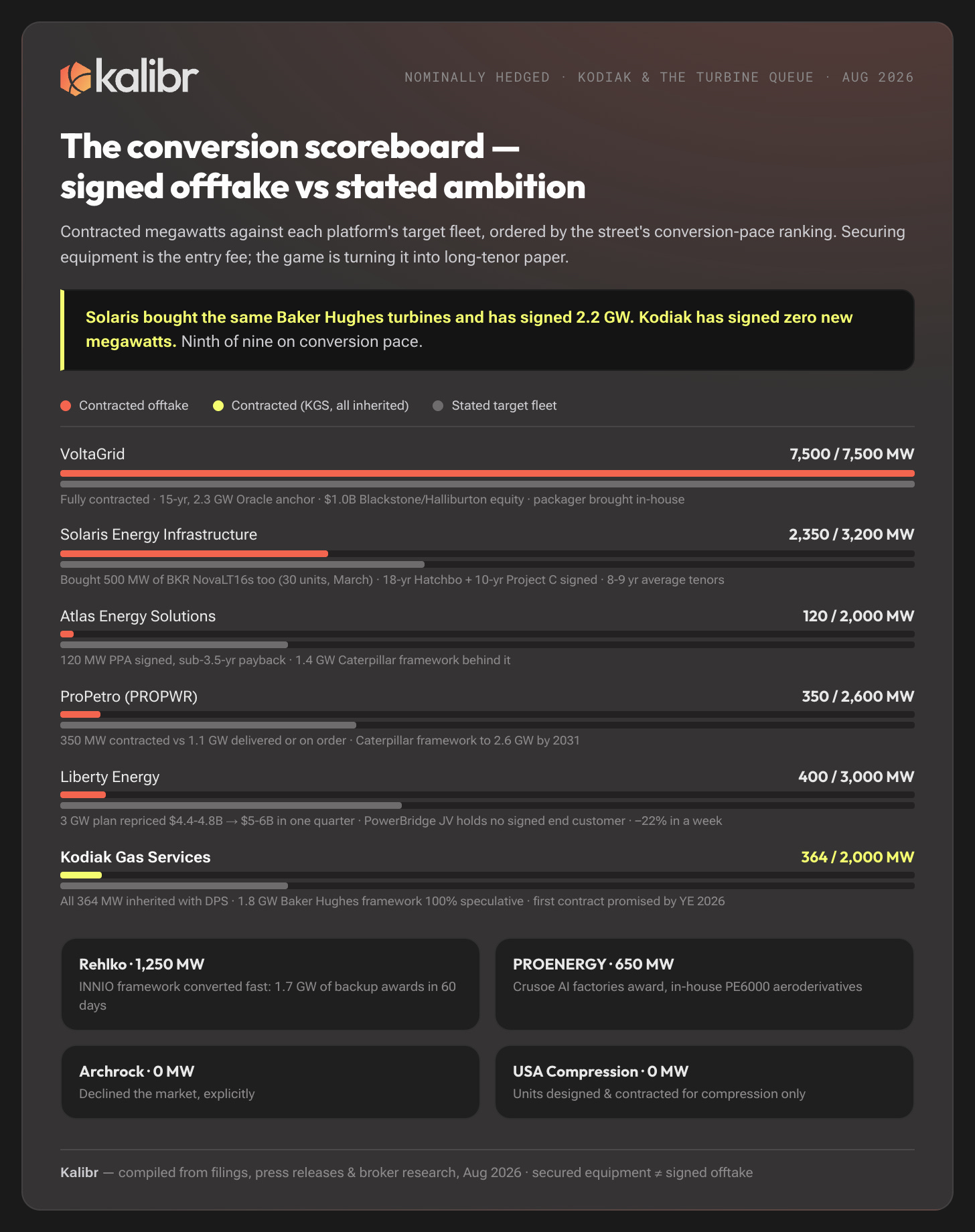
VoltaGrid holds 7.5 gigawatts of fully contracted backlog, anchored by a 15-year, 2.3-gigawatt turnkey PPA with Oracle, financed by a billion dollars of Blackstone and Halliburton equity on top of a $5 billion debt package, with 3.8 gigawatts of INNIO engines on order and its own packager acquired and being expanded toward 300 megawatts a month of throughput. That’s what finished looks like. Solaris is the more uncomfortable comparison, because it is running Kodiak’s exact play, a year ahead: it bought Baker Hughes NovaLT16 capacity too (500 megawatts, 30 units, in a March rights deal) and has already converted its equipment into 2.2 gigawatts of contracted backlog, a roughly 900-megawatt joint venture, an 18-year 660-megawatt turnkey contract, a 10-year contract behind that, average tenors of 8 to 9 years, and 18-to-20-percent unlevered returns on Wolfe’s math. Same turbines, same market, signed paper. Liberty is the cautionary tale on the third side: a 3-gigawatt ambition whose cost estimate moved from $4.4-4.8 billion to $5-6 billion in a single earnings cycle, $1.3 billion of equipment purchase obligations already booked with essentially all of it falling due beyond 2029, a marquee joint venture with no signed end customer, and a 22 percent drawdown in a week when the market noticed (TD Cowen filed it under show-me). Kodiak reported nothing that month, and its stock absorbed the hit anyway. That is the unwritten term in joining a peer group: your comps’ mistakes get charged to your multiple whether you made them or not.
On the deal book’s conversion ranking, Kodiak sits ninth of nine: 364 contracted megawatts, every one inherited with DPS, against a framework that runs to 1,800. So management’s promised first behind-the-meter contract by year-end, in 150-to-200-megawatt phases at 15-to-20-year tenors, is carrying more than narrative weight. Jefferies calls it the validation event, and I agree, but the more concrete stake is the debt: project lenders won’t advance against speculative equipment frameworks, and infrastructure credit wants 10-to-20-year take-or-pay paper with letters of credit behind it before an SPV gets levered. The first signature validates the story and, more usefully, turns on the financing architecture that makes every contract after it cheaper to fund.
And the thesis has a shelf life. That part should keep Kodiak’s board up at night. Behind-the-meter gas is priced as a bridge: roughly $30 per kilowatt-month against $15 for the same megawatt in front of the meter, premium 24/7 paper clearing $100 to $110 per megawatt-hour with hyperscalers openly balking above $110, all of it paid for speed because interconnection takes years. Every force compressing that window attacks the premium. ERCOT’s 765-kV transmission plan is designed to do just that. New Jersey is legislating minimum-payment structures (ten-year electric service agreements, 85 percent minimum payments) so data centers stop socializing costs onto ratepayers, and other states will copy it. Bloom’s fuel cells deploy in 90 days with no combustion permit and a levelized cost headed for $102 a megawatt-hour by 2030, against roughly $92 for combined-cycle gas. The hyperscalers are signing SMR commitments (Google with Kairos, Oracle announcing a gigawatt-scale site fed by three of them) for the 2030s. None of these kills the bridge in the next five years. All of them shorten it, and a shorter bridge is a lower terminal value on 30-year turbine assets. Note the strange thing the market did with that risk: 10-year power contracts proved unbankable, so tenors stretched to 20 and 30 years, which is a long time to finance a technology everyone involved keeps calling a bridge.
Then there is the demand question, the one I ask in my less charitable moments. Satellite tracking says half the announced 2027 data center queue had not cleared land as of late June; announcing capacity costs nothing, concrete is the expensive part. And the demand under the queue has a measurement problem: AI compute is selling below cost, openly, the way Uber rides did during the zero-rate years, when venture money subsidized fares to buy adoption and the demand curve looked magnificent. Then the IPOs arrived, the subsidy died, fares reset sharply higher, and some of that demand went home. Every 20-to-30-year turbine contract in this market is underwritten against consumption nobody has observed at full price. (A longer discussion for another day, and I probably won’t be able to help myself.)
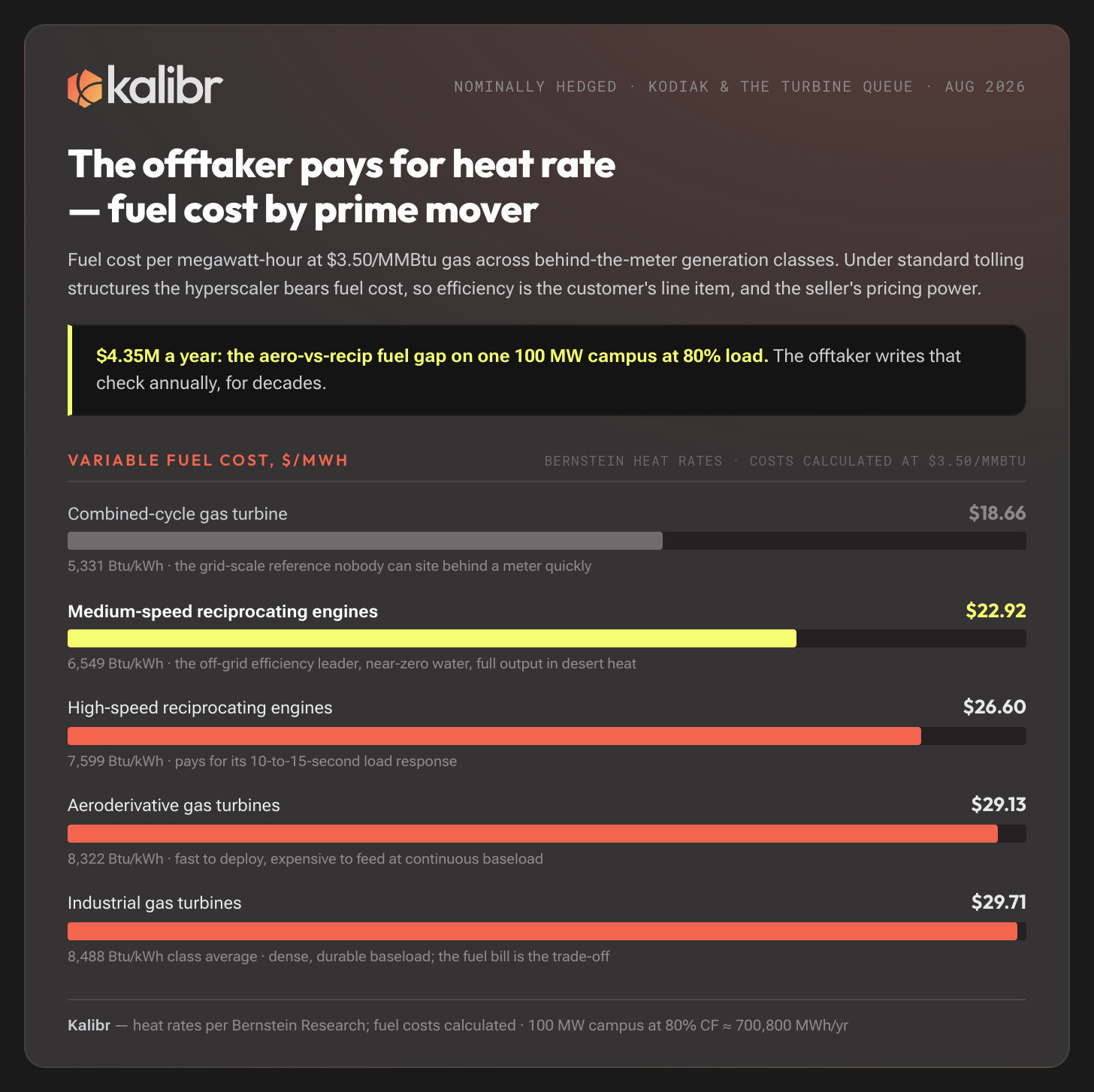
One entry on the other side of the ledger goes unpriced, though, and it is the reason this section is not a pan: fuel. Start with who pays it. Under the tolling structures this market is converging on, the hyperscaler bears the fuel cost, procuring gas directly or paying an indexed pass-through, which turns heat rate into the offtaker’s line item and fuel efficiency into pricing power for whoever owns the efficient iron. The spread is not small. Bernstein’s heat-rate ladder runs 6,549 Btu per kilowatt-hour for medium-speed reciprocating engines, 8,322 for aeroderivatives, and 8,488 for industrial turbines; at $3.50 gas that is $22.92 per megawatt-hour against $29.13 and $29.71. On a single 100-megawatt campus at 80 percent load, the difference between the right iron and the wrong iron compounds to $4.35 million a year, every year, in the offtaker’s column.
Now run that logic back through the compression book, because the same molecule is involved. A behind-the-meter plant in the Permian buys gas that Kodiak’s compression customers produce and its midstream customers gather, through relationships Kodiak has spent a decade servicing. At Waha prices, fuel gas is a rounding error; nobody prices the difference between an efficient compression unit and a thirsty 2008 vintage, because the gas is nearly free. The moment that molecule feeds a power purchase agreement instead of a pipeline, fuel efficiency becomes a line item with a dollar sign, and Kodiak’s newest Caterpillar iron burns meaningfully less fuel per horsepower-hour than the legacy fleet it would replace. That hands the sales team an upsell with arithmetic behind it: swap to new units, extend tenor, take the rate step-up, and the customer still nets out ahead on total cost. Run correctly, the power business reprices the compression upgrade cycle, which is worth more to the franchise than the diversification it was sold as.
The Archrock Null Hypothesis
Every bet needs a control group, and this one comes built in. Archrock looked at the same market, the same multiples, the same queue, and said no. Publicly, explicitly: no behind-the-meter power, on redeployment and structural-risk grounds. USA Compression said the same (its units are designed and contracted for compression, the end). So the two other members of the oligopoly are running the pure-play experiment for us in real time.
Archrock’s version of ambition is $250 to $275 million of 2026 growth capex, $1.4 to $1.6 billion of organic spend through 2030 adding about a million horsepower, a 665,000-horsepower midstream contract with an eight-year term as the flagship, 72 percent contract margins, 2.6x leverage, and dividend coverage north of 3x. It evaluated adjacent-market M&A and passed, on the stated grounds that the returns did not compensate for the operational risk. It is, in every observable respect, the disciplined version of the last decade of Kodiak, continued.
Except for one position, and it is the position that makes this a genuine duel rather than two companies drifting apart. Archrock owns roughly 600,000 horsepower of electric-motor-drive compression, acquired deliberately through TOPS and NGCS. Today that book is fighting a headwind: grid capacity is so scarce that Permian processors are converting back to gas drive, part of why compression lead times exploded in the first place. But play the tape forward. The scenario in which the grid gets built out (ERCOT’s 765-kV plan lands, interconnection queues compress, front-of-meter power gets cheap and available) is simultaneously the scenario that shortens the bridge under Kodiak’s turbine fleet AND the scenario in which electric-drive compression becomes the cheapest, most reliable iron in the basin. The two largest compression companies in America have taken opposite sides of a single variable: the pace of the Texas grid. Kodiak is short it. Archrock is long it.
That is what makes Kodiak’s bet asymmetric in a way the sell side’s sum-of-the-parts math doesn’t capture. If the power thesis wins, Kodiak re-rates toward 11x on a growing share of EBITDA and Archrock spends the decade explaining its 9x to income funds. If the power thesis loses, it most likely loses because the grid arrived, in which case the capital Kodiak sank into turbine slots is stranded just as Archrock’s EMD book and 2.6x balance sheet are compounding. There is no scenario where they both just, like, do fine. One of these companies is going to be very annoying at industry conferences in 2030, and (this is the section where I remind you we advise operators on compression procurement, not investors on stocks) which one it is determines what your next renewal negotiation feels like.