
The Market
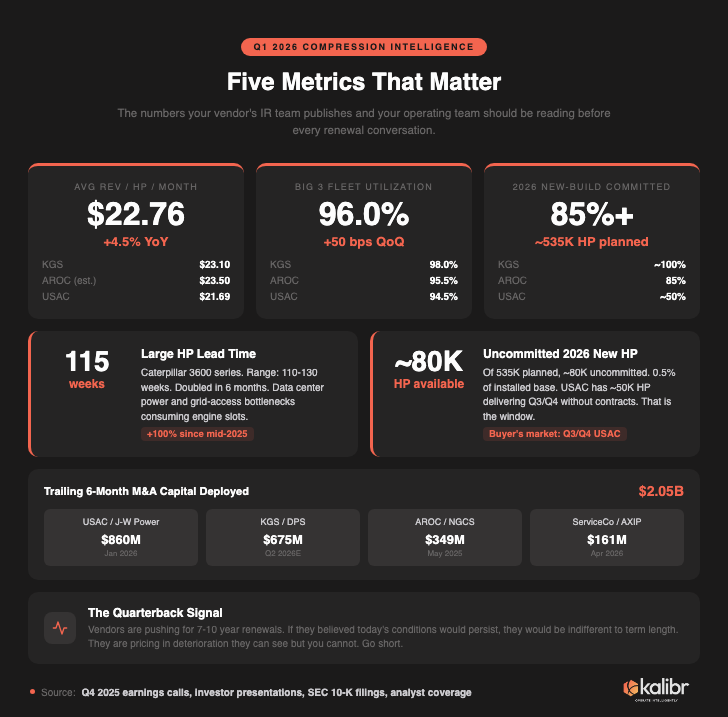
Large horsepower lead times doubled in six months. Roughly 55 weeks at mid-year 2025. 110 to 120 weeks today. The proximate cause is not a temporary supply chain disruption. It is a structural reallocation of industrial manufacturing capacity toward power generation, where demand visibility extends a decade, contract terms run 10 to 15 years, and payment economics are simply more attractive than anything the oilfield can offer.
Kodiak spent $675 million to buy a distributed power company. Permian gas processing plants, unable to access the electrical grid for seven to eight years, are converting what would have been 75,000 horsepower of electric motor-driven compression into gas-engine-driven units, consuming the same engine slots the oilfield needs. The compression industry quietly became a price-taker in its own supply chain.
Meanwhile, the Big Three reported Q4 results that belong in a private equity pitch deck.
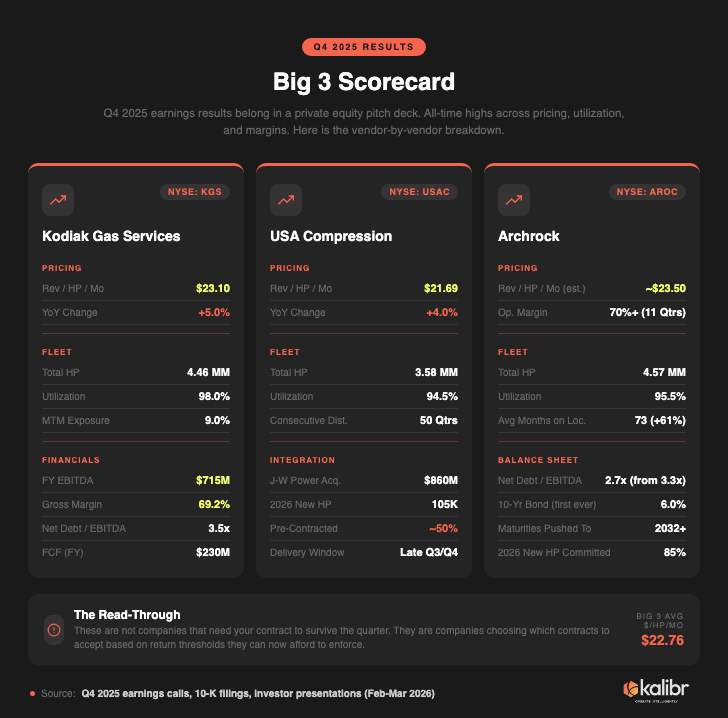
Blended fleet utilization at 95 to 98%. Revenue per horsepower at all-time highs: $23.10 at KGS, $21.69 at USAC, an estimated $23.50 at Archrock. And $2 billion in acquisition capital deployed in six months: KGS absorbing Distributed Power Solutions, USAC folding in J-W Power, Archrock integrating NGCS, and Service Compression acquiring AXIP Energy’s Chapter 11 estate. The competitive landscape has meaningfully thinned in a market where new equipment cannot physically arrive for two years.
What this means for your next renewal is straightforward and uncomfortable: your vendor’s best alternative to your deal has rarely been stronger. At 95%+ utilization with no credible supply response before 2028, the threat to walk away is not a negotiating posture. It is free. Every public vendor deleveraged this year. Archrock dropped from 3.3x to 2.7x and issued the first 10-year bond in compression history at 6%, then used it to push debt maturities past 2032. Enerflex hit 1.0x net leverage on record free cash flow. KGS delivered on its IPO commitment of 3.5x and bought back over $100 million in stock. When your counterparty is simultaneously improving margins, retiring debt, raising dividends, and repurchasing shares, the credibility of their walk-away is not hypothetical. It is funded.
The Signal the Earnings Calls Are Broadcasting
Here is the part the prepared remarks do not want you to hear: vendors are pushing aggressively for longer contract terms, and that behavior is deeply informative.
Kodiak is in active discussions with customers about seven- and ten-year renewals. Terms that would have been unthinkable three years ago. Archrock’s fleet now averages 73 months on location, up 61% since 2021, with large horsepower units averaging eight years. Eighty-five percent of Archrock’s 2026 new-build capacity is pre-contracted. KGS’s order book is full through 2026 and they are booking into 2027.
If vendors believed today’s conditions would persist indefinitely, they would be indifferent to contract length. The same terms would be available at renewal. By expending negotiating capital to lock in current positioning, they are pricing in deterioration they can see but you cannot.
This is the quarterback problem. When the party with peak current value demands a long-term commitment, the rational counterparty goes short.
The structural demand runway is real. Raymond James estimates 26 Bcf/d of incremental U.S. gas growth through 2030, implying 15 million additional compression horsepower, a 25% increase in the installed base. Demand will be enormous. But demand is not the same as vendor leverage. The supply response will come, the utilization plateau will break, and the operators who preserved renegotiation optionality through this constrained window will capture disproportionate value on the other side.
Key Performance Indicators | Q4 2025