


On Tuesday I argued that nobody prices contract duration out loud, that a term contract is a bet on the trajectory of both sides’ alternatives, and that every input to those trajectories is observable. This issue keeps the promise and runs the machine. The mechanism, the bottlenecks, and the component that decides how fast this market unwinds are free. The scenario table, the weights, and the verdict sit behind the wall.
Nominally Hedged, The Iron Report and The Counterparty Read is Kalibr Partners’ briefing on what oil and gas actually costs: every category, CAPEX to OPEX, proprietary data systems, interpreted through a commercial lens. Whichever side of the negotiating table you sit on, you are the intended reader. The data is neutral: the iron does not change shape depending on who reads it. In any single engagement we sit on one side of the table, and we tell you which.
On August 5, Archrock signed the largest compression services agreement in our coverage’s history: approximately 665,000 horsepower, an 8-year base term, a price management would not discuss. Tuesday’s piece built the frame for grading that trade. Both parties hold a walk-away, the deal lives in the zone between them, and an eight-year term is a wager on where that zone travels between now and 2034.
Half of that wager barely needs a model. By our work the demand for horsepower is a function of geology, and geology is patient: the Permian gas-oil ratio has climbed from 3.2 to 4.6 since 2014, Permian gas grew 9% last year against flat crude, and Archrock’s own materials chart LNG pull nearly doubling by 2030. I will state the conclusion our demand model produces, because the model itself is the thing clients engage us for: horsepower demand does not bend downward inside the window this contract lives in. You can quarrel with the claim over a beer; the machinery stays in the shop, and it isn’t the interesting half anyway.
The interesting half is the vendor’s. Every floor in Tuesday’s framework, the sliver-thin zone, the record rates, the 3-to-5-year tenors stretching to eight, rests on one physical fact: nobody can get a large engine. Caterpillar quotes 195 weeks. The whole compression market has repriced off that number, and an eight-year commitment signed into it is a bet that the number holds. So the question this issue answers is narrow, checkable, and worth real money on both sides of the table: does the supply constraint hold?
One Company in Lafayette, Indiana
Break the eight years into pieces and the bet clarifies. Years one and two are already decided: the iron that will arrive by 2027 is bought, deposited, and scheduled, and no scenario in anyone’s model un-books it. The money years are three through eight, and across those years the vendor’s floor is set by two forces pulling on the same factory. The first is physics: whether Caterpillar and its suppliers can physically make more large engines, which Tuesday’s piece traced into the metallurgy, the block castings and crankshaft forgings nobody can source. The second is competition: who else is bidding for the engines that do get built, which is the data-center build, a customer that signs fifteen-year power agreements and orders in gigawatts.
Hold both forces at once, because the mechanism cuts both ways. If data-center demand persists, compression stays crowded out of the order book and today’s floors hold through the decade’s back half. If it flinches, capacity comes back faster than a 195-week quote implies, and the operator who locked eight years at record rates spends years four through eight explaining the invoice. Sign a compression contract of any length this year and you have taken a position on the data-center build; the only open item is whether you priced it. The rest of this piece takes the two forces apart, then reassembles them as probabilities.
Where the Queue Lives
Tuesday’s piece established what the United States cannot do: cast a large engine block anywhere on its own soil, or forge a large crankshaft on more than four presses. The queue’s anatomy goes deeper than that, and the deeper you go, the more the constraint looks like other industries’ problems that compression happens to be standing in.
Start with the castings. The foundries that can pour a 3600-class block are countable on a hand or two worldwide, and their capacity is already owned. Tupy, the Brazilian giant that is the world’s largest iron foundry, runs three plants totaling 748,000 tons a year, and its blocks and heads sit in 70% of the medium and heavy trucks on American roads; its new large-engine contracts start delivering in 2027 and 2028. India’s Craftsman Automation spent a decade scaling from 100-kilogram castings to 3-tonne ones and now serves seven of the world’s ten largest engine OEMs; its Kothavadi foundry expansion, the nearest net-new block capacity anywhere in the pipeline, reaches commercial production in fiscal 2029, and it’s being built against a $100 million order book linked primarily to data-center demand. From the compression chair that sentence reads: the next block foundry to open is already sold, to the other bidder, before the first pour.
And casting the block is the easy part. Machining it requires vertical machining centers and large-bore boring machines of a class only a small group of machine-tool builders on earth produces (DMG Mori is the name that keeps coming up), with a year-plus lead time on the equipment itself. This is the chokepoint underneath the chokepoint: the machines that make the parts are scarcer than the parts.
The crankshaft story compounds the same way. The worldwide fleet of large forging presses spans roughly 33 facilities, and the presses are promiscuous: the same open-die equipment forges aerospace structural parts, defense components, wind-turbine shafts, and nuclear pressure vessels. Commercial aerospace and defense are, in the words of analysts, monopolizing critical press time. Safran is spending €150 million on a 30,000-ton press in France; Pratt & Whitney is adding its seventh isothermal forging press in Georgia for $200 million; India’s Happy Forgings, whose 14,000-ton line is among the largest of its kind anywhere, is adding two more presses this fiscal year. None of that capacity is meant for engines that compress gas, and all of it bids on the same steel, the same metallurgists, and the same press-shop labor, which a GE Aerospace program lead describes as harder to find every year for five years running.
Then there is the third bottleneck, the one that got a single clause on Tuesday: turbochargers. A large-bore turbo’s hot section is made of Inconel 718, Hastelloy, and Waspaloy, alloys so miserable to machine that many American shops refuse to quote the work. The inputs are identical to a jet engine’s hot section, which means Caterpillar’s turbo suppliers bid directly against Airbus, Boeing, GE, and Siemens Energy for the same superalloy castings, in the middle of an aerospace super-cycle. Garrett Motion, which built the very large “MEG” turbocharger frames this market needs, launched them commercially in 2025, aimed at one application: stationary power for data centers. Aerospace consumes about 75% of the world’s 150,000-tonne titanium market, China and Russia control 70% of the titanium chain, and the industry runs on raw-material buffers of two to four weeks. The turbocharger base, unlike castings and forgings, has no adjacent capacity to borrow; the Kalibr term is structurally isolated.
One more layer, because it’s the kind of detail that decides outcomes: concentration. CIE Automotive India is the only major supplier that can make heavy crankshafts by both casting and forging; Bharat Forge, through an acquisition, now supplies heavy forgings and structural engine castings from the same corporate roof. A power failure, a strike, or a scrap shortage at either company halts two of the three critical constraints for the 3500 and 3600 platforms simultaneously. This is what Caterpillar’s $725 million at Lafayette buys, one of the largest single manufacturing investments in the company’s history by its own description: the city filings that first carried the number put $625 million of it toward machinery alone, the building grows by 300,000 square feet, and analysts who toured the plant report crank milling automated down from 30 operators to eight. Management put the binding question on the record in January: how fast can the external supply base come along? Demand never enters the sentence.
For Want of an Alternator
Everything above binds both of Caterpillar’s markets the same way. A block is a block whether the engine ahead of it compresses gas in the Permian or backs up a campus in Virginia; so is a crankshaft, so is a turbo. Which raises the question that decides how fast this market can unwind: is there anything the power-generation build needs that compression does not?
There’s exactly one big thing. A genset needs an alternator, the generator end that turns shaft power into electricity, and it is the second-largest component in a power-generation package and a gating item in its own right. A compression package has no alternator anywhere on the skid; the engine couples directly to the compressor frame. The alternator is not a compression component at all; it is the hinge the entire reversion question swings on. If the binding constraint on data-center power sits at the alternator, then bare engine block lines (understanding the size differences between the two applications for the 3600 class) can be redirected to compression packagers almost instantly the moment powergen demand slips. If the constraint sits upstream, in the castings and machining both markets share, nothing redirects, because both queues starve at the same foundry. Cummins, for what it’s worth, owns its alternator makers outright (Stamford and AvK are subsidiaries); Caterpillar buys a meaningful share of its alternators from outside. The tighter alternators get, the more of CAT’s engine output can pivot to the customer that does not need one.
The rest of the compression package already tells you where the constraint does not live. Ariel frames and coolers still quote 25 to 30 weeks, normal by any historical standard; third-party packaging adds 30 to 40 weeks; USA Compression self-packages 100,000 to 125,000 horsepower a year through its own facilities precisely to skip that line. The engine is the queue. Everything around the engine is a store with inventory.
And the desperation gauges around the engine are worth watching in their own right, because they move faster than any earnings call. Buyers who can’t get one large engine are ganging up multiple sub-1-megawatt engines, which still quote about six months, and running them in parallel; Evercore reads that substitution as a real-time indicator of how desperate the large-engine market is, and so do we. Roughly 20% of new data-center builds are going up with hybrid diesel-plus-battery backup instead of pure genset arrays, the shape an early resolution would take. Caterpillar’s own aftermarket is cannibalizing its new-build line: data-center engines run hard, run-hours pull overhauls forward, and replacement parts compete with new engines for the same castings. And the share of CAT’s backlog expected to deliver within twelve months has slipped from roughly 73% at the end of 2024 to 62% at the end of 2025 to 59% today, which is what a queue looks like when it lengthens from the inside. When Caterpillar found a way to add capacity without touching the bottleneck, it did: a 10-megawatt medium-speed gas platform it had stopped producing got restarted in a single quarter, 1.5 gigawatts of capacity coming back online, shipments beginning Q4 2026, an investment management called minimal in the rounding. The places Caterpillar can add capacity quickly are, by construction, the places the three bottlenecks do not reach.
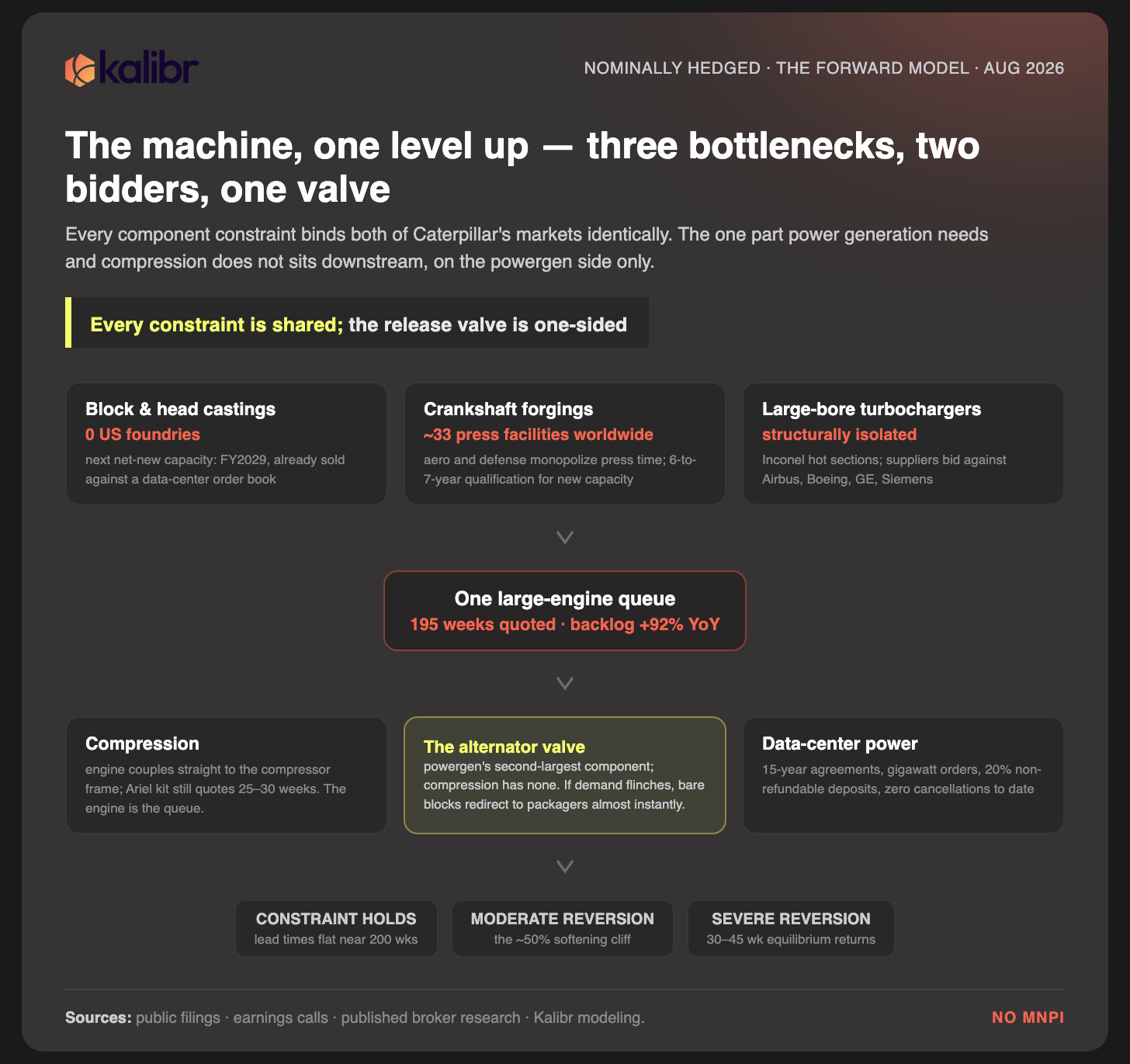
That valve is why this piece has a paid half. Below the wall we run the scenarios it gates: the lead times, the rates, the tenor, and the verdict on the years.
The Other Bidder’s Book
Whether a real constraint holds is a question about the other bidder, and the other bidder’s book, which is to say Caterpillar’s own order tape, is the strangest object in this analysis, because it supports both answers at once.
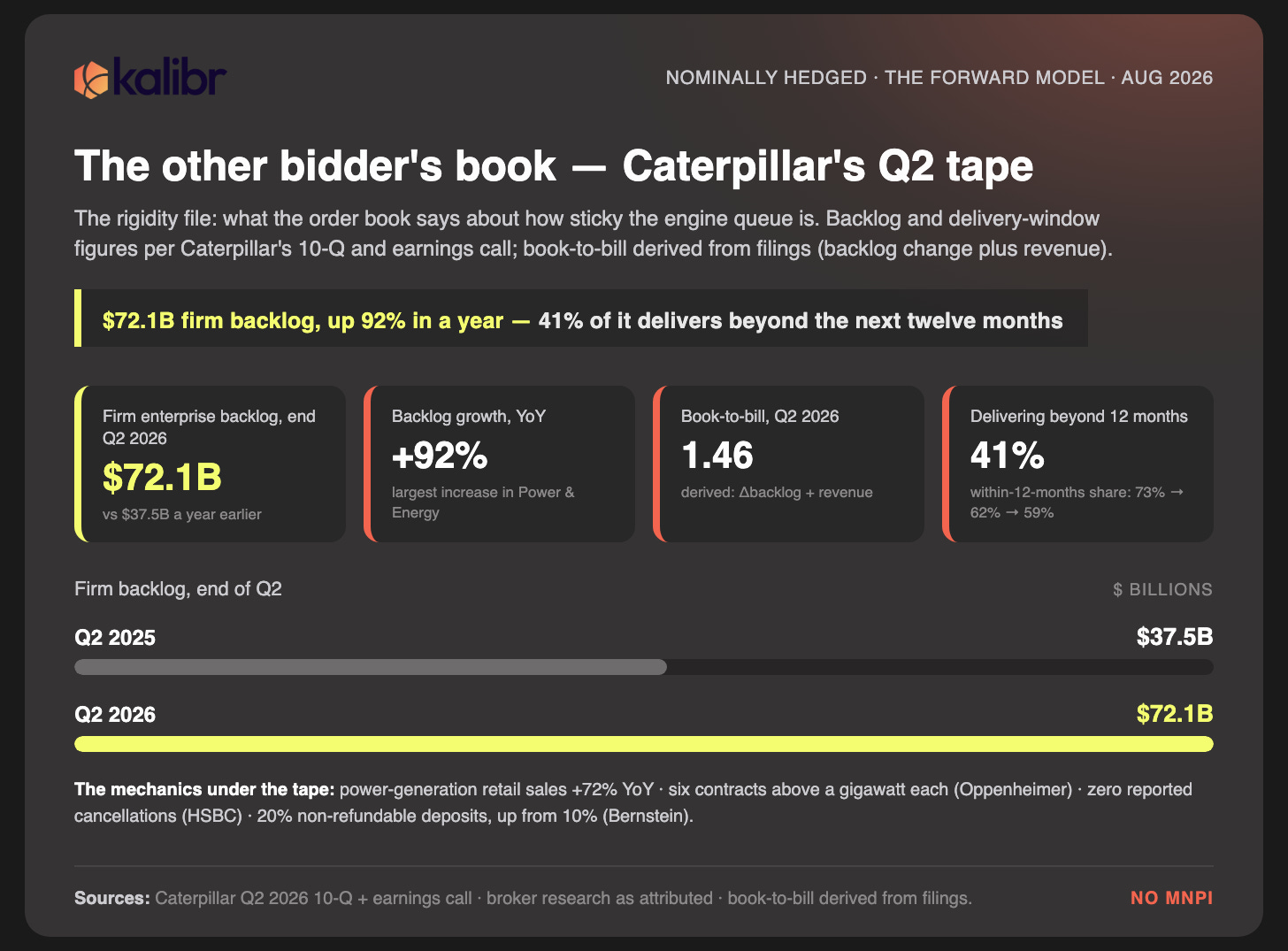
The rigidity case is Caterpillar’s own tape. Firm enterprise backlog reached $72.1 billion at the end of the second quarter, up 92% in a year, with roughly 41% of it scheduled beyond the next twelve months and a book-to-bill that backlog-plus-revenue arithmetic puts at 1.46. Power-generation retail sales grew 72% year over year. Six separate contracts exceed a gigawatt each, by Oppenheimer’s tally. The reciprocating engine backlog has seen zero cancellations, per HSBC, and the mechanics explain why: down payments on these engines run 20% and non-refundable, up from a traditional 10% by Bernstein’s count, and framework agreements require firm purchase orders 15 to 24 months ahead. Nobody has walked away from a deposit yet. A developer who sours on a site pushes the project out or moves it; the engine order stands, because the engine, in this market, is worth more than the site.
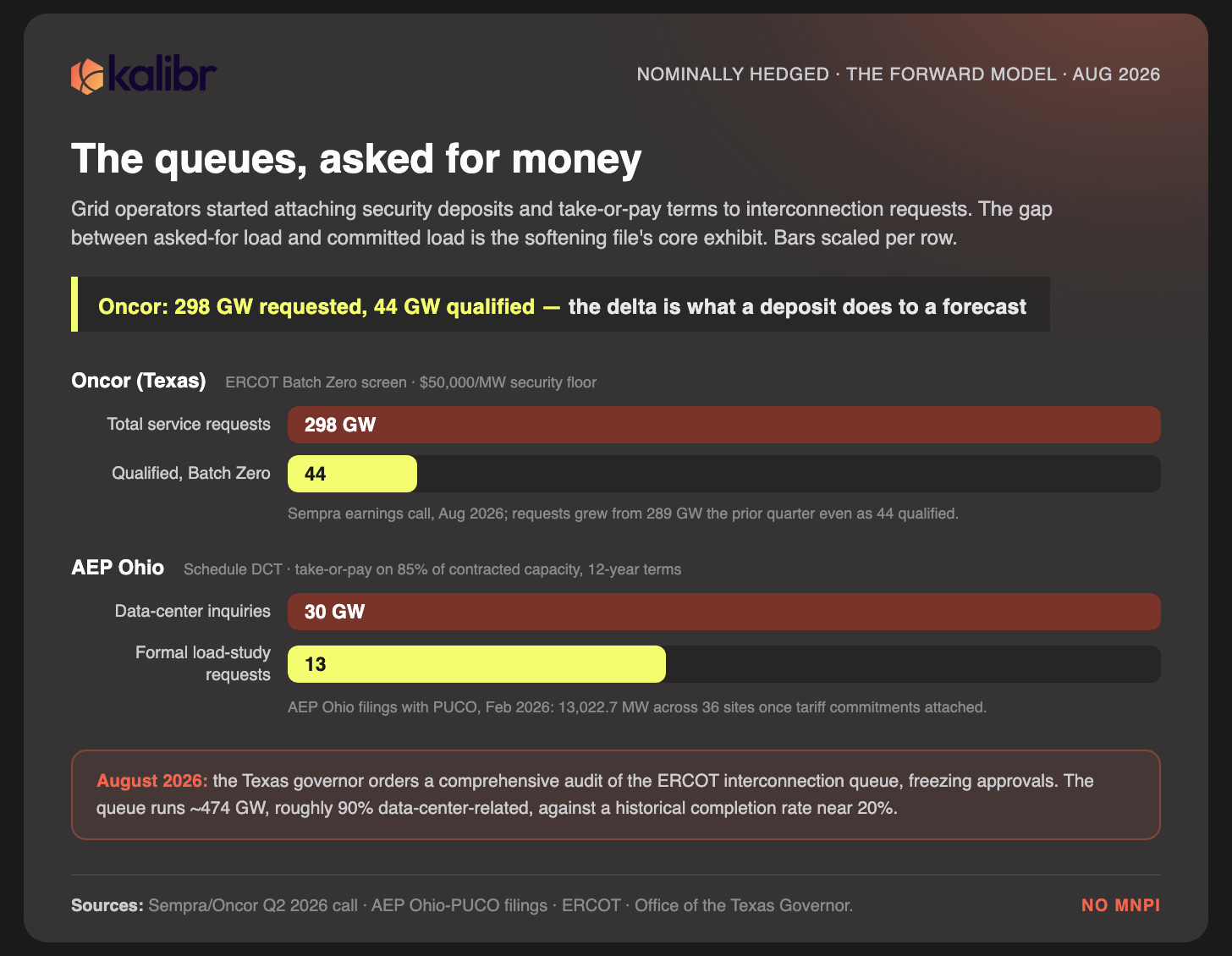
The softening case is everything around the tape. United States data-center project cancellations rose from 6 in 2024 to 25 in 2025, by Heatmap’s count, and Data Center Watch tallied 75 projects worth roughly $130 billion blocked or delayed in the first quarter of this year alone. The grid operators have started asking their queues for money, and the queues are failing the ask: of the 298 gigawatts of service requests sitting with Oncor, 44 have qualified for ERCOT’s new Batch Zero screen and its $50,000-per-megawatt security floor; AEP Ohio’s 30 gigawatts of data-center inquiries became 13 when take-or-pay terms arrived; and in August the Texas governor ordered an audit of every data center in the ERCOT interconnection process, freezing approvals on a queue that is roughly 90% data-center-related against a historical completion rate near 20%. Scotiabank’s arithmetic says the nominal queue runs up to twenty times 2030’s deliverable capacity, which is another way of saying most of the announced demand is a call option somebody reserved for free. Meanwhile the hyperscalers themselves are printing the early tells: Meta’s operating margin compressed from 43% to 31% with free cash flow of $784 million against $8.5 billion a year earlier; Microsoft stretched the useful life of its data centers from 15 to 25 years and reclassified leases in a way that trims this calendar year’s capex optics by $15 billion, while Bernstein notes its purchase commitments are concentrated in fiscal 2027 with “substantial flexibility to quickly throttle down”; Vertiv missed its own organic growth target; GE Vernova’s electrification orders fell from $7.1 billion to $6.3 billion quarter over quarter. None of that is a collapse. It is what the year before a collapse would look like, and equally what a mid-cycle breather would look like, which is the interpretive problem this model exists to price.
The game theory says the resolution, when it comes, will be abrupt. “Megawatts are a moat, and the queue is where you hold them,” every hyperscaler thinks, including the ones that will never build the campus, so everyone over-projects load on purpose: a queue position is a cheap call option on capacity a rival might otherwise take. Options get exercised or abandoned all at once: the first material guidance cut by one player repricing everyone’s expectations is the mechanism by which 15% softening becomes 50% inside two quarters. The demand side of this model behaves less like a dial than like a coiled spring with a deposit on it.
One paragraph on the demand side of compression before the wall, stated rather than shown. Our model has Permian horsepower demand growing through every scenario in this piece, on gas-oil ratios, gas-lift conversions, and LNG pull, none of which care about Nvidia’s quarter. (Yes, data-center gas demand and compression demand are co-variant; the campus that outbids you for an engine burns gas somebody has to compress. We are stepping over that loop deliberately, it deserves its own issue, and if you want to argue about it sooner, you know where to find me.) The demand floor under compression is why every scenario below is a supply story: the zone’s width for the next five years will be decided at the foundry level.
One number on the way out of the free half. The single largest sensitivity in the model is a threshold, and crossing it moves leading-edge compression rates by about $4.50 per horsepower-month and cuts the market’s standard tenor roughly in half. It has nothing to do with the rig count, and it is the first thing on the other side of the wall.
Below the wall: the scenario table, our weights on it, the sensitivity ranking, and the verdict on going long or short on compression term today. Paid subscribers get every read.