


Sixty Thousand Horsepower
In a recent engagement, we renegotiated roughly 60,000 horsepower of compression. The outcomes, in the order the client cares about them: about $3 million a year in compression cost savings, throughput up 25%, a contracted fleet averaging roughly ten years newer, 98 to 99% uptime guarantees, First Call status, months of free credit, transition cost crediting, no penalty for downsizing, and 50/50 splits on craning and trucking.
Every line on that list was bought with the same asset: we sat down knowing the vendor’s financial position, in places better than their own commercial team seemed to. We knew which parts of their fleet were earning and which were sitting, and what their balance sheet needed from our paper more than it needed our rate. Know that, and asks turn into trades: you are giving the vendor something its own financials say it needs, and charging for it.
The raw material traces back to documents anyone can download: earnings call transcripts, 10-Qs, investor decks. Which raises a fair question about why outcomes like that are rare. Here is the answer, and it is the thesis of everything Kalibr publishes: reading the filings is not the edge. Converting them into deal structure is. The earnings call tells you what a vendor needs; the 10-Q tells you what it can afford. Neither is worth anything until it shows up in how you package, sequence, and paper your negotiation.
That is the connection between our engagement work and the breakdown you are about to read. This piece is the diagnostic we run before every negotiation, performed in public on USA Compression’s second quarter: what does this vendor need right now, what can it afford, and where is its walk-away weak? The quarter answers all three unusually loudly, and the back half of the piece turns those answers into contract language. The list above is what answers like these are worth once they reach a table.
For context on where the process comes from: I have negotiated hundreds of agreements in oil and gas, across supply, M&A, land, and midstream, on a method built outside the industry alongside a world-renowned negotiation expert and run through enterprise sales, supply chain, M&A, and executive compensation before it ever touched a compression renewal. Next week I am publishing the full anatomy of the 60,000-horsepower engagement: how our proprietary data drove each outcome on that list, step by step, behind a real case study. This week: the quarter, and how to use it.
The full case study publishes next week for paid subscribers: how the data drove each line on that list.
How to Use This Data
Everything below serves one question: what is USAC’s optionality? If they lose your renewal, who takes the iron, at what rate, and how fast? A vendor’s alternative to you is every other E&P and midstream operator they could place that unit with. Their negotiating strength is exactly as good as that alternative, and no better. Weaknesses in their optionality are your leverage, and this quarter’s filings disclose several. That is the vendor’s BATNA. There are two BATNAs in every negotiation, though, and the second is yours to build. A note for midstream readers before the chairs: everything here applies to you, and usually harder. Gatherers and processors tend to be more price-sensitive than E&Ps, and your financial structure gives you a higher natural propensity to insource, which means your walk-away starts stronger than you may be treating it.
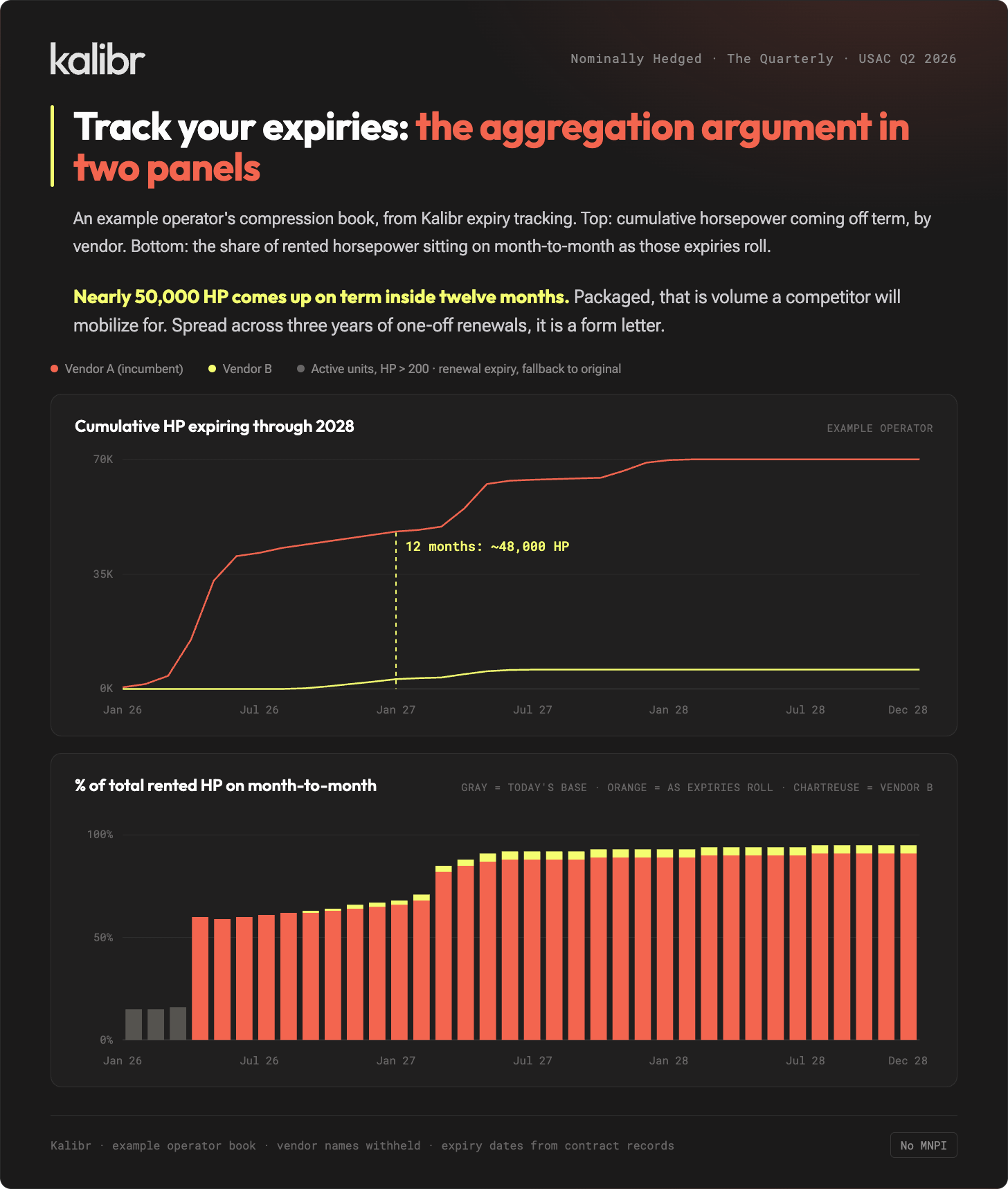
If USAC is your incumbent, build the curve first. Track the expiry date on every contracted unit you run, then package everything coming up on term over the next twelve months into a single negotiation. The chart above is an example operator’s book: nearly 50,000 horsepower comes up on term inside twelve months, and within six months more than half the rented horsepower is sitting on month-to-month. Unit by unit, none of that moves a vendor. Aggregated, it is volume a competitor will mobilize for, and volume the incumbent’s investor deck cannot afford to lose. The sequence matters as much as the volume: bring the aggregated book to market before you sit down with the incumbent. An alternative you have not developed is not an alternative, and you cannot develop one in the two weeks after their renewal letter arrives.
If someone else is your incumbent and you want USAC in. The same curve is your entry ticket. Aggregated volume is what makes a vendor’s best pricing available: USAC has roughly 497,000 idle horsepower and in-house manufacturing capacity, which means they can say yes at scale, and this quarter’s filings say they are motivated to.
If you sell compression against USAC. The filings are your differentiation map. Margin down two straight quarters, roughly $12 million a year of lube-oil cost with no contractual recovery, an integration in the middle innings: those are exactly the pressures that make us worry about where uptime lands (more below). So differentiate on every performance attribute you own: uptime, call-out windows, spares inventory per horsepower. Put 98% runtime and first-call-out guarantees in your initial proposal, priced in, to force the operator to ask the questions back: does USAC’s bid honor the same terms? You want the comparison to happen on the dimension where the 10-Q says your counterpart is squeezed.
And in every chair: negotiate the package. The most expensive mistake in vendor negotiation is sequencing. You settle price and horsepower, you award the work, the other bidders stand down, and then the “contract details” conversation starts: first call, uptime guarantees, the right to downsize or swap without penalty. By then you have no leverage left, and each detail gets traded away one at a time. Price, term, volume, and every service and performance term move together, at one table, at the moment your alternatives are real. We run this as multiple equivalent simultaneous offers (MESOs): several packages on the table at once, varying the things the vendor values against the things you value, so every trade is visible and priced. The quarter you are about to read makes one of those packages unusually powerful, because USAC just told the market exactly what it values.
The Eleventh Minute
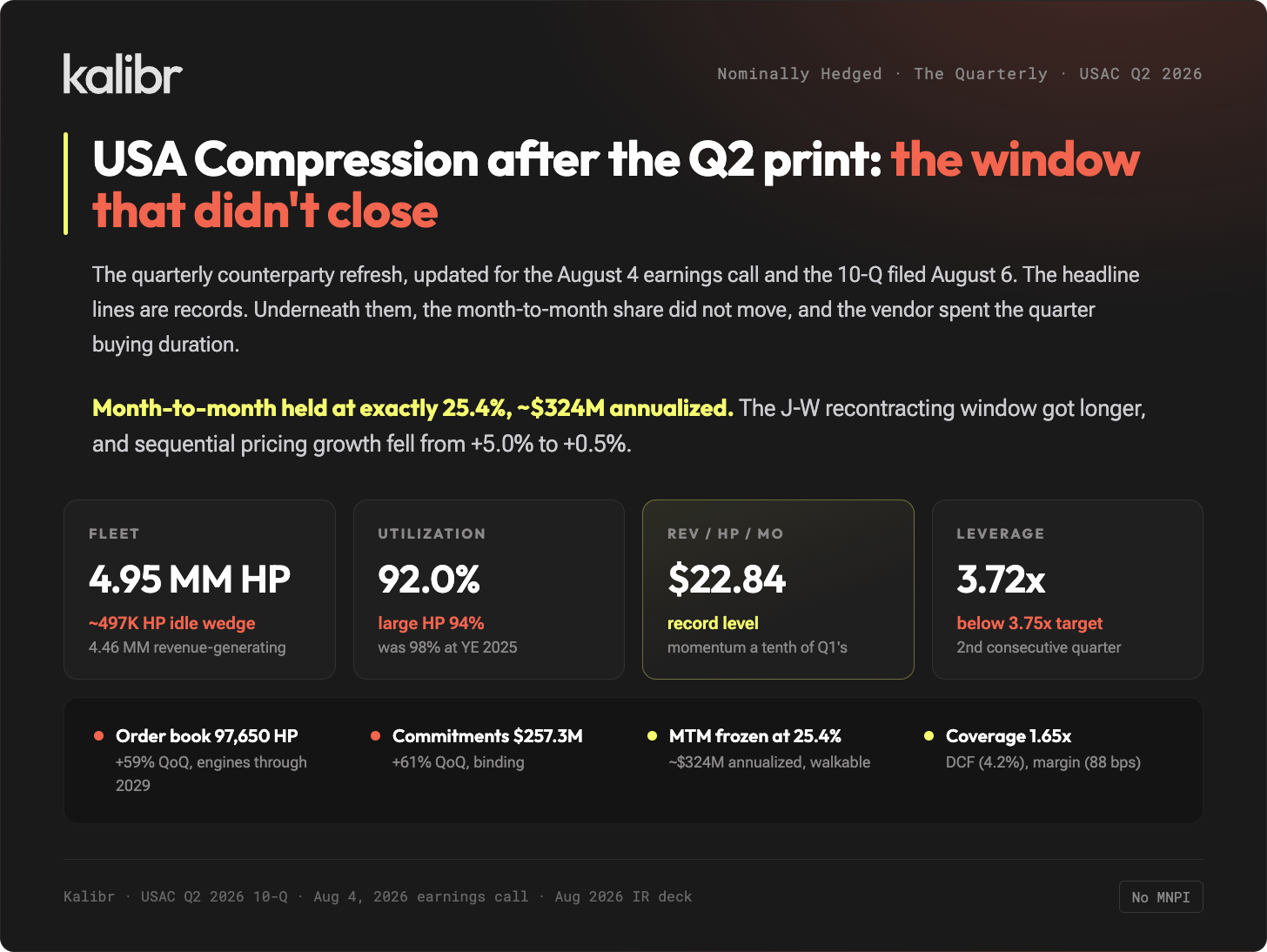
The headline print was serene. Record revenue of $342.1 million, record adjusted EBITDA of $193.2 million, a 1.3% consensus miss forgiven by lunchtime, guidance reaffirmed on every line for the third consecutive quarter, leverage down to 3.72x. The distribution didn’t move. It never does.
The usable material surfaced eleven minutes into the Q&A, when Citi’s Doug Irwin packaged a question about lube-oil costs with one about medium-term pricing. Chris Wauson, USA Compression’s chief operating officer, got to the pricing half and said this: “Our new units, we’re still contracting units at a healthy rate of return. In regards to more of an idle unit set, we’re not seeing the price increases that we once have experienced.”
Nobody asked about the idle set. The distinction was volunteered, and volunteered precision is the most informative kind. The sell side mostly kept typing: Raymond James’s same-day note printed sequential pricing growth of 3.6%, while the company’s own figure, stated in the 10-Q, repeated on the transcript, and copied correctly by Mizuho, is 0.5%. (When a bank can miss the quarter’s most consequential datapoint by a factor of seven on the day it prints, that datapoint is not priced in.)
Two numbers organize everything that follows. The one that collapsed: sequential pricing growth, +5.0% in Q1 to +0.5% in Q2. And the one that refused to move: month-to-month revenue, frozen at 25.4% of the book. Read together they describe a vendor that is strong where you order new iron, weak where you renew existing iron, and desperate for one commodity across the entire book: duration.
The Number That Didn’t Move
The month-to-month pool held at 25.4% of contract-operations revenue. To the decimal. That is $81.1 million in the quarter, roughly $324 million annualized, the largest walkable revenue base in the sector by a wide margin.
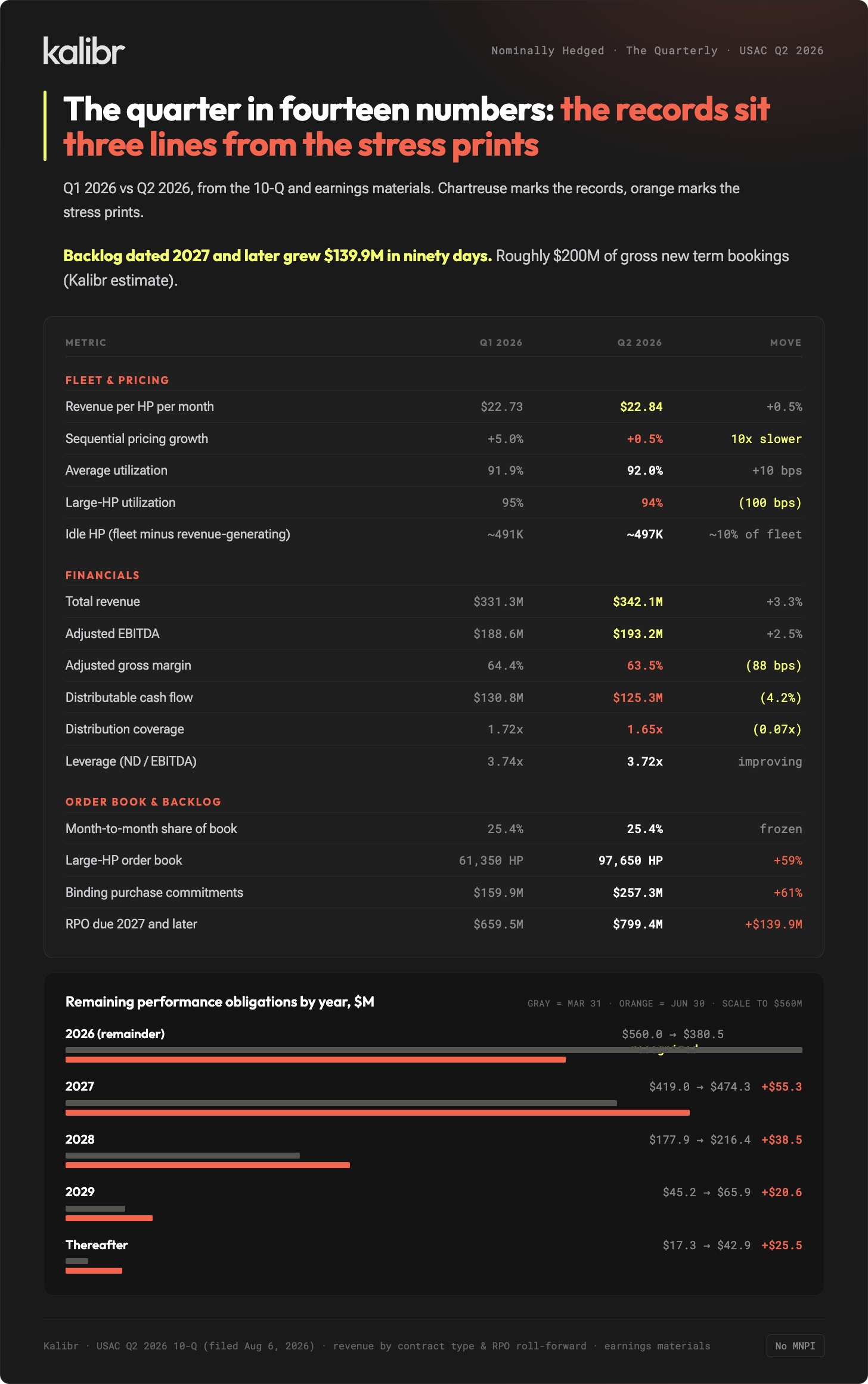
In May I read USAC’s conversion campaign as a window closing on J-W-legacy operators: the vendor was standardizing terms, the walkable book would shrink, move before it did. The campaign is real, and it is enormous. Backlog dated 2027 and beyond grew $139.9 million in ninety days ($55.3 million added to 2027, $38.5 million to 2028, $20.6 million to 2029, and $25.5 million past that). Back the quarter’s recognized revenue out of the roll-forward and USAC booked roughly $200 million of gross new term contracts in a single quarter (Kalibr estimate). The August investor deck now advertises 75% of revenues under primary terms of two to five years.
And the pool did not shrink. That is the revision this quarter forces: the conversion campaign is running flat out, and the month-to-month share still printed 25.4%, identical to Q1, because contracts are rolling off primary terms into month-to-month at almost exactly the rate the campaign converts them to paper. The treadmill runs; the window stays open. Legacy J-W operators hold more walk-away optionality, for longer, than the May read implied, and I am correcting that read in public because the correction is the opportunity.
Do not mistake a stable share for a stable position, though. Your specific units convert the day you sign their letter. The pool refills behind you; your optionality does not. USAC is spending $257 million of binding purchase commitments and re-ranking its own distribution to buy duration, which tells you precisely what your signature is worth to them. Roughly $140 million of walkable book converts to term paper every quarter, and Wauson described the campaign’s focus on the call: “standardized terms, tenure and pricing.” Arrive ahead of it and you write your own conversion terms; wait, and you receive theirs.
Below the line: what the exchange-rate move is worth in your next renewal, where the sold-out order book is actually going (Kalibr census work), the margin squeeze that funds your discount, the six-part negotiation playbook, and the re-rated leverage map.