


Why You Should Listen to a Small-Town Central Pennsylvania Boy
Last week I published an award table from an Eagle Ford compression engagement that closed in July, with the names removed and the figures exactly as they signed: $3,476,479 a year off the committed book, a 12.7% reprice on every unit the incumbent kept, a mechanical-availability guarantee moved from a 96% run rate to a contractual 98%, and one row that went the wrong way, published anyway, because real award tables have one. What earns a small-town central Pennsylvania boy the right to publish numbers like that is a process, built outside this industry with a world-renowned negotiation expert and run through hundreds of oil and gas agreements since: a census reads the basin unit by unit, a leverage screen reads the counterparty’s filings, and a normalized RFP forces every bid onto one all-in number. The outcomes are bought with the vendor’s own financial position, understood earlier and in more detail than the vendor expects across the table.
That is the standing thesis of this series, and I will keep repeating it: reading the filings is not the edge. Converting them into deal structure is. This issue runs the diagnostic on Kodiak Gas Services, whose second quarter (reported August 7, 10-Q filed the same day) is the strongest print any compression vendor will file this season. With USA Compression last week, the filings disclosed weaknesses and the job was pricing them. With Kodiak, the filings disclose strength almost everywhere, and the job is finding the places your leverage survives, because there are fewer of them every quarter and the quarter just told us the closure rate. A weak counterparty would forgive sloppy preparation; this one charges for it.
The Counterparty Read runs this diagnostic on each of the major compression vendors as they print. Paid subscribers get every read.
How to Use This Data
Every negotiation has two walk-aways: the vendor’s and yours. The vendor’s is the question this piece answers: if Kodiak loses your renewal, who takes the iron, at what rate, and how fast? The full frame, chairs and all, ran in last week’s USAC read; below is only what changes when the counterparty is Kodiak. Start with the gap: a fleet running 98.2% utilized with roughly 82,000 idle horsepower on 4.5 million re-lets your unit before the demob crew has left your pad, so the walk-away you build carries more of the load here than in any other read we publish.
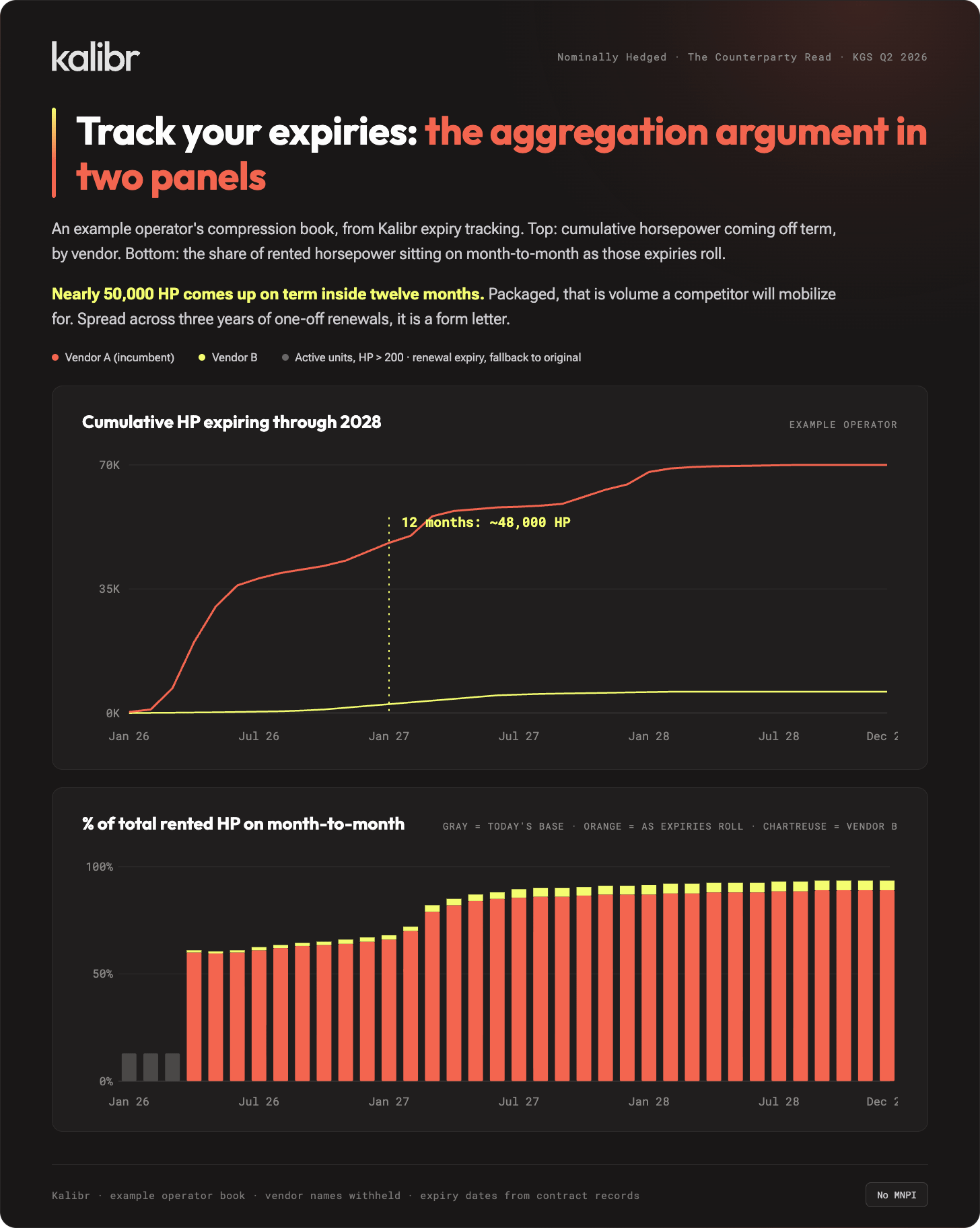
If Kodiak is your incumbent: map every expiry, package the next twelve months of renewals into one negotiation, and go to market before the term-conversion letter arrives, because this quarter proves the letters are going out and being signed. Unit by unit you are a rounding error on a 4.5-million-horsepower fleet; aggregated, you are the thing their investor deck promises never to lose.
If you want Kodiak in: entry runs through the order book, because there’s no idle fleet worth naming. Half of the 2027 new-build deliveries are already contracted and 2028 is selling now; what gets you the other half is looking like the customer Kodiak’s own screen selects for. The CEO described that screen on the call, in public, and most of his customers were not listening.
If you sell compression against Kodiak: their print is your map of where not to fight. Bid availability inside twelve months (their lead times are about 200 weeks), the small and mid-size classes they keep divesting, basins outside their declared core, and electric drive, where Kodiak has now gone two consecutive earnings calls without a word.
And in every chair, negotiate the package, as multiple equivalent simultaneous offers: price, term, uptime, first call, swap and downsize rights, escalators, all at one table, at the moment your alternatives are real. This print tells you precisely what Kodiak values, which is what makes the MESO conversation unusually easy to design against them.
A note for midstream readers: Kodiak’s book is roughly 70% midstream by customer mix, so most of what follows is about you, and the aggregation math works harder for you, because your books are bigger and your insourcing threat is structurally more credible than an E&P’s.
Not a Bad Thing Either
The find this quarter came out of an ordinary compression question. Citi’s Doug Irwin asked about demand for longer-duration contracts, referencing a peer’s eight-year midstream deal, and whether Kodiak might keep terming out its fleet. CEO Mickey McKee said yes, they would love to, and then kept going:
“It’s really kind of a customer-by-customer preference here. So some want to keep them a little shorter to preserve some optionality, which in our minds is not a bad thing either because it gives us the ability to churn the fleet a little bit and kind of high-grade customers there if we want to do that.”
That sentence retires an assumption your renewal strategy may be built on. The standard operator model of a short term is optionality that belongs to you: stay walkable, keep the vendor honest, preserve the exit. The investor-relations reading of McKee’s answer fits that model fine: customer preference, cheerfully accommodated. That’s not how I would put it. I would put it as: at 98.2% utilization and 200-week lead times, a month-to-month unit is an option held by whichever side can replace the other faster, and the CEO just told you, unprompted, which side he believes that is.
“High-grade customers” is a vendor saying it grades customers, and the grading makes sense once you say plainly what this industry is: real estate masquerading as reciprocating engines. Ride the landlord logic one step and churn is a dream vacancy (the unit comes back, the street rate went up while it was out, and a building ordered today opens in 2030). Ride it a second step and the tenant roster is the strategy: a building good enough to attract Fortune 10 tenants, whose rent clears in any commodity environment, fills itself with them, all day of the week, and lets everyone else find other space. If you are a financially fortified E&P that is not yet a majority-Kodiak book, that cuts in your favor: you are the tenant the building wants, and this print is your invitation to negotiate like it. If you are anyone else, your position has to run through the few weaknesses the filings disclose, and one of them is geographic: a well-established operator in the Eagle Ford holds a card the Permian names do not, and the playbook below prices it. The rest of the quarter agrees with McKee, in ways the paid half walks through line by line.
None of the five broker notes in our file carries the sentence; they were filed before the call or on the print itself. The market priced the record EBITDA; the vendor’s stated willingness to let your contract expire is not in anyone’s model yet.
A Billion Dollars in Ninety Days
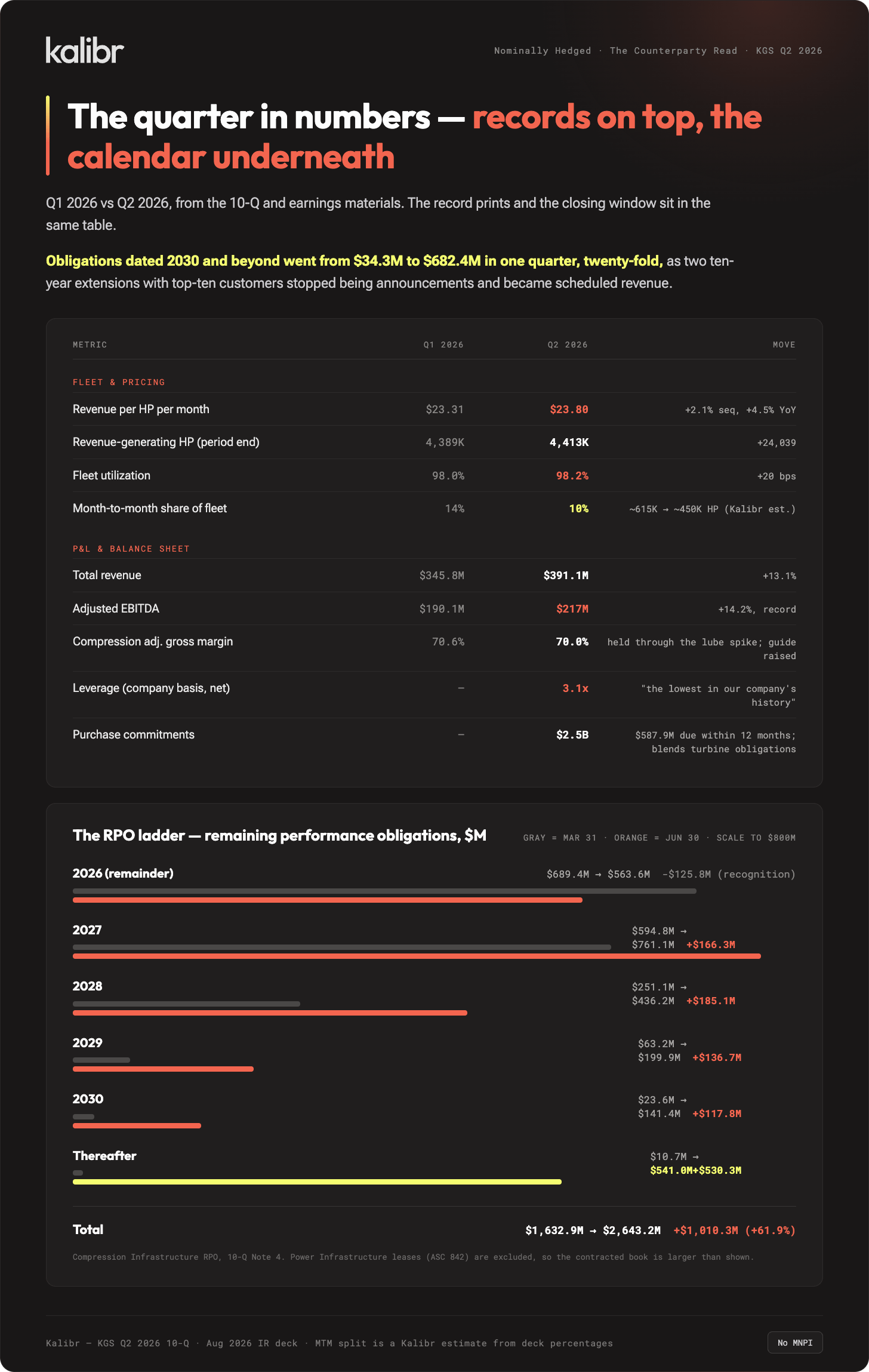
The headline numbers were loud enough: revenue of $391.1 million, adjusted EBITDA of $217 million, a company record, above every published broker estimate (JPMorgan, at $214 million, called it in-line; the other four scored it a beat). But the number this file will still care about in 2028 sits in the revenue footnotes. Remaining performance obligations in the compression segment grew from $1,632.9 million to $2,643.2 million in one quarter. That is $1,010.3 million of new contracted future revenue, up 61.9%, in ninety days, and once you add back the revenue Kodiak recognized out of the ladder during the quarter, it implies something like $1.3 billion of gross new term bookings (Kalibr estimate, order of magnitude). Call it a hair over $11 million of new term signed per day, weekends included.
Now look at where the billion sits on the calendar. Obligations dated 2030 and beyond went from $34.3 million to $682.4 million, twenty-fold, as two ten-year extensions with top-ten customers stopped being announcements and became scheduled revenue. For scale: USA Compression’s term-conversion campaign, which I covered last week as a genuine machine, added $139.9 million of out-year backlog in the same ninety days. Kodiak added roughly eight times that, on a fleet about nine-tenths the size.
Three months ago our Q1 Kodiak file told operators the month-to-month pool was the best asset in the book: 14% of the fleet, roughly 615,000 horsepower, contractually walkable, the largest negotiable surface Kodiak had carried since 2024. I need to update that advice while it still matters. The Q2 deck prints month-to-month at 10%. Roughly 450,000 horsepower remains (both figures are Kalibr estimates from investor-deck percentages; the 10-Q does not disclose the split, and I wish it would). The difference, about 165,000 horsepower a quarter, is the rate at which expiring iron is rolling into term paper instead of rolling free. The window is still open. But it’s closing on a printed schedule: two more quarters at the observed pace and the walkable pool is back to its 2023 floor, at which point the churn sentence above stops being commentary about the fleet and becomes the standing answer to your renewal call.
Below the line: what the closing window prices your duration at, the balance sheet that is now shopping for your compressors, the inventory read on Kodiak’s customer base and what it means for your chair, the eight-part negotiation playbook, and the re-rated leverage map.