


The Season’s Hardest Read
This is the third vendor print of the season, and the hardest one to read. USA Compression disclosed its weaknesses in public, and the job was pricing them. Kodiak disclosed strength almost everywhere, and the job was finding the places operator leverage survives. Archrock filed both at once: the only guidance cut any major compression vendor took this quarter, and the largest single compression services contract any of them has ever disclosed, in the same 10-Q. A reader who takes the vendor’s framing gets a growth story. A reader who takes the banks’ gets a miss. (Three of the four notes in our file lead with that word, and all four were finished before management picked up the phone: JPMorgan’s credit desk published on the release August 4, and Wells Fargo, Mizuho, and Texas Capital all dated their notes August 5, pre-call.) The read that survives contact with the filing is neither, and it’s worth more than either.
The proof of method lives in the first two reads and in the Eagle Ford award table we published in July, names removed, figures exactly as signed. I won’t re-run the credentials each issue; the standing thesis of this series does that work: reading the filings is not the edge. Converting them into deal structure is. This issue runs the diagnostic on Archrock.
The Counterparty Read runs this diagnostic on both vendors (for Operator negotiations) and Operators (for OFS sales) as they print. Paid subscribers get every read.
How to Use This Data
Every negotiation has two walk-aways: the vendor’s and yours. The full frame, chairs and all, ran in the USAC read; below is what changes when the counterparty is Archrock. Start with the paradox the balance sheet hands you. This is the financially strongest vendor of the three (2.6x levered against Kodiak’s 3.1x and USA Compression’s 3.72x, positive outlooks at all three rating agencies), and it’s also the one with the most legible structural need: $868.9 million of equipment purchases already committed, a $1.4 to $1.6 billion build declared through 2030, and a fleet whose contracted revenue has to grow into all of it. Kodiak’s scarcity ran the table in last week’s read. Archrock’s appetite for duration runs this one, and duration is a thing you own.
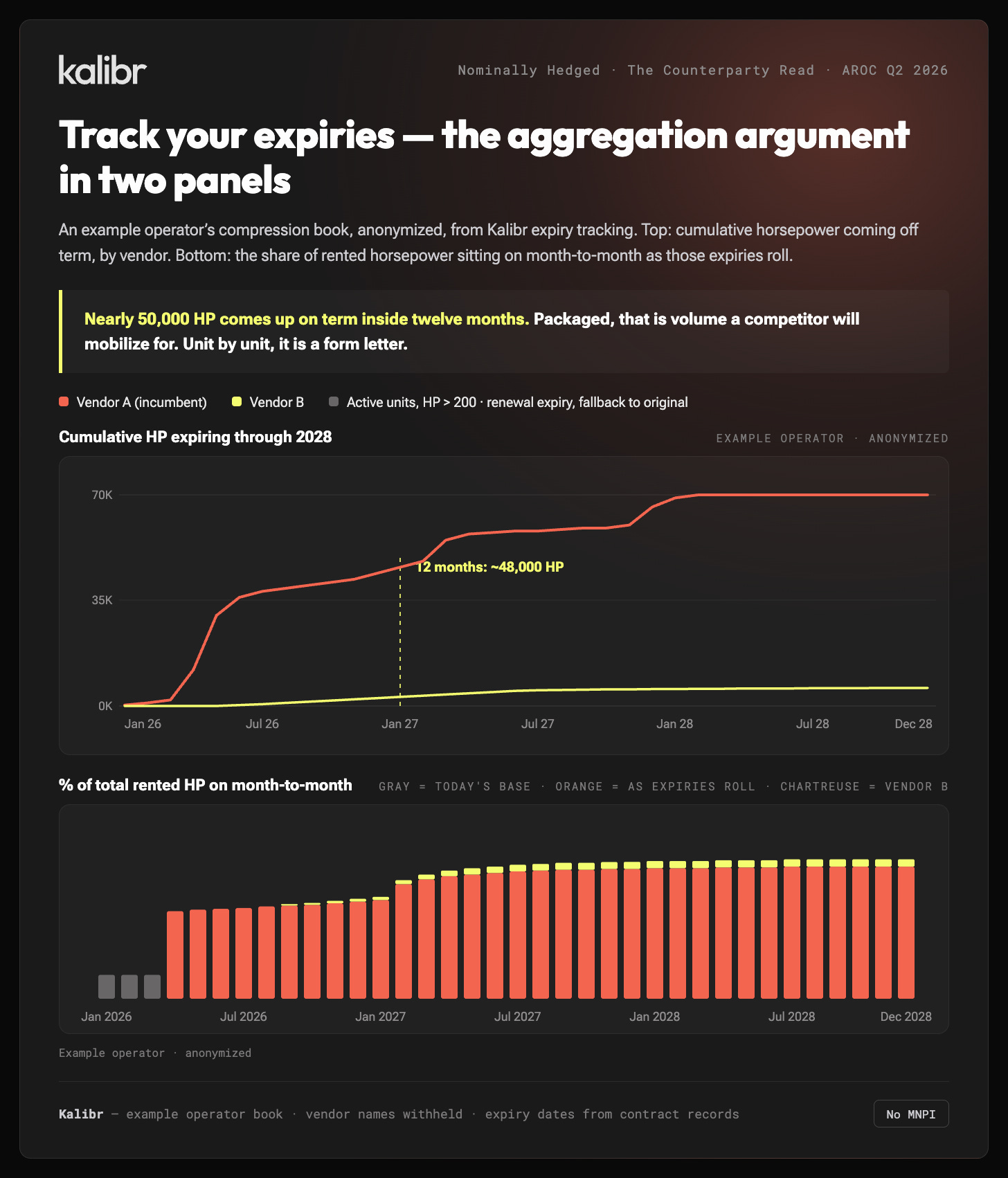
If Archrock is your incumbent: figure out which side of the new 81% coverage disclosure you sit on before their commercial team does the math for you. The term-conversion wave now has a template, a 665,000 horsepower precedent, and a stated executive expectation that “these longer term tenors may be more in the future.” The conversion letter is coming; the question is whether you’ve priced your signature before it arrives.
If you want Archrock in: the diversified footprint is real. Half of recent bookings landed outside the Permian, the NGCS acquisition added depth in Appalachia and the Mid-Continent, and 19% of the fleet is electric motor drive, the only meaningful EMD position among the three majors. If your site holds firm power, this fleet was built with you in mind, and the playbook’s seventh item prices what that is worth.
If you sell compression against Archrock: the openings are at the edges. The sub-1,000 horsepower revenue band shrank 3.0% year over year and the company keeps exiting it; aftermarket customers are deferring overhauls into what will become a queue; and don’t build a pitch on the 94.4% utilization print, because on a like-for-like definition it’s a tighter fleet than the headline suggests (section five walks through the arithmetic).
In every chair, negotiate the package: as multiple equivalent simultaneous offers, with term as the axis this time: this vendor has told you, in an SEC filing, exactly which concession it values most.
A note for midstream readers: the 665,000 horsepower contract is a midstream deal, gathering applications are 61% of Archrock’s horsepower, and the top ten customers are roughly 63% of contract operations revenue. The conversion template was built for your side of the market, and presumably there is a list, and presumably you are on it.
Including With Our Customers
The find this quarter is one sentence of unprompted restraint. The pricing question on the August 5 call drew the answer you would expect from a vendor printing a 71% gross margin: “It’s a very supportive environment for pricing and profitability in contract operations in our business. And you’re seeing that come through with the 71% gross margin we delivered in the quarter and our forecast that even with the headwinds we articulated, we’re going to be at 70% in this current environment.” Standard 2026 compression-vendor contentment. Then Childers kept going:
“I will point out, it’s a competitive market, however, including with our customers. And so we do approach this incredible business to generate great returns for our investors, but we are responsible in how we have those negotiations with our -- and drive that pricing with our customers.”
A quarter ago the same executive’s pricing language was “very happy with the overall pricing in the market,” with no responsibility clause anywhere near it. No peer executive volunteered anything comparable this season: Kodiak’s CEO used his pricing airtime to explain that churn lets him high-grade customers, and USA Compression’s management volunteered a price crack on idle iron. Vendors do not add restraint language to a bullish answer while exercising none. Two readings fit. The generous one: genuine posture, consistent with signing a strategic customer to eight years at a rate nobody will discuss. The cynical one: reputational cover for increases that continue on schedule. The sequential facts lean toward the first, gently: derived revenue per horsepower rose 0.4%, the slowest of the three majors, and the full-year contract operations margin guide came down half a point at the midpoint.
Either way, the sentence now exists on the record with a date attached, and it survives being read back across a negotiating table, which is what you should do with it. Management told the street on August 5 that it prices responsibly in a competitive market that includes its customers. The next Archrock renewal proposal you receive can be measured against that sentence, out loud, in the meeting. None of the four bank notes carries it, because none of the four banks was writing after the call.
Eight Years, Price Undisclosed
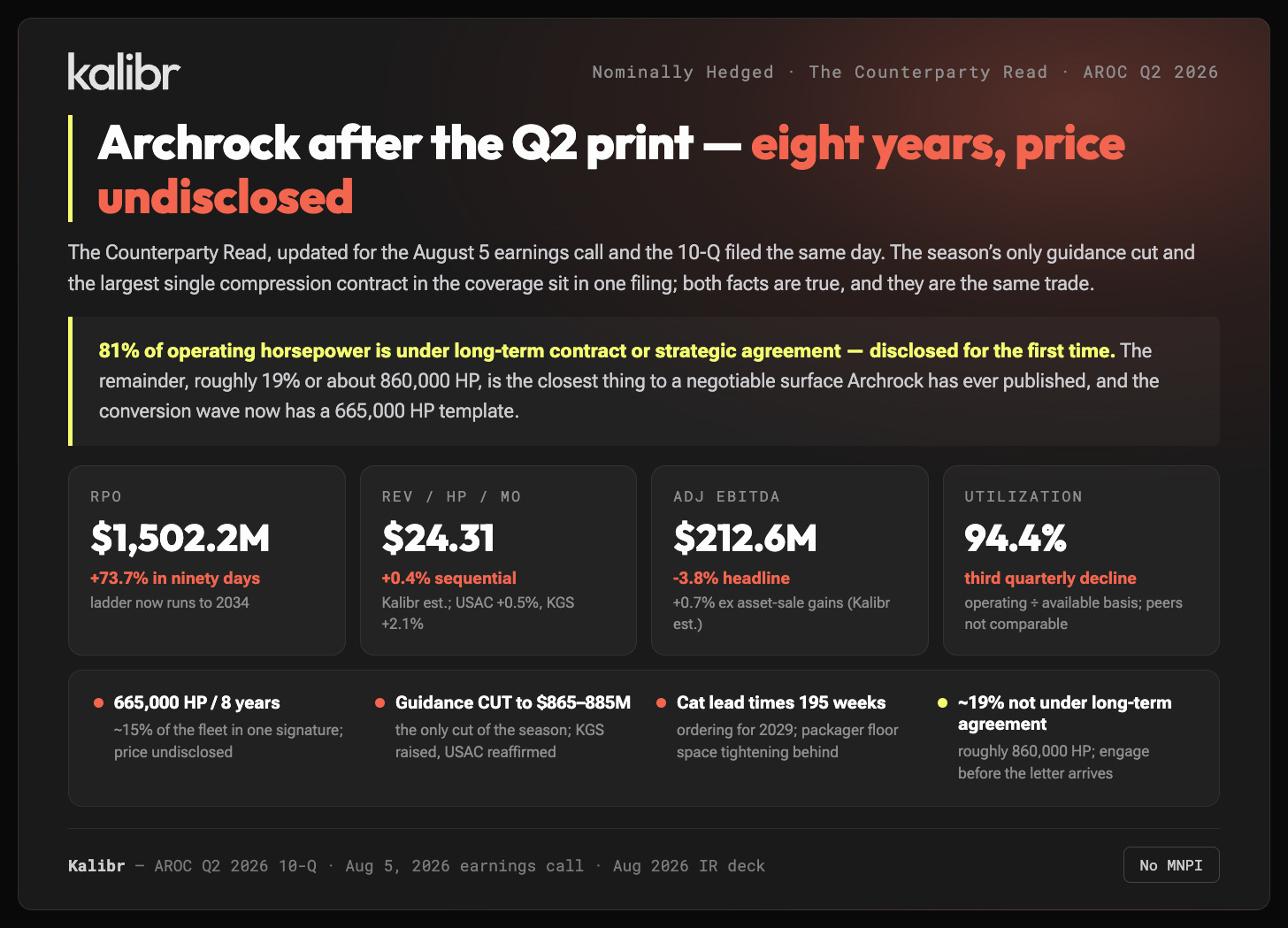
The headline set reads soft in every direction the sell side checked. Adjusted EBITDA of $212.6 million fell 3.8% sequentially and missed every published broker number. Spot utilization slipped to 94.4%, the third consecutive quarterly decline. And the full-year EBITDA guide was cut at the top by $30 million, to $865 to $885 million, in the same week USA Compression reaffirmed and Kodiak raised. The season’s only guidance cut belongs to Archrock, and the paid half of this issue prices how much of it is real. (Less than the notes imply. You should still spend none of it carelessly.)
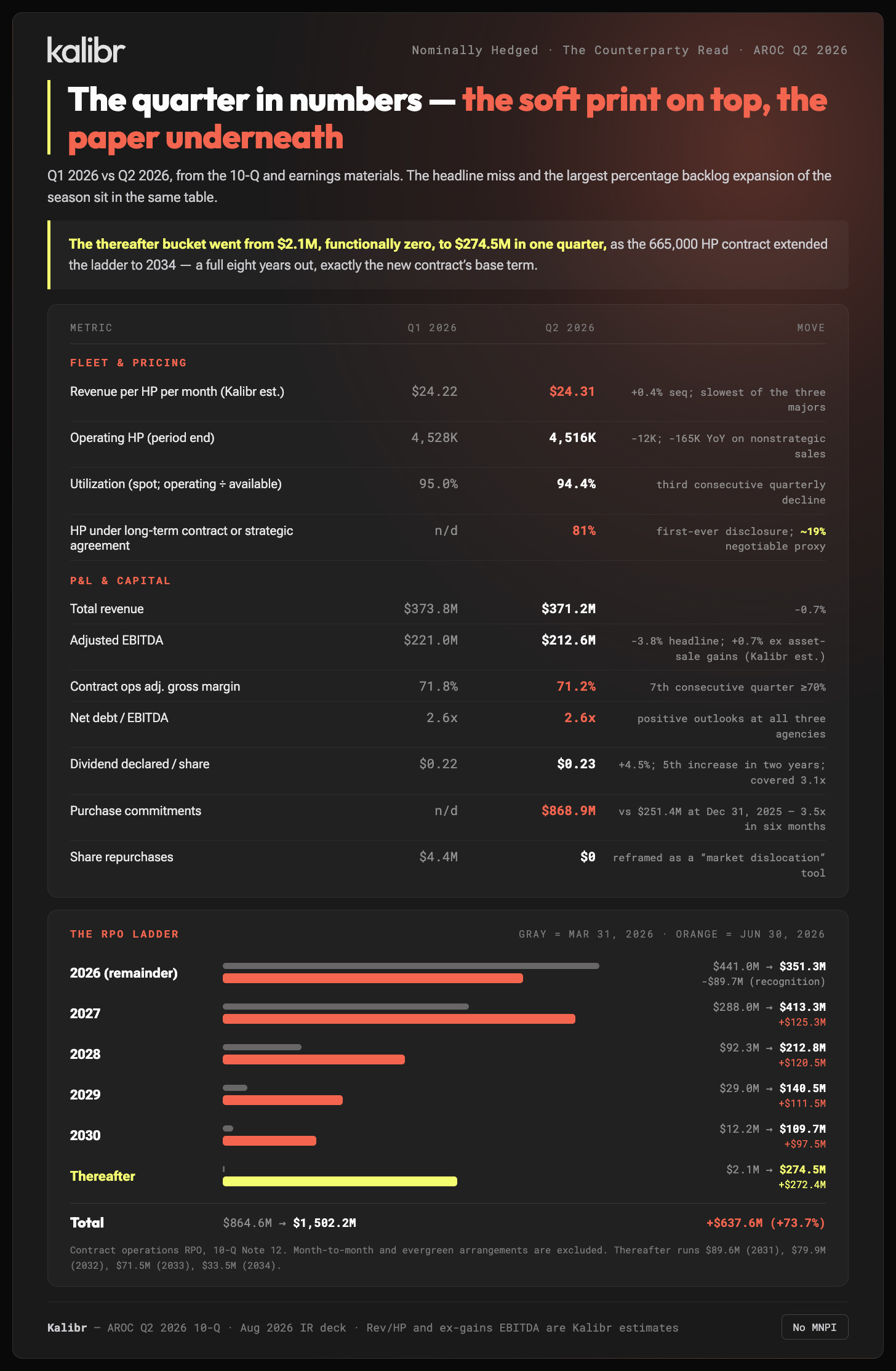
Then there is the other thing in the filing. Childers, prepared remarks: during the quarter Archrock signed a long-term contract with an existing strategic customer covering “approximately 665,000 horsepower for midstream applications,” on “an 8-year base term and a 2-year extension option.” That is roughly 15% of the operating fleet termed in a single signature, the largest compression services agreement any vendor in this coverage has disclosed. Asked for the economics: “Well, look, we’re not going to go into the details of the contract, as you can imagine, just for commercial reasons.”
Below the line: the backlog table that answers the question the CEO wouldn’t, the arithmetic that unwinds the miss (and why you should never cite it first), what a vendor with $868.9 million of ordered iron will trade for your signature, the electric-drive delta nobody prices, the seven-part negotiation playbook, and the twelve-dimension leverage map, re-rated.