


Suppose you sell industrial lubricants and a war breaks out. Not your war; nobody is shooting at a blending plant in Louisiana. But diesel margins blow out, refiners chase them, base oil gets scarce for a season, and your costs go up some. How much do you raise prices? If you have ever run a pricing desk you know that is the wrong question. The right question is: on whom? The passenger-car buyers are leaving for EVs; hold them flat and fight for share. The trucking fleets have index contracts; pay the index, sigh. The industrial accounts have procurement departments and a one-quarter lag written down; take the quarter. And then, at the bottom of the account list, there is a small, wonderful category of customer that runs its equipment 8,400 hours a year, is bound by OEM warranty to a half-dozen approved brands, has never audited an invoice in the relationship’s history, is growing faster than every other segment in your book, and buys through a handshake set up two procurement directors ago. You know exactly what to do, and it isn’t villainy, it’s pricing. Everyone in this story knew what to do. In the second quarter they did it, more or less simultaneously, and the receipts printed in the same two weeks of earnings calls.
Archrock’s receipt printed first, an August 5 8-K cutting full-year EBITDA guidance to $865 to $885 million with lube oil inflation named as a cause. Kodiak’s arrived the next morning, when RBC asked CFO John Griggs what margins would have looked like without the headwind, and he did the math live: “You’re going to test my CFO math in public, which scares me,” then, “it’s kind of a $1.5 million a month or so uptick,” call it “what, $18 million of annualized margin.” USA Compression disclosed roughly $1 million a month of the same cost and added the sentence that ought to be laminated and handed to every supply chain team in the sector, from COO Chris Wauson: “We don’t have a direct pass-through in our contract related to increases or decreases in lube oil prices.” JPMorgan titled its Kodiak note “Dude, Where’s My Lube Oil?” Call it $30 million a year of new cost across two companies, with a third cutting guidance over its share.
The calls settled who eats the increase, at least for now. Kodiak absorbs it and holds margin anyway. USA Compression wears it until renewals, and Archrock takes it on a quarterly lag and will hand much of it to operators, since 60 to 65 percent of its contract compression agreements are eligible for annual repricing. The question no analyst asked, on any of the three calls, is whether the increase was priced correctly in the first place. That’s a checkable claim. A gallon of gas engine oil has a bill of materials, the bill of materials has published prices, and you can decompose a price increase the way an auditor decomposes any other invoice.
We did. The justified increase for a well-papered buyer was 3 to 5 percent. The justified increase for a buyer with the worst possible paper was about 21 percent. The collected increase was 26 to 36 percent. The rest of this piece is the arithmetic, the exhibits, and what a compression company (or anyone else writing eight-figure lubricant checks) should do about it before the market does the suppliers the favor of making the whole thing moot.
Nominally Hedged reads supplier paper so the people writing eight-figure lube checks don’t have to. Tuesdays, 6:00am Central.
A Gallon of Gas Engine Oil Has a Bill of Materials
A frame-class Caterpillar running 8,400 hours a year drinks 0.15 to 0.25 gallons of engine oil per operating hour, which works out to roughly a gallon per horsepower per year across a fleet. Kodiak Gas Services runs 4,413,451 revenue-generating horsepower at 98.2 percent utilization: call it four million gallons of low-ash natural gas engine oil a year, arriving by tanker truck from the Delaware to the Haynesville, and, by the company’s own May 2025 disclosure, about 16 percent of its total compressor operating expenses. That is the account the pricing desk was looking at.
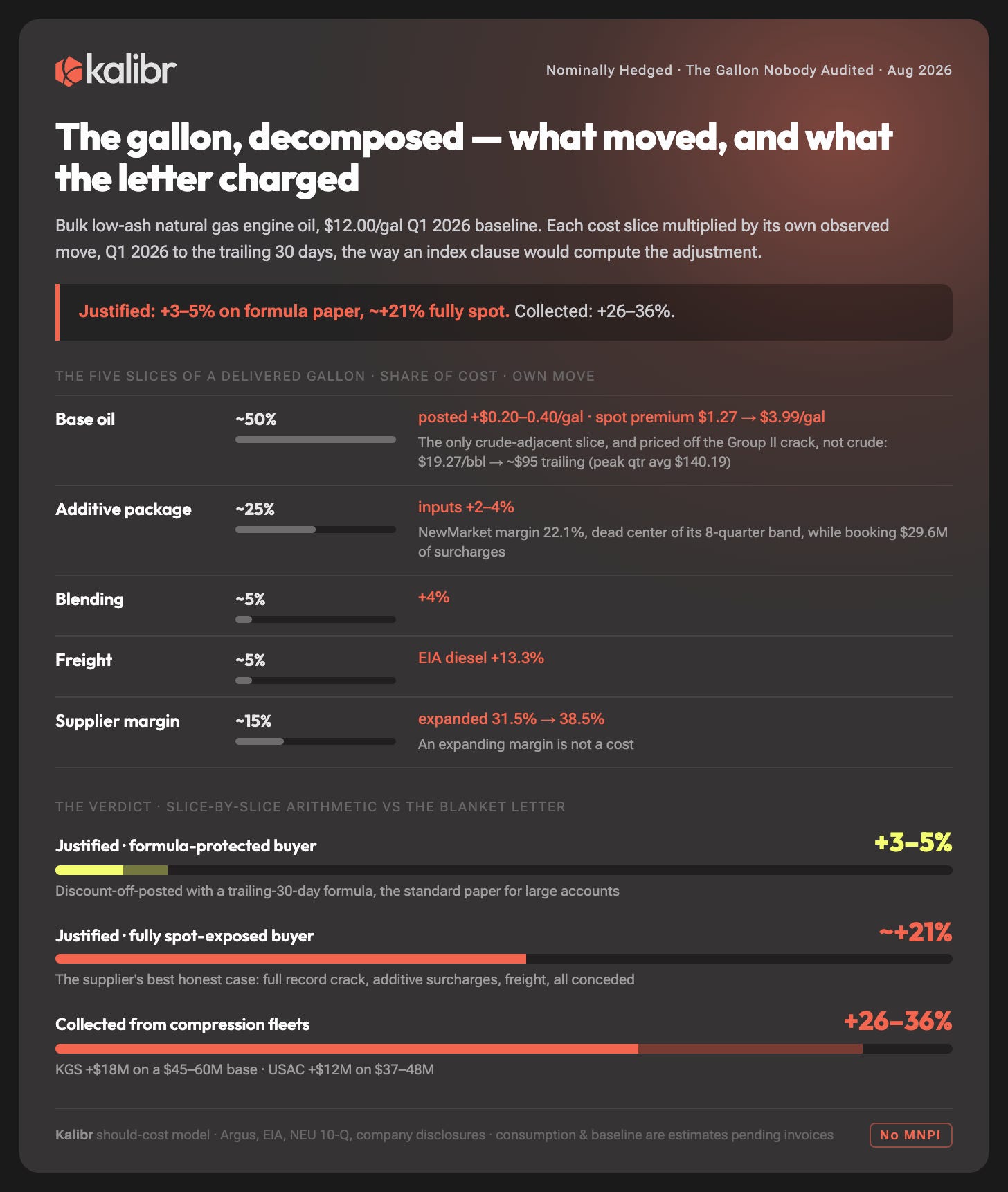
The gallon itself is a recipe. By volume, 85 to 90 percent of a low-ash NGEO is base stock, high-viscosity Group II paraffinic oil out of Gulf Coast and Ontario refineries. By cost, base stock is only about half the delivered price. The additive package (the detergent, dispersant, and anti-wear chemistry that keeps sulfated ash near half a percent so the engine’s valves survive) is 10 to 15 percent of the volume and roughly a quarter of the cost. Blending is about 5 percent, freight about 5 percent, and the marketer’s margin sits around 15 percent. These shares are not contested territory; in our research the suppliers’ own best-case framing conceded the same split.
Now walk the slices through 2026, from the Q1 pre-conflict baseline to the trailing 30 days.
Crude moved 23.5 percent, WTI $71.98 to $88.90. That is the number in every price-increase letter, and the letter is a genre worth describing: one page on supplier letterhead, regret in the first sentence, the war in the second, an effective date at the bottom, and a theory of your gallon that amounts to “crude is up, so oil is up.” Which would be a fine theory for a product priced off crude. Base oil is priced off the spread refiners earn for turning vacuum gasoil into base oil instead of diesel, and in the second quarter it went vertical: the Group II crack over VGO ran $19.27 a barrel in the first quarter (against a three-year average of $28.50) and averaged $140.19 at the peak of the second, with the trailing 30 days near $95. Argus’s assessment of the Group II N100 premium set a record at $3.99 a gallon, from $1.27 in 2025. The mechanism matters more than the magnitude. When the war blew out middle-distillate margins, refiners pushed hydrocracker feed toward diesel and jet, and base oil output got starved. Nothing was destroyed. The 2022 spike ran on permanent refinery closures; this one runs on a yield decision, and a yield decision reverses when the incentive does. The global base oil market clears at something like 60 to 65 percent of nameplate capacity in normal times (one desk’s arithmetic, but nobody disputes the direction), and Argus was already printing easing Group II margins by early July.
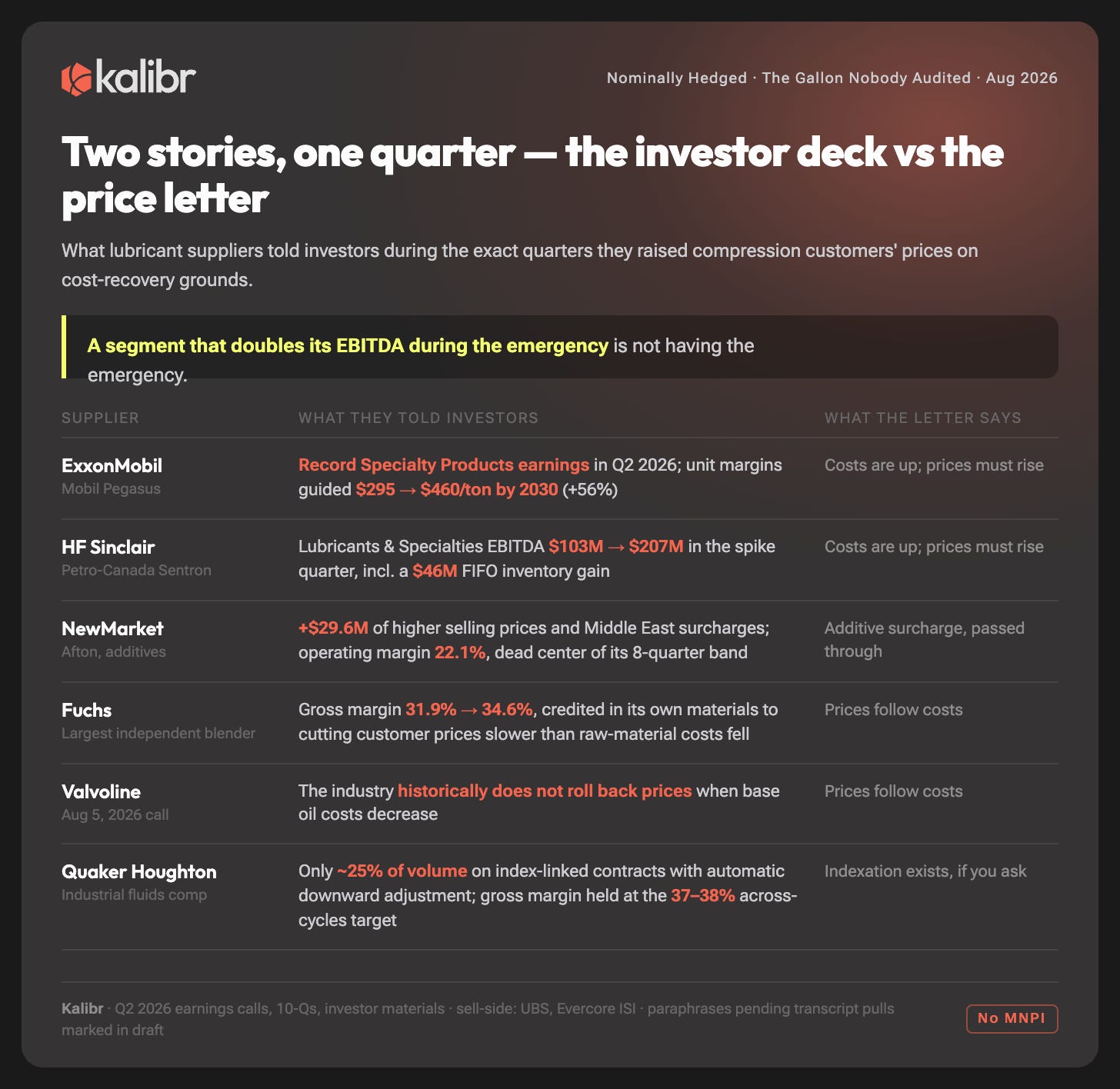
Additives are the half of the story nobody reads. Four houses supply roughly 85 to 90 percent of the world’s additive packages: Lubrizol, Afton, Infineum, and Oronite. ExxonMobil and Shell own Infineum 50/50. Chevron owns Oronite outright. NewMarket, Afton’s parent and the only public pure-play, is the disclosure window into the oligopoly, and its Q2 filing is unusually frank for a 10-Q: petroleum additives revenue up $29.6 million on higher selling prices and Middle East surcharges, operating margin 22.1 percent, dead center of an eight-quarter band that runs 18.3 to 23.7. The underlying raw-material basket moved 2 to 4 percent. A surcharge that lands on a flat margin is a price increase that has been renamed, and two of the four houses charging it are owned by the same companies selling you the finished gallon.
The small slices: blending costs moved about 4 percent on utilities and labor. Freight tracks the EIA on-highway diesel series, which went $4.05 to $4.59, up 13.3 percent, on a 5 percent share. And the marketer’s margin did move this year. It expanded, 31.5 to 38.5 percent gross at the blender level during the spike. An expanding margin is a lot of things, but it isn’t a cost.
So do the arithmetic the way an index clause would. Each slice times its own move. A formula-protected buyer, meaning an account on discount-off-posted paper with a trailing-30-day pricing formula (the standard large-account structure, by our read, typically 12 to 25 percent off posted), saw posted base oil rise $0.20 to $0.40 a gallon: the justified increase on the finished product works out to 3 to 5 percent. Grant the supplier everything instead. Assume the blender bought every barrel at the record spot premium, concede the full $2.72-a-gallon base oil move, the additive surcharges, the freight: about 21 percent. That is the supplier’s best honest case, and it is the ceiling.
What was collected: Kodiak’s $18 million, against an annual lube spend its own 16-percent disclosure brackets between $45 and $60 million, is an increase of 30 to 36 percent. USA Compression’s $12 million on a $37 to $48 million base is 26 to 32. Our model, run on fleets of those sizes with those disclosed increases, puts the overpayment against formula-protected pricing at roughly $15 million and $10 million a year, and even against full spot exposure, the floors are $5 to 7 million and $2 to 4 million. Those are ranges because two inputs (gallons per horsepower, baseline price per gallon) are estimates until someone hands us invoices; the overpayment holds anyway, because the disclosed increases are printed facts and the assumptions only move the small number being subtracted.
The Investor Deck and the Price Letter Disagree
When a supplier raises your price on cost grounds, the most useful thing you can read is what that supplier told its investors the same month. The 2026 lube panel makes this unusually easy, because the spike quarter and the earnings cycle landed together.
ExxonMobil sells Mobil Pegasus and printed record Specialty Products earnings in the second quarter, on what it described to investors as tight basestock markets and integrated refining margins. A UBS deep dive from late July lays out the plan: unit margins of $295 a ton in 2024 growing to $460 by 2030. A division guiding a 56 percent unit-margin expansion has its cost recovery scheduled through 2030. The increase is the margin plan arriving early, with a war for a cover story.
HF Sinclair, which sells Sentron, is the clearest print in the set. Its Lubricants and Specialties segment posted $103 million of adjusted EBITDA in the first quarter and $207 million in the second, the spike quarter, helped by base oil price increases and a $46 million inventory gain. The company is simultaneously retiring most of a 15,600-barrel-a-day base oil unit in Ontario and contracting to import Group III from South Korea instead, a pair of moves the industry files under supply discipline. That’s not how I would put it. A refiner shutting its own base oil capacity in the middle of a base oil shortage, and replacing the barrels with imports, has told you what it expects scarcity to be worth once the letters stop working.
The pass-through record going the other direction is where it gets almost funny. Economists who study gasoline stations have a name for retail prices that surge with input spikes and drift down long after inputs collapse: rockets and feathers. The finished-lubricants industry runs the pattern at institutional scale and has started admitting it in public. Fuchs, the largest independent blender, expanded gross margin from 31.9 to 34.6 percent into 2024 and attributed it, in its own investor materials, to cutting customer prices slower than its raw-material costs fell. Valvoline told investors on its August 5 call, in the middle of this cycle, that the industry historically does not roll back prices when base oil costs decrease. And the 2023-24 record backs them: base oils fell 15 to 20 percent, finished lubricant prices fell 3 to 5, with a lag of six to nine months.
Quaker Houghton proves the alternative exists inside the industry’s own book. About a quarter of its volume sits on index-linked contracts that adjust downward automatically on a 30-to-60-day lag. The other three quarters is freely negotiated, which is how the company holds gross margin at its stated 37-to-38-percent across-cycles target. Indexation with symmetry is a product the industry already sells, to customers who insist.
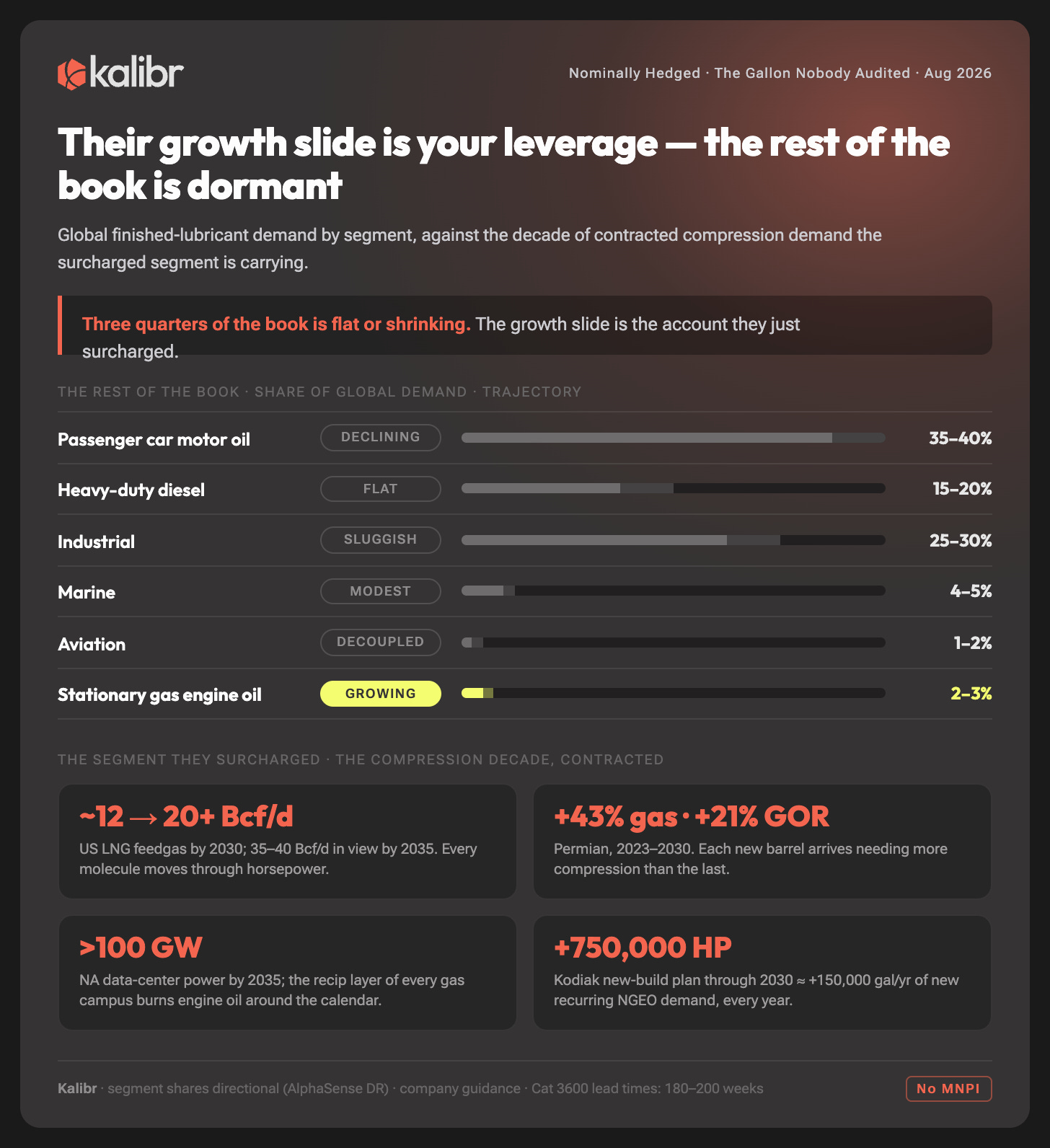
The demand data confirms that the pricing desk at the top of this piece is not a hypothetical. Around three quarters of global lubricant volume (passenger car oils at 35 to 40 percent of demand, heavy-duty diesel at 15 to 20, industrial at 25 to 30) is flat, declining, or contractually resisting increases, just as the account-list walk would predict. Stationary gas engine oil is 2 to 3 percent of global demand, growing mid-to-high single digits, locked to OEM approval lists, burned by fleets running at 94-plus percent utilization that can’t idle a unit over an oil dispute. The 2026 adjustment ran exactly as wide as the paper allowed: customers with index contracts paid the index, and customers without paper paid the letter.
Anyway: we’ve run this movie before, one industry over. This spring a production-chemicals supplier sent one of our clients a tiered surcharge pegged to WTI, 10 percent at the prevailing crude tier, justified by a list of feedstock inflation claims. Decomposed slice by slice, the justified number was closer to 6, the tiers had no downside participation, and the client ended up paying neither, in part because the supplier’s own filings guided margin expansion in the same breath. The lube version of that contradiction is larger, better documented, and sitting in the public record right now.
Same Molecule, Three P&Ls
The same input shock hit Kodiak, Archrock, and USA Compression in the same quarter, and the results came back like a controlled experiment.
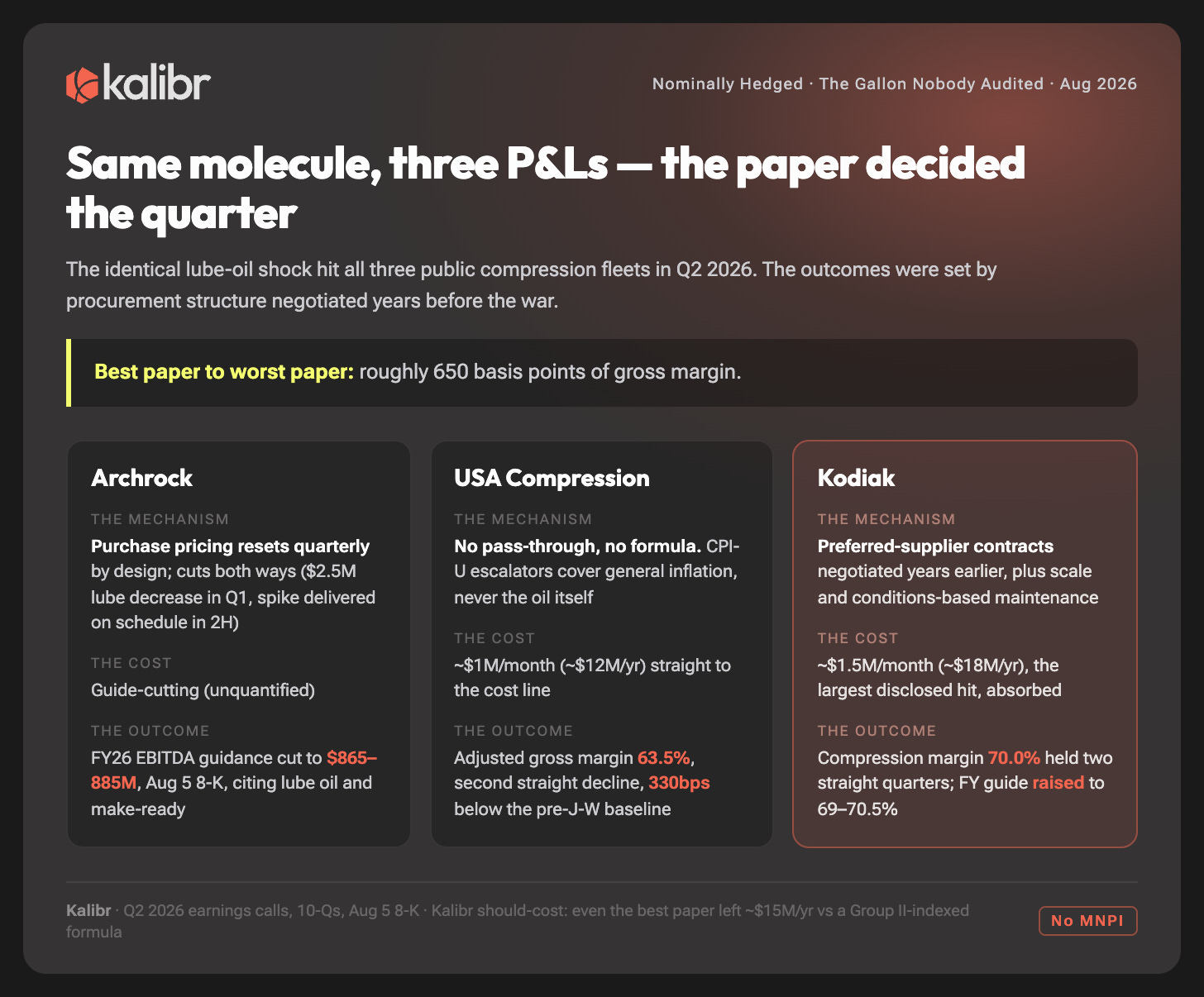
Archrock’s purchase pricing adjusts quarterly by design; CEO Brad Childers had told the street back in the first quarter that lube pricing “adjusts quarterly” and the headwind would land in the back half. The design cuts both ways: Archrock’s Q1 filings show lube expense falling $2.5 million on lower early-year prices, and then the same reset machinery delivered the spike on schedule, hard enough to feature in an August guidance cut.
USA Compression had no mechanism at all. No pass-through, no formula, roughly $1 million a month arriving directly on the cost line, with CPI-U escalators covering general inflation but never the oil itself. Adjusted gross margin printed 63.5 percent, down for a second straight quarter and 330 basis points below where the book ran before the J-W Power acquisition. The company’s stated synergy target for that acquisition is $10 to 20 million. Its new oil bill is $12 million. The integration program and the lubricant invoice are currently about the same size, which is a sentence nobody in that deal model ever expected to write.
Kodiak bought its outcome years in advance. Preferred-supplier lube contracts, negotiated long before the war, plus scale and a maintenance program the company says breaks things less. It absorbed the largest disclosed hit of the three, $1.5 million a month, held compression gross margin at 70.0 percent for a second consecutive quarter, and raised its full-year margin guide to 69 to 70.5 percent. Management called the supply strategy out by name in prepared remarks: lube oil is a significant component of cost of goods sold, they manage it deliberately through preferred supplier relationships, and the strategy is paying off.
Mostly! The outcome across the three books was decided by procurement paper signed years before the shock, and the range between the best paper and the worst is about 650 basis points of gross margin. The second finding is the one that should bother even the winner. Our should-cost says a formula-protected account running four million gallons a year had a justified increase of $1.5 to $3 million; the disclosed uptick was $18 million. The best lube procurement in the sector blunted the spike; a Group II-indexed formula with fixed adders and a symmetric true-up would have mostly deleted it. The gap between best-in-sector and what the paper could say is roughly $15 million a year, about 2 percent of the winner’s EBITDA guide, recurring, for the cost of a negotiation.
The full read scores the six-brand supplier panel rung by rung, runs the five-move playbook that converts this audit into signed paper, and prices the renewal defense for Compression Providers. Paid subscribers get all of it.
Stepping Over Nickels to Pick Up Pennies
The demand fact that explains why compression got the bill is also the strongest card in reversing it. A supplier surcharges the captive, growing segment because it can. But growth is the one thing that supplier’s own book is short, and a buyer holding a decade of contracted growth is holding something the supplier’s investor deck needs more than it needs this year’s surcharge. In the negotiations we run, this argument is called stepping over nickels to pick up pennies, and your job is to price the nickels out loud.
Look at what the rest of a lubricant division’s book does over the next decade. Passenger car motor oil, 35 to 40 percent of global demand, shrinks as EVs spread and drain intervals stretch. Heavy-duty diesel sits flat and enforces index contracts. Industrial churns sideways. The growth slide at every major’s lubricants division features power generation and gas infrastructure, and it features them because nothing else on the page grows: Shell names them as its unit-margin expansion channels, and ExxonMobil projects $4 billion of cumulative specialty-products earnings growth by 2030 on the product family sitting in your storage tanks.
The compression decade is the other column. US LNG feedgas roughly doubles by 2030, from about 12 Bcf a day of export capacity toward more than 20, with 35 to 40 in view by 2035, and every incremental molecule moves through horsepower. Permian gas production grows 43 percent from 2023 to 2030 while the basin’s gas-oil ratio climbs 21 percent, so each new barrel arrives needing more compression than the last. Caterpillar’s 3600-series lead times run 180 to 200 weeks, which is a very long time to wait for an engine and does not appear to be deterring anyone; the demand is contracted, sitting in order books, and immune to sentiment. Kodiak alone plans 750,000 new large horsepower through 2030, roughly 150,000 a year, with engine slots and shop space secured through 2028. At a gallon per horsepower-year, every year of that deployment adds about 150,000 gallons of new, recurring, never-goes-away NGEO demand, and an account like that compounds rather than renews.
Kodiak can flex a second story the rest of the fleet can’t. Its Distributed Power Solutions acquisition brought a 396-megawatt behind-the-meter fleet built mostly of Caterpillar reciprocating engines averaging 1.9 megawatts a unit, a few hundred thousand horsepower-equivalents of oil-burning engine, including a 100-megawatt Virginia data-center contract that has run above 99.9 percent uptime since 2023. Engines at power duty burn oil around the calendar. Management has told the street it sees 400 megawatts a year of deployment capacity, and the emerging campus architecture keeps reciprocating engines in every build, absorbing the load swings the turbines can’t chase. To a lubricant supplier, that is two growth stories on one invoice, and the second one is the data-center demand curve every energy investor deck opens with.
The materiality math is the same math we ran for a chemicals client this spring. To the supplier, the surcharge is the penny: roughly $15 million a year of margin capture from an account this size, collected by a Specialty Products division that just printed record earnings, on volumes that amount to about 0.2 percent of ExxonMobil’s global lubricant gallons. The account is the nickel: the marquee, compounding, reference-able customer in the only segment on the growth slide, worth something like $300 million over the next five years to whichever supplier holds it, before the power fleet’s gallons and before the next decade of horsepower. And the offer writes itself. Rescind the blanket increase, or replace it with the symmetric index, and in exchange take the growth: locked fleet volume with monthly horsepower-additions forecasts, the co-branded reliability case study your investor materials are missing, first-look pilots on extended-drain formulations across the largest NGEO field dataset in the sector. You can keep $15 million of surcharge this cycle, or you can anchor the account your growth slide is written about, and the RFP that reprices it would be the most-watched lubricant tender in the sector. Make that argument at the regional business unit, where the account is somebody’s whole growth number. At corporate, the 0.2 percent arithmetic runs the other way.
Free readers stop here. Behind the wall: the six-brand panel scored rung by rung (who concedes structure first, who bids to defend a crown, who never defends the number in writing), the five-move playbook from should-cost to signed index, the contract terms that never get conceded, and the renewal defense for operators about to receive this bill secondhand.