


A programming note before we get started.
I have officially launched the paid tier of this Substack, with the first deep-dive dropping this Friday. The content pipeline will stay fluid. I would rather give you the best and latest from our proprietary dataset than stick to a rigid calendar. The rough weekly cadence will look like this:
1. Quarterly breakdowns of the market and every service provider in the space
2. Basin-level reports: HP setting trends, potential primary term expiry pools, performance benchmarking by vendor
3. Relative positioning of CAT and other OEM suppliers feeding the ecosystem
4. General trend analysis on compression-adjacent activity
These will refresh every quarter. My goal is to arm you with the data to close more deals and lower LOE. I have always believed that great commercial negotiation is not about one side beating the other on book cost. It is about creating better vendor-operator pairings based on their relative positioning and strategy that, as a byproduct, produce better cost outcomes for both sides. If there is something you want me to dig into, just e-mail me. I am here to serve my readers.
Easter marks the launch into spring sports in my household, which means I am currently operating as an unpaid Uber driver shuttling between batting practice and field hockey, curating walk-out music for a 7U baseball team whose tastes span Hakuna Matata to Sicko Mode, and trying to maintain the thin membrane of sanity that separates a functioning adult from someone who has just explained to a group of 7-year-olds why we cannot all play shortstop.
It also means explaining to a 7-year-old boy why we cannot do baseball practice, ride our bike, *and* watch a movie all in one night.
This is, whether my son appreciates it or not, game theory. Not the John Nash, Beautiful Mind, write-equations-on-windows version. The real kind. The kind that governs every resource allocation decision from a 7-year-old’s Tuesday evening to a Fortune 500 capital plan.
The principle is simple enough for a child to understand and difficult enough that most companies get it wrong: every time you say yes to something, you are saying no to everything else. Not just the thing you considered and rejected. *Everything* else. The entire universe of alternatives you did not evaluate, did not model, did not even see. All of them are now off the table. And if you say yes to everything? Well, you end up like this. And here is the part that makes it interesting: those alternatives do not vanish. They become available to everyone around you. Your no becomes someone else’s yes. Their yes reshapes a market you may not be watching.
A professor I had in business school used to say: “Tell me how often you say no, and I will tell you how strategic you are being.” I have thought about that line roughly once a week for a decade. It sounds like something you’d embroider on a throw pillow, but it is actually a precise statement about competitive positioning. Strategy is not the things you choose to do. Anyone can make a list of initiatives. Strategy is the things you choose *not* to do, and whether you understood, at the moment you declined them, the full map of what you were giving away.
The hard part is not the choosing. The hard part is tracing the consequences. Because trade-offs do not stay local. They cascade. Your product exit becomes an operator’s procurement constraint. Their constraint becomes a competitor’s market opportunity. That opportunity reshapes demand in an adjacent service category that nobody in the original decision room was even thinking about.
Which is why certain rumors percolating around ESPs could have implications for compression demand.
Let me explain, starting with the aircraft manufacturer that has generated more MBA case studies than a compression vendor has reasons they cannot lower your rate.
Boeing’s Hundred-Billion-Dollar Gift to Airbus
Boeing stopped producing the 757 in late 2004. This was, on paper, a straightforward product rationalization. Sales had slowed. The 737 and 787 programs were where the growth capital was going. The 757 was a tweener: too big for short-haul economics, too small for long-haul prestige. Management made the trade-off.
Nobody panicked. The planes still flew. Airlines had years of useful life left in their existing fleets. The consequences would arrive later.
The 757 fleet aged. Meanwhile, the industry shifted toward flexible point-to-point network strategies, exactly the routes where a 757-class aircraft earned its keep. Boeing had read the market for the 757 as declining. What was actually declining was the hub-and-spoke model the 757 was built for. The aircraft category itself was about to matter more than ever.
Airlines that needed to replace their aging 757s did what airlines do: they bought the best available product for the route economics. They did not care whose logo was on the fuselage. Airbus, which had stayed in the category, was happy to oblige. The A321neo, the A321LR, the A321XLR. Airbus built an entire product family to fill the vacuum that Boeing had voluntarily created.
The mechanism is clean enough for a physics textbook. Manufacturer exits product. Operators run aging fleet. Fleet ages out. Operators shop for replacement. The only credible replacement is a competitor’s product. Market share shifts permanently. What looked like a production decision was actually a gift to Airbus that compounded for two decades. The financial magnitude, measured in lost orders, ceded market share, and strategic positioning surrendered, is comfortably north of a hundred billion dollars.
I thought about the 757 when I heard whispers this week about SLB.
The RC(1000) and Me
Specifically, I heard rumblings that SLB is discontinuing production of certain RC series pumps as well as other legacy gas handling equipment.
That one caught my attention. Let me tell you why.
Back in my days as an engineer in industry (let me have my millennial “back in the day” oilfield story), we picked up a large acreage package in the North DJ Basin that came with an existing DUC. This DUC was critical to underwriting the economics of the acreage, which heightened the criticality of getting the frac design and production profile right. The challenge: no gas infrastructure to support gas lift, rods would not cut it on rate, and we had to embrace ESPs. Trade-offs.
That is a tall order in 5.5-inch monobore within a basin whose best ESP run time to date was something around six months. So I called some really smart people (shout out Jeff Dwiggins) and asked the question you ask when the well economics depend on getting artificial lift right: what is the most reliable system you would put downhole if your career depended on it? The answer, without hesitation, was the RC series. Not because it was the newest or the most technically exotic. Because it was the workhorse. The RC family was the thing you ran when you could not afford to be wrong, the go-to pump that every completions engineer in my network reached for when the wellbore was difficult and the margin for error was thin.
We ran an RC1000. The result: 18 months of continuous run time in a basin where six months was bragging rights. I fully intend to tell my kids about it someday, if they ever ask, which they will not, because I am just the Uber driver.
So when I hear that the RC series, the workhorse of the ESP world, the pump that a generation of engineers defaulted to in their hardest wells, might be getting rationalized, my instinct is to pay attention.
But we do not make commercial decisions on instinct. The whole premise of Kalibr is that anecdotal pattern recognition (”I ran this pump once and it worked great”) is not a strategy. It is a starting point. The question is what signals we can pull from public filings, analyst coverage, and operational data that either corroborate or contradict the rumor. What does the data say that the hallway conversation cannot?
Now I want to be clear. These are rumblings, not press releases. No formal announcement from SLB confirms the explicit discontinuation of specific legacy ESP models.
But oilfield rumors are a lot like the scale in the bathroom. They often tell the truth, even when you would rather they didn’t.
So let’s see what we find.
$407 Million Worth of No
Before I show you the financials, I want to say something that may surprise you given the direction of this article: I think SLB’s strategic repositioning is smart. Genuinely smart. Not “smart for the press release” smart. Smart in the way that a well-constructed BATNA is smart, where the move looks obvious only after you understand the positioning it creates.
Here is the thesis. We are in a world of geological headwinds, maintenance CapEx drilling cycles, and PDP-structured entities that need to squeeze every barrel out of every producing well. There are multiple ways to win the next decade in oilfield services. You can build bigger frac fleets and compete on power generation technology, and some companies will win that way. But the capital intensity is brutal and the commoditization cycle is already well advanced. There is another way to win, and it requires a fraction of the capital: embed yourself in the production lifecycle. Every barrel optimized. Every failure predicted before it happens. Every well monitored, chemically treated, and artificially lifted by an integrated system that the operator cannot easily unbundle.
SLB looked at the board and picked that square. From a corporate finance perspective, the math works: production optimization is less capital intensive than drilling and completions hardware, stickier than equipment rental, and, if you can stay ahead of the commoditization cycle, structurally higher margin. The CapEx tells the story. Total capital investments declined to $2.4 billion in 2025 from $2.6 billion in both 2024 and 2023, with management guiding to 5-7% of revenue going forward. You spend less on physical manufacturing. You spend more on software, chemicals, and digital surveillance. The capital intensity drops. The recurring revenue grows. Finance departments love this.
The $4.9 billion ChampionX acquisition (finalized July 2025, all-stock, which is the corporate finance version of paying for dinner by offering to merge your bank accounts) was the enabling move. SLB already held 21% of the global artificial lift market. ChampionX added 5%, plus a production chemicals business, plus the XSPOC optimization platform. Combined: 26% market share and the ability to bundle lift hardware, chemical treatment, and digital monitoring into a single integrated offering that is extremely difficult to unbundle.
Two product catalogs. Two sales organizations. Two overlapping sets of legacy pump lines that were, until recently, competing against each other. You do not maintain both indefinitely. I mean, you *could*. But no one who has ever sat through an integration planning meeting would recommend it, and the bankers who sold you the deal certainly modeled the synergies assuming you would not.
The financial evidence of that rationalization is not subtle. It is, in fact, rather loud if you know where to listen
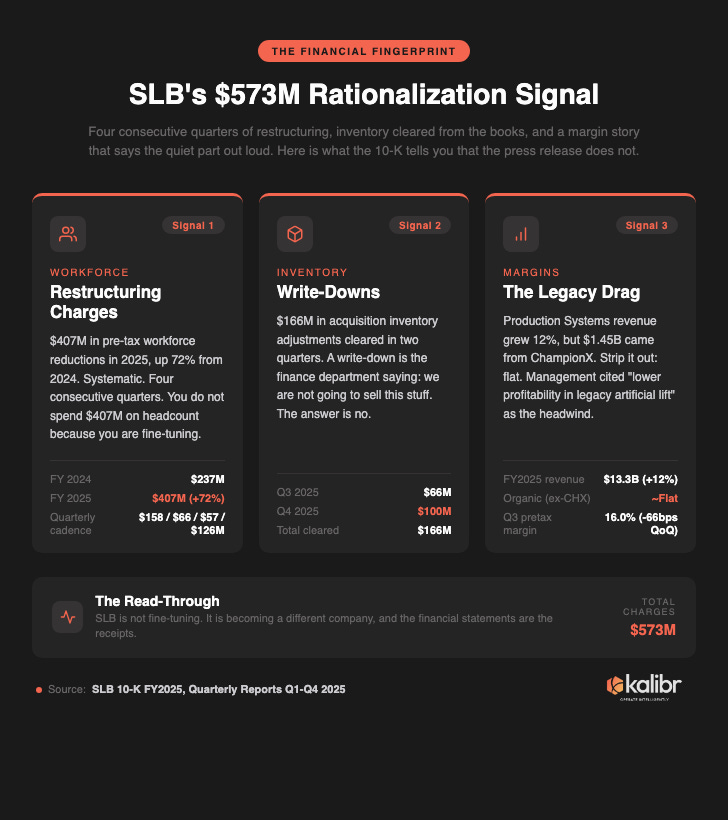
$407 million in workforce restructuring. $166 million in inventory write-downs. A Production Systems segment where the 12% revenue growth vanishes once you strip out ChampionX and the margin story (”lower profitability in legacy artificial lift,” in management’s carefully hedged language) reads like a quarterly memo from the finance department explaining why the thing they are sunsetting needs to be sunsetted faster. There is a version of the SLB story where the old product lines are a beloved heritage. This is not that version. The incentive to accelerate is not theoretical. It is quarterly.
The replacement products, and the pricing power logic.
This is the part most people will miss, and it is the part that matters most.
SLB is not just swapping old pumps for new pumps. It is doing something more deliberate: introducing products that specifically close the escape routes operators currently use to avoid ESP pricing. This is classic commoditization avoidance, the same playbook you have seen in [frac]() and [compression](), where the vendor introduces differentiated technology that no one else has, commands a pricing premium, and reduces the buyer’s credible alternatives.
Consider what each new product actually competes against.
The Reda Agile compact ESP pushes the pump node deeper into the wellbore and increases drawdown, which makes the ESP option competitive in well profiles where operators were previously concluding that gas lift was the better path. It does not just replace the RC series. It attacks the reason operators were leaving ESPs in the first place.
The Reda PowerEdge ESPCP closes the other exit: the “single run, then convert to rod or gas lift” lifecycle that (full disclosure) I used routinely as an engineer. By extending ESP economics deep into the mature well phase, it eliminates the conversion event that ended the ESP revenue annuity.
And sitting on top of both: the Lift IQ and Lumi platforms, wrapping every pump in AI-driven digital surveillance. SLB’s Digital segment now surpasses $1 billion in annual recurring revenue at 35% accretive margins. The hardware is becoming the delivery mechanism for the software. If you squint, this is less of an oilfield services business and more of a SaaS company that happens to involve things that go downhole.
The sell-side agrees. Unanimously. RBC, Jefferies, Capital One, Bernstein, Piper Sandler, Evercore ISI, TD Cowen, HSBC. Every major coverage name reaches the same conclusion, which is notable given that these are people who are professionally incentivized to disagree with each other. A 26% market share entity with overlapping product portfolios will consolidate. The only question is pace.
Good strategy. Good corporate finance. Genuinely. Some E&Ps will welcome this. If you have been fighting drawdown limitations or burning through ESPs on single-run cycles before converting to rod, the Agile and PowerEdge solve active problems you are already spending money on. Those operators will adopt quickly.
But not every operator thinks linearly inside the ESP category. The ones running tried-and-true legacy systems that work for their wells are not going to see new, unproven technology as an upgrade. They are going to see it as risk. And because they are engineers, not ESP salespeople, they will not ask “which ESP should I run instead?” They will ask a broader question: “Is this the right lift mode at all?” Once you open that aperture, the evaluation is no longer Reda Agile versus RC1000. It is ESP versus gas lift versus rod pump, holistically, with all the upstream implications for casing design, surface equipment, and operating philosophy that come with switching lift modes entirely.
That is where the cascade starts.
Fewer Doors, Same Hallway
If this were just SLB rationalizing a product line, you could shrug. Companies prune catalogs constantly. Operators migrate. Life goes on.
But SLB’s catalog is narrowing inside a supplier market that is simultaneously consolidating at the top, fracturing at the bottom, and walling itself off digitally at every tier. The operator who decides to re-evaluate lift mode will discover that the hallway has fewer doors than it did two years ago.
The top of the market is a fortress. SLB and Baker Hughes now operate with balance sheets clean enough (0.9x and 0.4x net debt-to-EBITDA, respectively) and revenue diversification deep enough (data center power, geothermal, critical minerals) that they can walk away from low-margin ESP tenders without flinching. Post-ChampionX, SLB manages over 20,000 connected assets through Lift IQ and XSPOC. Once your algorithms manage someone’s drawdown in real-time, the switching cost is no longer the pump. It is the data. These are not desperate suppliers. They are choosing their customers.
The middle is gone. ChampionX was the last standalone, publicly traded artificial lift pure-play. SLB absorbed it. The mid-tier negotiation option that operating teams historically played against the Big 3 no longer exists.
The independents face a tariff wall. Most US-based ESP assemblers source pump stages, motors, and cables from Tianjin and Jiangsu. The “Made in USA” label gets applied at final assembly. The core metallurgy is Chinese. Under current tariff structures, these assemblers have no margin buffer. Halliburton itself has acknowledged that artificial lift is its “largest component of tariffs” and that rewiring the supply chain will take quarters.
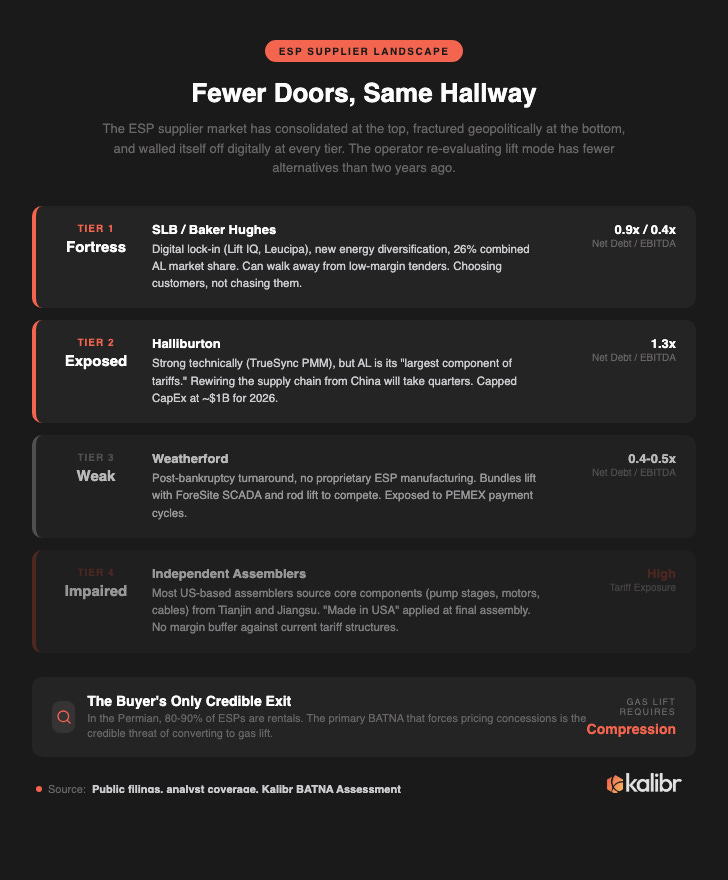
And in the Permian, where 80-90% of ESPs are deployed under rental agreements and the supplier captures a replacement revenue annuity every 6 to 9 months, the operator’s primary negotiation lever against all of this is the credible threat of converting to gas lift. Jefferies identifies it explicitly: the gas lift BATNA is what forces ESP pricing concessions. It is the only credible exit most operators have left.
Gas lift requires compression.
The buyer’s negotiation leverage in the ESP market and the compression demand signal are the same mechanism viewed from two angles. As the supplier landscape consolidates and the exits narrow, that BATNA gets exercised more frequently. Not because operators want to switch. Because it is the only credible threat they have left.
So What Do You Do With This
The cascade does not require every operator to convert. It does not require SLB to formally discontinue a single SKU. It requires only that the aggregate probability of gas lift conversion ticks upward at the margin, across hundreds of wells, across multiple basins, across the next 18 to 24 months, as legacy ESP options narrow and the economics of staying versus switching shift.
The mechanism is the 757. Manufacturer rationalizes legacy product. Operators run existing fleet. Fleet ages out. Some migrate within the new catalog. Others discover that their well conditions push them toward an alternative that lives in an entirely different service category.
High-pressure gas lift requires compression.
For compression service providers:
Start having longer-term conversations with operators who lean heavily on SLB ESPs, particularly in basins with limited gas lift infrastructure. An operator whose ESPs are failing more frequently, whose replacement parts are harder to source, whose OEM is steering them toward a product that does not fit their wellbore geometry is going to start asking about HPGL. When they do, they will need horsepower. The obvious demand drivers are the ones everyone tracks. The subtle ones are where the edge lives.
In the Kalibr Compression platform, this is relatively straightforward. We have every compression site mapped. We can flag ESP-specific operations. Overlay that with workover frequency from our signals and you have a targeting map for conversations that no one else is having yet.

For E&P Operators:
If you are running SLB ESPs today, evaluate the new product lines now, before a failed pump and no replacement parts forces the decision for you. If HPGL is even a potential path, begin the compression procurement conversation early. And if you are using the gas lift BATNA as negotiation leverage against your ESP provider, understand that credibility cuts both ways: the more you signal willingness to convert, the more you should actually be prepared to source the compression.
The Larger Point
The SLB example is interesting on its own. But it is not really about ESPs.
It is about the difference between having data and interpreting it. The world is not short on data. Every public company files quarterly. Every earnings call is transcribed. Every analyst publishes a note. The data is everywhere. What is scarce is interpretation through a lens that actually matters to the person sitting across the negotiating table.
Here is how we think about market intelligence at Kalibr, and it is the framework that made this article possible.
First, aggregate. And if you know the lens you are interpreting through, you can build datasets that do not exist anywhere else. We did not find a public database of every compression site in the Lower 48 mapped to artificial lift method, workover frequency, and vendor attribution. We built one. Because we knew the commercial questions we needed to answer, and the data infrastructure followed the interpretation, not the other way around. This is the part most people think is hard. It is not. It is plumbing with a thesis.
Second, interpret through the lens of negotiation. Not “what does this data mean for the market” in the abstract. What does it mean for the commercial levers available to a specific operating team sitting across from a specific seller? The $407 million in restructuring charges is interesting to an equity analyst. To an operating team negotiating an ESP contract, it is a signal about product availability timelines, spare parts inventory, and the vendor’s willingness to negotiate on legacy equipment they are actively trying to sunset. Different lens. Different output.
Third, apply it to your counterparty. Then apply it to your peers, because your counterparty’s alternatives are dictated by what your peers are doing. If three operators in your basin are already evaluating gas lift conversion, your ESP vendor knows that. Your negotiation position is not independent of theirs.
Fourth, cascade it outward. Upstream. Downstream. Adjacent service categories. The SLB story started as a product rationalization inside an artificial lift division and ended as a compression demand signal. That connection is invisible if you are only watching your own market. It is obvious if you are watching the full topology.
This is the power of interpreting data through the commercial negotiation lens. Not every signal matters equally. Not every rumor deserves a response. But when you can quantify and qualify the signals that do matter, sort them by impact, and map them to specific actions for specific counterparties, you stop being the operating team that reacts to the cascade after it arrives. You become the one that saw it building.
My son cannot do baseball practice, ride his bike, and watch a movie in one night. He has to choose. And his choice, picking baseball, means his sister gets the TV, which means he is catching the tail end of KPOP Demon Hunters for the hundredth time when he finally walks through the door.
Trade-offs cascade. The question is whether you see it coming.
Nominally Hedged goes out to a small list. If you know someone running compression negotiations this cycle — or who should be — forward it. That's the whole ask.
Love the piece on ESPs! Is it relevant to the Boeing analogy logic that SLB wouldn’t be exiting a category by ending RC as much as continuing a comparable legacy ChX line instead?
Casting ESP provider as SaaS business is also super interesting to think about how to preserve optionally.