


Q3 Kalibr Commentary - Frac
Strip away the earnings calls and the investor day, and business strategy is a long, occasionally elegant campaign to make leaving more trouble than it is worth. Dependency reduces competition; reduced competition grants pricing power; pricing power lengthens contracts and widens margins. That is the whole mechanism. It also explains most of what you will see, feel and be vaguely annoyed by in 2026.
The same instinct that makes you hard to leave also makes you better, because you cannot lock a customer in without handing them something nobody else has, and charging accordingly. In the limit you would retire the old product and move every client onto the new one. You cannot, for two reasons. The old product anchors the price: the customer hears “better” and asks for last year’s rate. And your competitors still sell the old product (or some version of it), so abandoning it hands them the slack. You end up selling something you would rather not sell, at a price you would rather not charge, while arguing that the replacement is worth more.
Coordinating your way out of that is the hard part. Idle the legacy capacity alone and a rival redeploys its own nominal capacity and takes the business. Idle it together and you have built a cartel, and cartels are well documented. They are illegal, which means fines, a congressional inquiry and a brief career as a meme. They are also unstable, because every member’s best move is to defect, and the only thing worse than a cartel is one that comes apart in public. What you want is an enforcement mechanism that is absolute and invisible; a rule that compels everyone without anyone having agreed to it.
Which is the trap the pressure pumpers spent most of the 2020s in. In frac, the enforcement mechanism turned out to be the customers. I flagged the shape of this in Q1. By Q3 it is visible: a widening separation between the cost-competitive and the merely nominal, which matters more than usual in an E&P sector already consolidating toward champions.
The Paradox of Thrift
Most of the 2020s was investor relations: hand the cash flow back as dividends and buybacks and let tomorrow be tomorrow’s problem. The engineering contribution was smaller; produce more for less. Two levers, really. Cut the inputs (cheaper crews, wet sand, dry FR, so on and so forth) or get faster. Consolidation took the first one, through G&A reduction and purchasing power; the industry took the second by going longer and pumping harder.
Physics has opinions about harder. Each increment toward the limit buys less, because you cannot bake a cake in half the time by doubling the oven temperature. You can bake two cakes at once, which is roughly the road to simulfrac in 2026. The same appetite for efficiency also moved the industry onto better prime movers (gas direct drive, turbine, electric) which look considerably better in light of the war with Iran.
Which leaves a completion engineer in 2026 exactly two ways to take real cost out: the second wellhead and the fuel. Here is the paradox. Both are cost cuts, made by operators in their own interest, one decision at a time, and together they (E&Ps, that is) handed the pricing power back to the pressure pumpers.
Start with fuel, because it is the biggest line on the invoice and the least interesting one to a board. A Tier II fleet burns diesel, and diesel was $6.28 a gallon in late October, up $2.66 on the year. A fleet on field gas saves tens of millions annually: Liberty prices a single conversion at $50 million, runs its fleets above 60% gas substitution, and puts its customers’ annual savings above $1 billion. At those numbers a year of dyed diesel costs more than the fleet that burns it. Operators asked for gas fleets. The pumper that owned one priced it against a diesel fleet plus the diesel and kept a slice of the gap as rate. Reasonable. Every investor deck stops there.
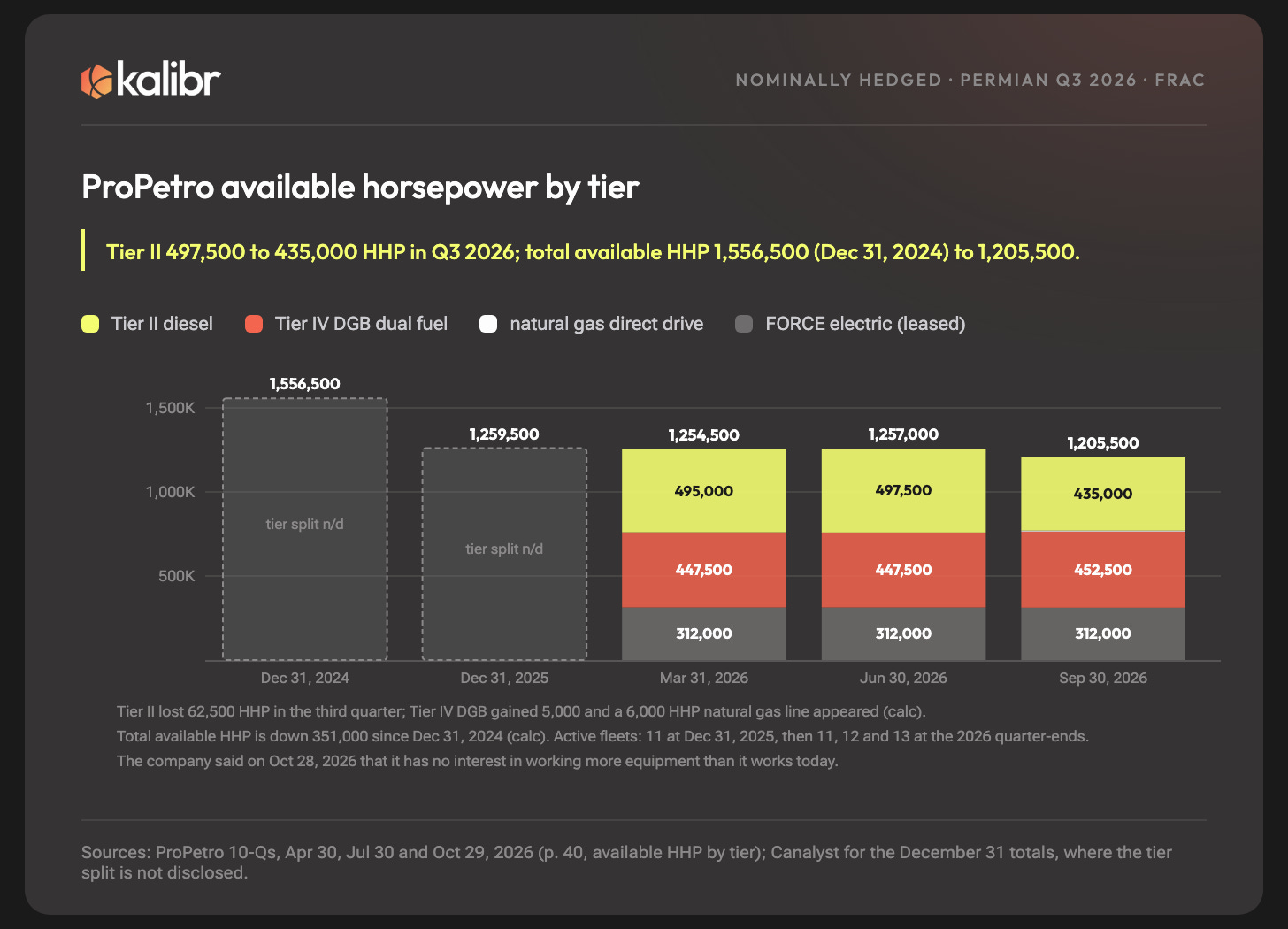
The part nobody mentioned in the boardroom is that the switch funnels everyone into a bottleneck the pumpers built, own and now sit inside of, like a troll under a very profitable bridge. Nobody else on earth wanted a Tier II frac engine, so the old diesel fleet was frac’s private supply chain. The new iron (gas direct drive, turbine, electric) comes off the same manufacturing lines as behind-the-meter power generation, and in 2026 those lines have other customers. Our compression readers know this queue: 82.1% of the new large-frame compression sets placed in the Permian since 2024 are redeployed used units, because the new ones (engines) are behind a data center in an order book. And the cheap frac tier an operator might fall back on is being cut up as it idles. ProPetro’s Tier II horsepower went from 497,500 to 435,000 in the third quarter alone. Patterson-UTI will hold active horsepower flat through the first half of 2027. The legacy diesel still running (~20% of U.S. completion horsepower) is uneconomic to maintain. The efficient fleet the operator asked for is efficient, scarce, and getting scarcer.
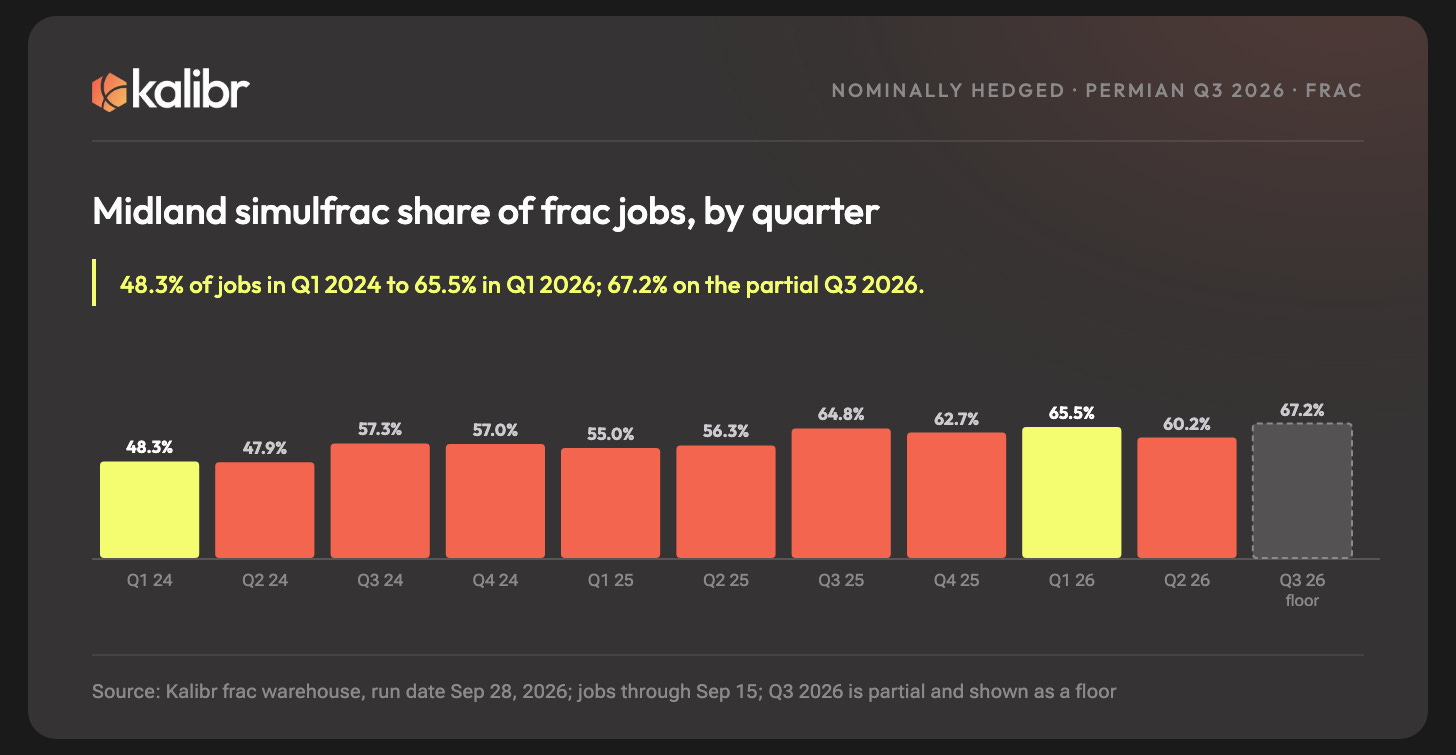
Then the second lever. Simulfrac is two wells off one crew, and operators took it up for the only reason anyone needed: it is cheaper per foot. In the Midland it went from 48.3% of jobs in the first quarter of 2024 to 65.5% in the first quarter of 2026. Over 2025–2026, average monthly crews are down 20.8% while jobs fell 8.9%. Every pad that went from one wellhead to two was horsepower nobody needed, and horsepower nobody needs is horsepower you can retire, and retired horsepower cannot undercut you on the next RFP.
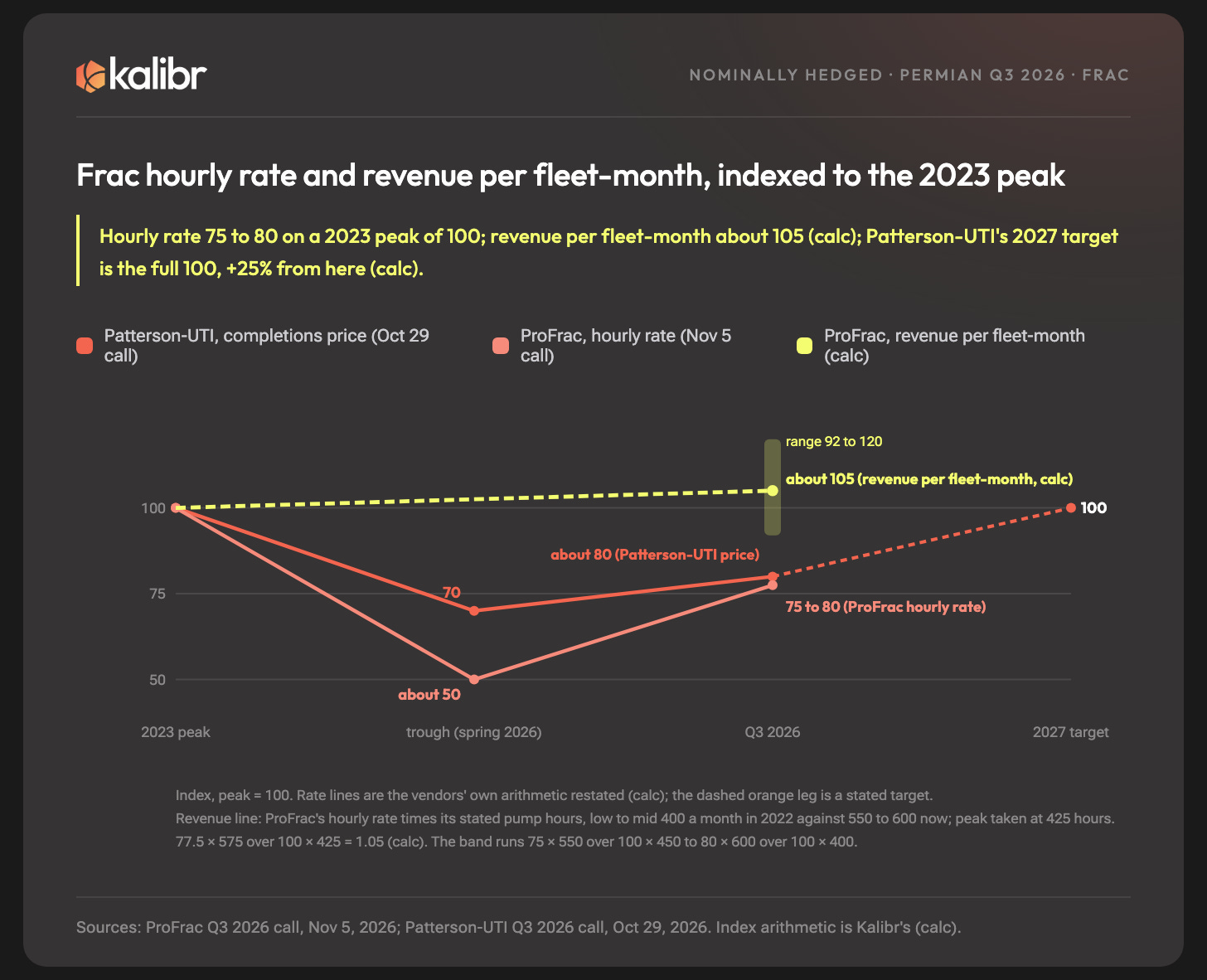
From the pumper’s side it looks like this. A fleet pumped about 425 hours a month in 2022 and about 575 now. The hourly rate halved off the 2023 peak and has come back roughly half to three-fifths of that: call it 77.5 against a peak of 100. The arithmetic is the whole story. 77.5 times 575, divided by 100 times 425, is 1.05. Rate down 25%, revenue per fleet-month up 5%, same crew cost either way. Completions pricing sits about 30% under its peak, a third of that is back, and Patterson-UTI says out loud that it means to recover the rest into 2027 (another 25% from here). A smaller fleet (on a unit basis), running fuller, at a rising rate: the only capacity cut a public company has ever volunteered for, and the customers volunteered it for them.
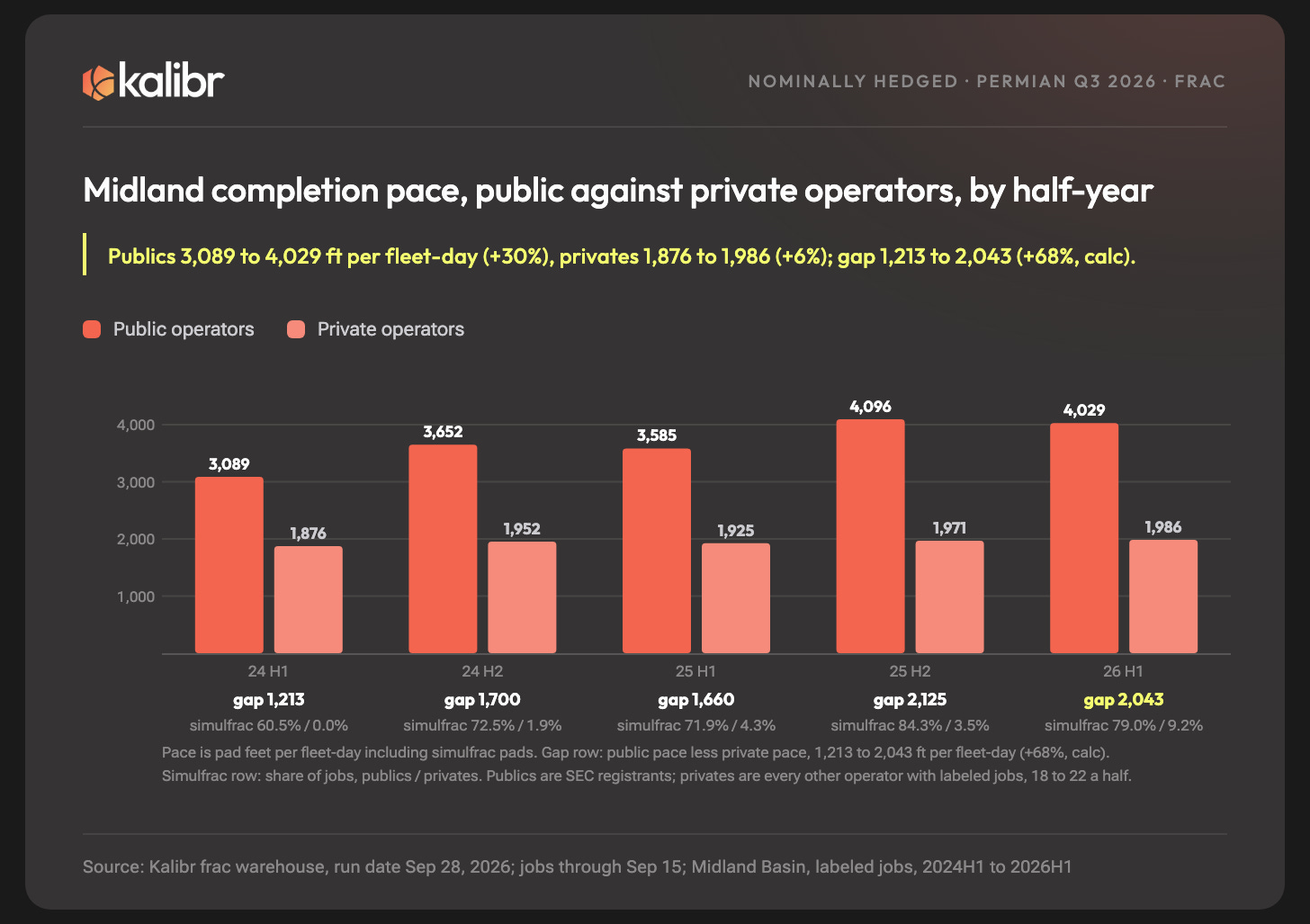
Which is where the completions job gets harder, in two different ways, depending on which operator you are. The Kalibr frac data warehouse splits the Midland into two populations. Every public operator with 100 or more Midland jobs runs at least 42% simulfrac; eleven privates with 20 or more jobs run materially lower. The publics went from 3,089 pad feet per fleet-day in the first half of 2024 to 4,029 in the first half of 2026, up about 30%. The privates went from 1,876 to 1,986, up about 6%. The gap went from 1,213 feet a day to 2,043, up 68%, and the reason is printed under the bars: publics 60.5% to 79.0% simulfrac, privates up to about 9.2%.
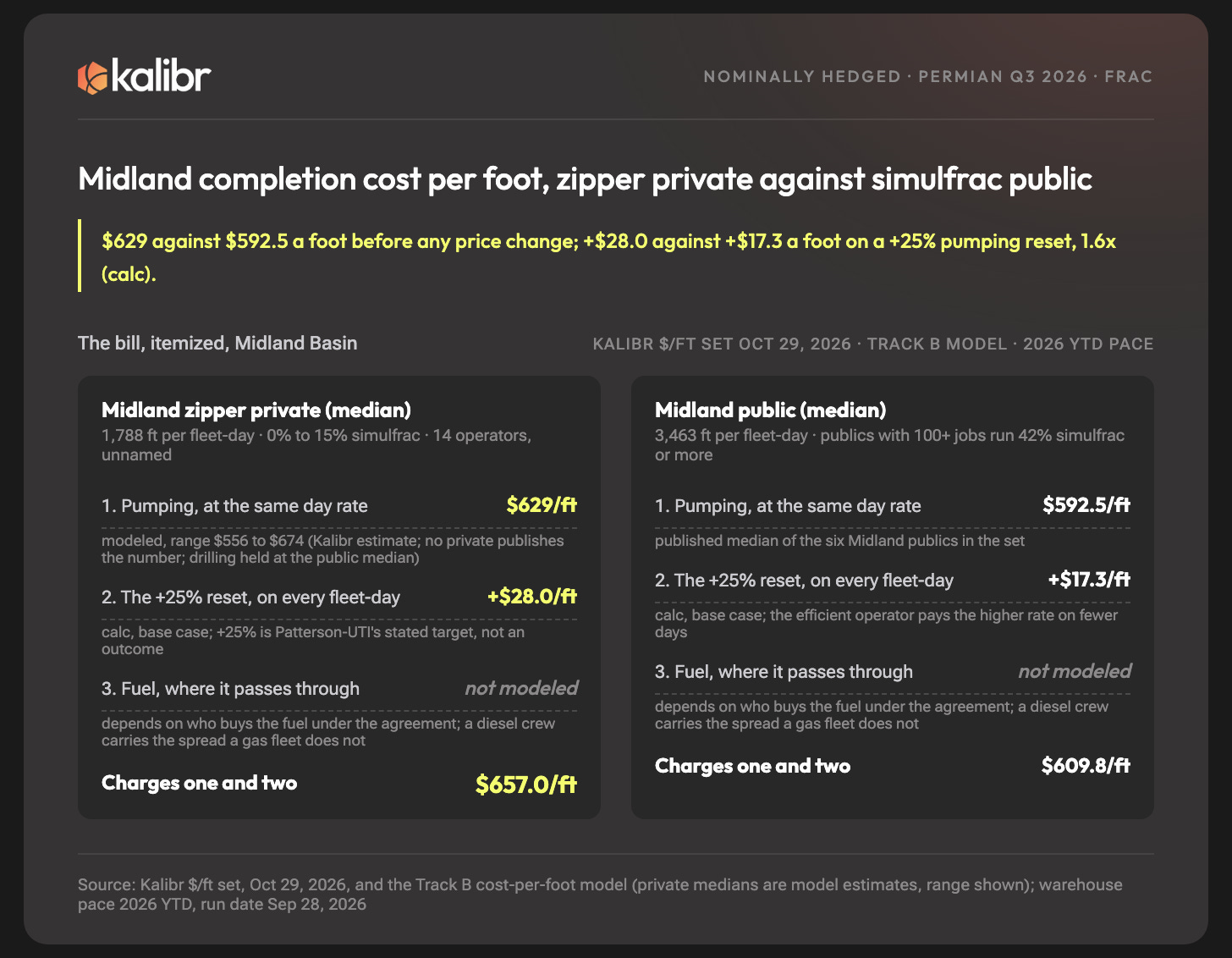
Now price the gap. On our $/ft set the Midland public median is $592.5 a foot; a non-simulfrac private pacing 1,788 feet a day against 3,463 models at about $629 (a Kalibr estimate, range $556 to $674, with the drilling side held at the public median so the whole gap is completions). That is the first charge, more fleet-days per well at the same rate, and it arrives before any price change.
The second is the 25%. Pumping cost per foot is the day rate times the days a well takes, over the lateral, so a percentage reset on the rate costs more dollars per foot to whoever uses more days: about $17.3 a foot for the median public and $28.0 for the median zipper private, 1.6 times the hit for the same announcement. The efficient operator pays the higher rate on fewer days, roughly nets it against the saving it already made, and goes looking for the next lever, because the fuel and the second wellhead are spent. The laggard pays it on all its days, after the first charge, and the cheap diesel tier it would have rented to get out of this is the one in the scrap line above. Billed twice, for an efficiency gain it did not share.
A pumper’s book looks like its customers, so the operator divide shows up as a vendor divide, and in the Midland it has a name. Halliburton’s 2026 Midland book is 83.5% simulfrac, and 65.4% of it is one customer, Public Company A, the busiest operator in the basin at 375 jobs this year, 99.5% of them simulfrac, at 4,716 feet a day. Patterson-UTI’s is 79.4% simulfrac, and 78.2% of it is two customers, Public Company B (the basin’s longest laterals, a 13,878-foot median, 71.9% simulfrac) and Public Company C (66.7%).
Liberty’s small Midland book is 72.1%. ProFrac’s is 28.8%, its pace including simulfrac is 2,228 feet a day against 3,258 to 4,187 for the other three, and its top five customers are Public Company D (58.2% simulfrac, 2,707 feet a day), Public Company E (77.4%, on 31 jobs) and Private Companies A, B and C, running 17.1%, 0% and 0% simulfrac, the slowest of them at 1,793 feet a day.
Three of the four got a full calendar and a price increase out of their customers’ efficiency. ProFrac got September white space between pads, which is what the same efficiency looks like from the other side of the table. It is also the one pumper with stacked diesel and a reactivation price (10% to 15% over the card, depending on the commitment that comes with it), and the one with $1,007.5 million of net debt at 4.03x, interest paid in kind since September and a cash sweep to its lenders. So the operators paying twice are concentrated at the one vendor that still has something to sell them, a coincidence with all the randomness of an earnings beat by a penny. It’s the vendor that can least afford to sell it cheaply, which is how you know God has a sense of humor, if not ProFrac short position.
The pursuit of efficiency did not merely reduce costs; it transformed the cost structure itself. Operators demanded supply-constrained technology-simulfrac, gas-direct drive-and in doing so retired the commodity tier of horsepower that once kept pricing honest. The service providers did not seize pricing power; it was handed to them by the very customers who now complain about it. For operators with the scale to run simulfrac, this is a manageable friction: they pay more per day but burn fewer days, and the savings on the second wellhead mostly cover the spread. For operators without that scale, it is a double penalty: they pay the higher rate without the offsetting efficiency, and the cheap diesel fleet they might have rented to escape the squeeze is the same fleet being cut for scrap. This bifurcation arrives at a moment when drilling inventory scarcity (Tier 1) already rewards consolidation into basin champions, which means the efficient get more efficient, the marginal get more marginal, and the flywheel-having been built by the operators-now spins without them.
Multiple Arbitrage
When a business is not thinking about stickiness (no profit boost is getting me onto your app, DraftKings) it is thinking about its multiple. Young companies tell stories: a slide about how everyone on earth will need the product. Mature industries have the harder job, because the story has been told and priced already. So you find the thing you are genuinely good at and look for a faster-growing segment to put it in, and in 2026 that segment is anything with AI attached (at least until last week?). Which is roughly how SLB stopped pumping frac jobs and became, in its own words, a technology company.
If you are a pumper, the thing you are genuinely good at is running large reciprocating engines in a field, hundreds of them, around the clock, with the fuel, the mechanics and the spares to keep them turning. In 2026 that skill has a second buyer. The people building data centers need power where the grid cannot reach this decade, the fastest machine that makes it is the same engine, and they will sign fifteen years to get it. A frac customer signs a year and opens with a RFP. Set the two contracts side by side and the question is not whether a pumper would rather be in the power business. It is how to pay for it.
The answer, so far, is the first contract. The frac business throws off the cash and carries the contracts that a lender will underwrite, and a lender financing a power build wants that business to behave like the thing it is being borrowed against: contracted, continuous, priced. You do not have to wait for a pumper to say so on a call. A company that has decided its future is power stops buying pumps, and the third quarter is the first one where that shows up in the cash flow statement instead of the strategy slide.
Two of the five pumpers spent more on power than on frac pumps in the third quarter. Liberty put $621.9 million into capital and about $450 million of it was deposits on power generation equipment. ProPetro spent $128.0 million on power against $39.1 million on hydraulic fracturing; $3.27 of power for every dollar of pump. Patterson-UTI, Halliburton, and ProFrac spent nothing on power, and nobody ordered a frac fleet (Note: HAL entered the space through investment in VoltaGrid).
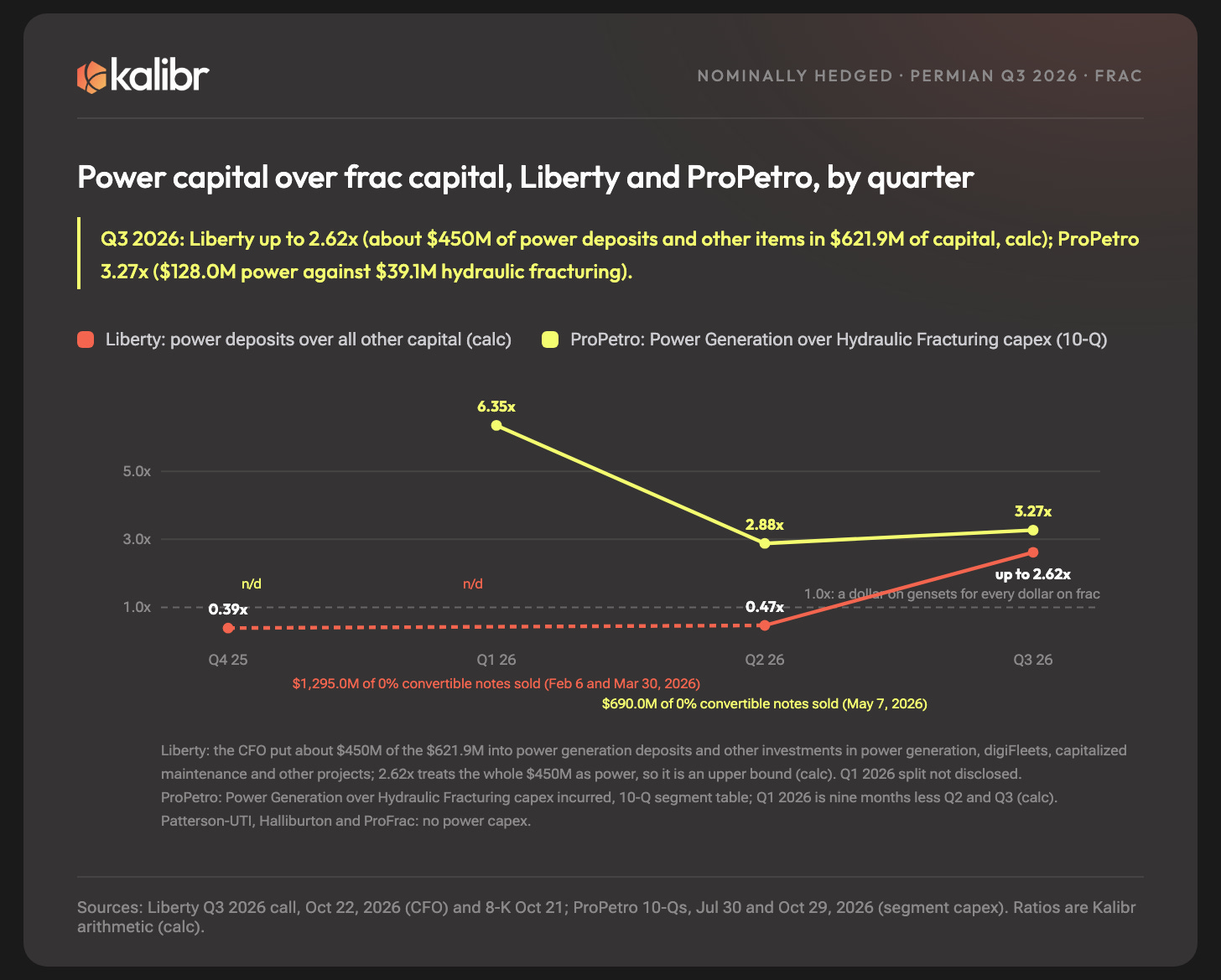
Start with what the money buys. A genset sold behind the meter on a fifteen-year energy services agreement earns, by Liberty’s account, high-teens unlevered returns. A frac fleet earns an hourly rate of 75 to 80 on a peak of 100, on a contract that runs a year if you’re lucky, from a customer who ran a RFP. Everyone with a gas engine on order in 2026 made the same choice,frac, compression, behind-the-meter power, Halliburton through its VoltaGrid stake, and all of them are waiting on the same Caterpillar lines, past a year.
The queue is crowded and the entry fee is large. Liberty has $2.1 billion of power equipment under contract, $1.6 billion of it still to pay through 2030, against adjusted EBITDA of $141.6 million for the quarter, every dollar of it frac. ProPetro has about 2.6 gigawatts secured and $463.1 million still owed on 570 megawatts, against a frac business of thirteen fleets.
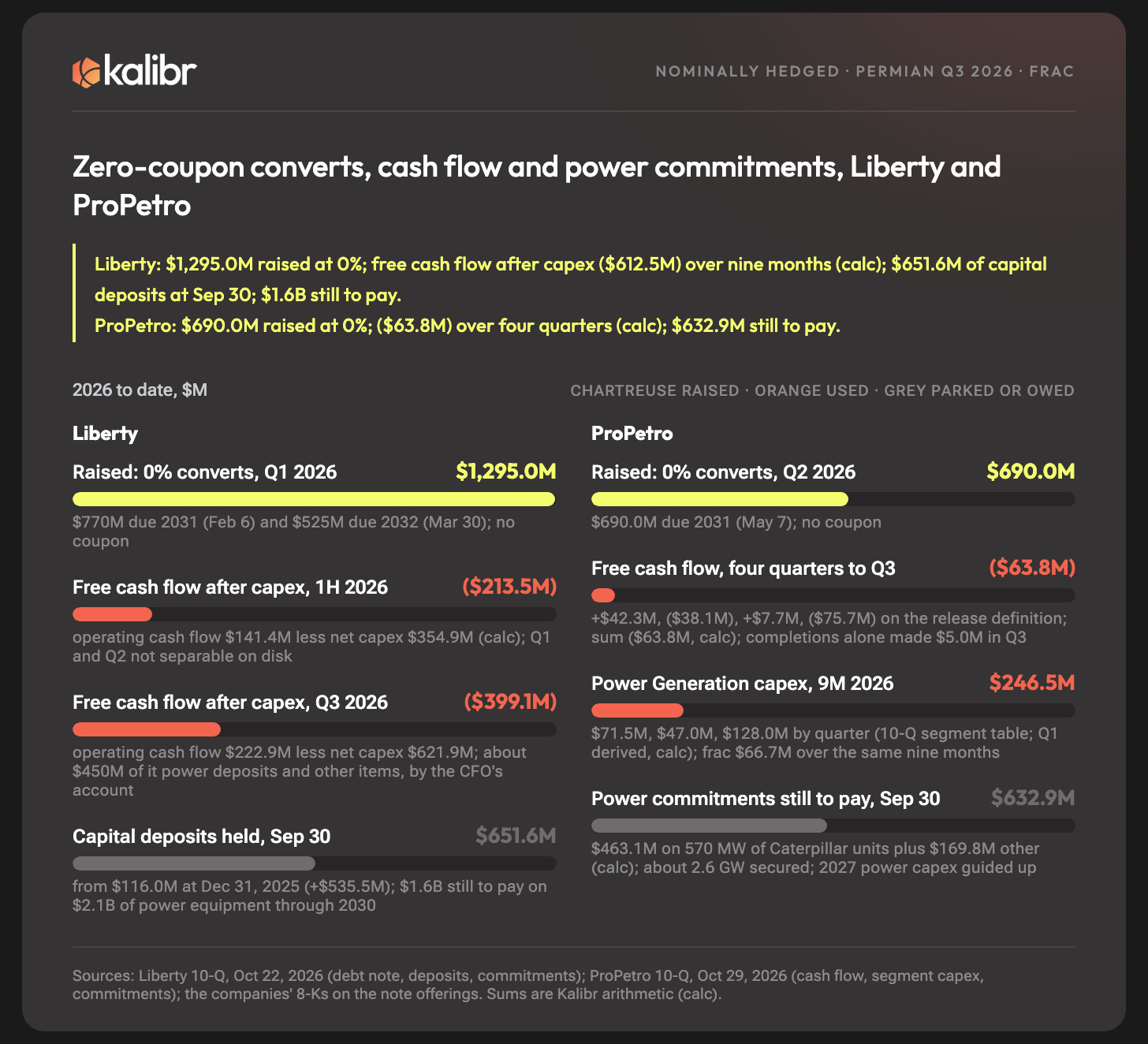
So where does $1.6 billion come from? Liberty’s answer has three legs: the frac business’s free cash flow, $1,295.0 million of convertible notes sold in the first quarter at a 0% coupon, and nonrecourse project financing that launches in early 2027. ProPetro’s version is $690.0 million of zero-coupon converts sold in May. That is the official version. I would put it as: a frac company is buying power plants with its customers’ day rates, borrowing the balance at zero, and promising a project lender that the day rates will still be there in 2027.
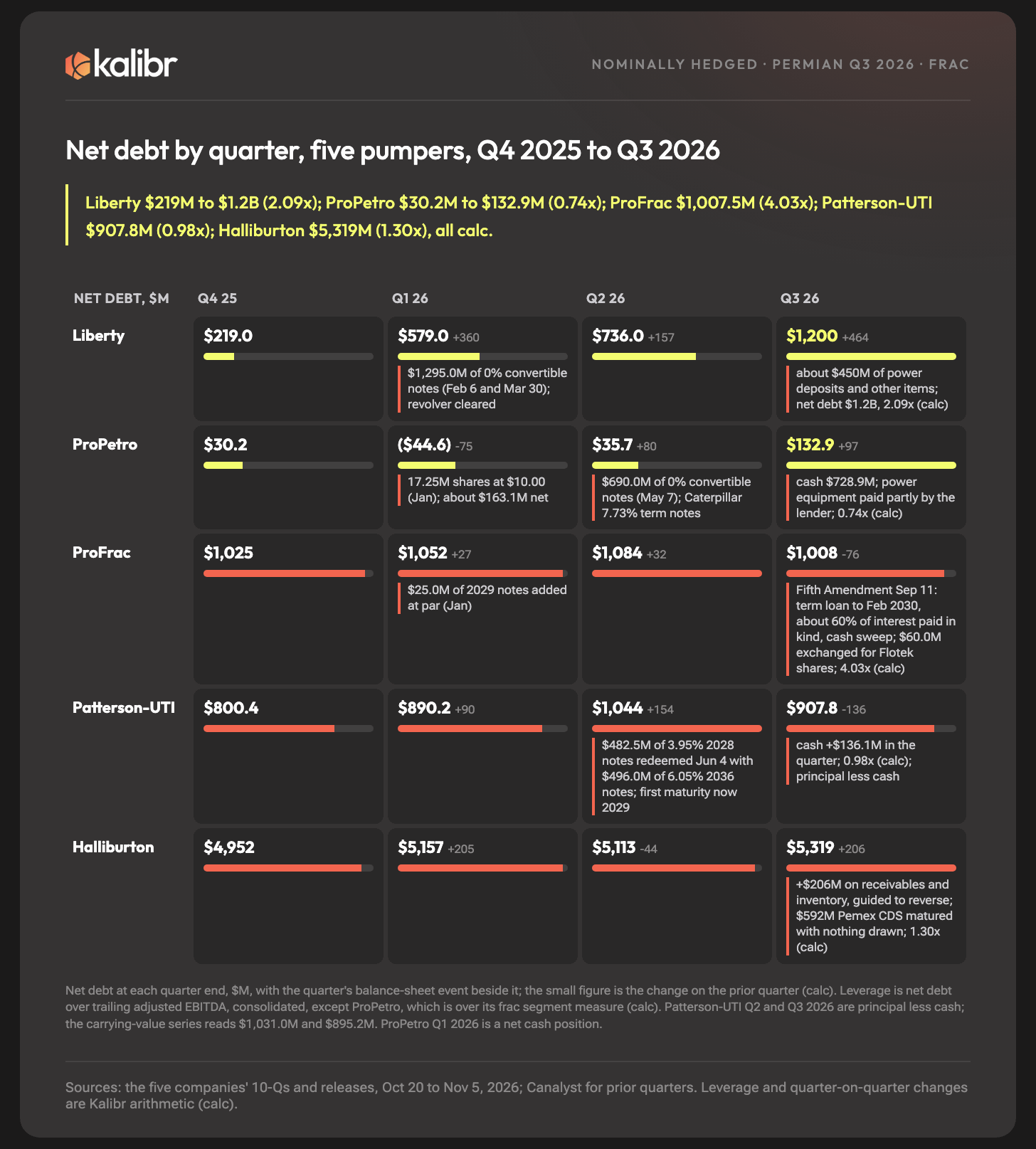
The first leg is the one that didn’t hold. Liberty’s free cash flow after capital spending was negative $399.1 million in the quarter and negative $612.5 million over nine months, and its net debt went from $219 million in February to $1.2 billion at September 30, 2.09 times trailing EBITDA. ProPetro’s completions business produced $5.0 million of free cash flow in a quarter the company called sold out. A frac business earning about $14.2 million of adjusted EBITDA per fleet-year is standing behind $1.6 billion of equipment it hasn’t paid for.
Now imagine you’re the pumper’s CFO, staring at a spreadsheet that has just become sentient and is actively judging your life choices. If the frac fleet is the cash leg of a power funding stack, four things about your frac contracts become very important:
1. Hours: a fleet pumped about 425 a month in 2022 and about 575 now, the arithmetic from the last section, rate 75 and revenue 105.
2. Calendar: every one of the five named white space as its third-quarter problem; Halliburton about $81 million light on the downtime from moving crews, Patterson-UTI $7.2 million short on sand mines and trucking, Liberty’s crews caught up to the rigs, ProFrac’s September opened up between pads.
3. Duration: three of the five CEOs actually said the word “duration” on their earnings calls, which is the corporate equivalent of screaming into a pillow; more than two-thirds of ProPetro’s horsepower reprices in the first half of 2027, Liberty says most of its 2027 homes are placed, some without an RFP, and Patterson-UTI names a multiyear program as the one thing that would get it to build.
4. Pass-through: labor, trucking, sand and fluids move onto the customer’s page as they occur, so the margin the lender is looking at stops moving.
So the price increase will not summon a single new horsepower, because every dollar of capex that might have built a frac fleet is already pledged to a different god. Patterson-UTI’s CFO has decreed active horsepower shall remain flat through H1 2027. Halliburton’s 2027 plan files North America frac under “optionality” and has already redeployed two spreads to Argentina and Jafurah. ProPetro’s board will not approve a fourteenth fleet; the motion would die for lack of a second. The pricing power endures exactly as long as the Caterpillar queue, and nobody standing in that line is thinking about pumps.
Q2 Earnings Analysis
Which is how a quarter of flat horsepower strengthened four hands out of five. In February we scored the five from the buyer’s side on eight dimensions, 40 points available. Re-graded on the Q3 record: Patterson-UTI 31 to 29, Halliburton 31 to 27, Liberty 23 to 18, ProPetro 18 to 15. Each is the operator’s hand getting weaker, by two to five points, and the two biggest drops are at the two companies buying power gen.
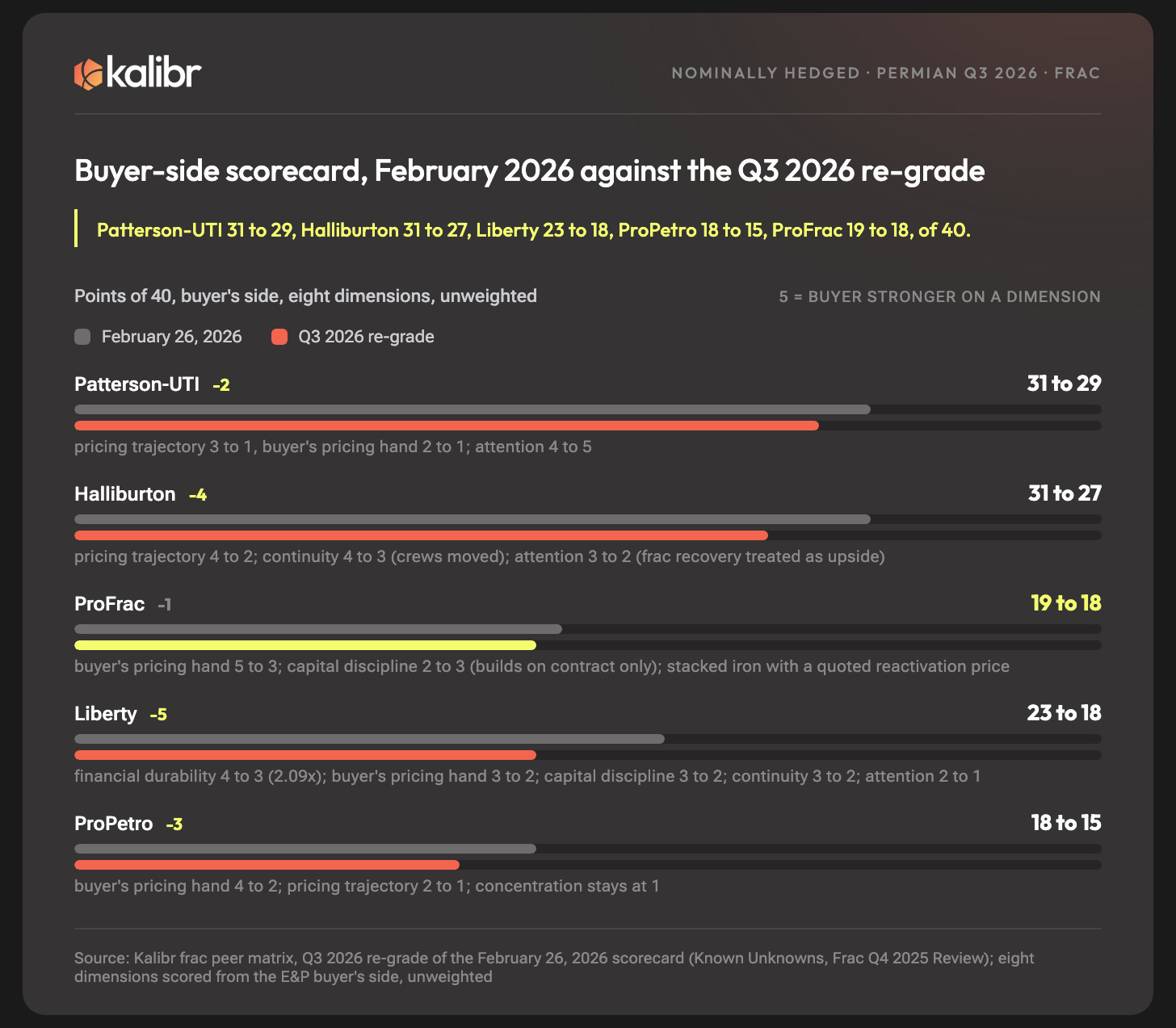
ProFrac went 19 to 18. It got the single-digit price increase too, but it has no power business to fund, and its lenders got to the cash first: net debt $1,007.5 million at 4.03 times, and a fifth amendment on September 11 that pushed the maturity to February 2030, let it pay about 60% of September’s interest in kind, sweeps its excess cash and caps what the frac segment can spend. It is also the one pumper with stacked diesel and a quoted price on it, 10% to 15% plus a commitment. ProFrac can’t join the trade that turned frac cash into power deposits at Liberty and ProPetro, so its capital plan is written by its creditors, which is also why it is the one vendor an operator can still buy iron from.
So, the prescription, in the order a pumper’s lender would write it.
1. Bring the calendar, documented: back-to-back pads, staged sand and water, drilled inventory ahead of the crew; every pumper paid for white space this quarter and an efficient operator closes it for almost nothing.
2. Index the pass-through to third-party prices only.
3. Sell duration last, priced, and only for something specific: a gas-fleet slot with a number on it, a dedicated crew, a cap on the pass-through. Never for free, because at two of the five your signature goes into a lender’s data room in the first quarter of 2027, and the lender isn’t going to pay you for it.
It’s unclear whose spreadsheet gets to price Liberty’s frac cash first; the project lenders arriving in Q1 2027 with their covenants, or the operators whose renewals actually generate it. I note, however, that only one side has bothered to put a firm date in a cell.
Halliburton: raising the price, losing the plot
Q3 reported October 20. Completion and Production margin 14.8%, flat against a guide of 125 to 175 basis points of improvement, and revenue about $81 million light at the midpoint, which is the price of moving several crews mid-quarter to customers paying more.
So the company’s CEO gets on the earnings call and says, look, we’re the electric price leader, and you have to take our word for it because the evidence is sort of weird: a large tender drew exactly one bidder (us), which is either a sign of market dominance or that nobody else wanted it, and then another customer extended an e-fleet contract at the new price and also added a whole additional fleet, which feels like the corporate equivalent of ordering dessert after complaining about the meal.
Q4 guide: C&P revenue up 3% to 5%, margin up 75 to 125 basis points. The 2027 plan is about 15% margin on a flat North America with any frac recovery treated as upside, so the walk-away is credible in a way no other pumper’s is. The alternative to your pad is Argentina or Jafurah.
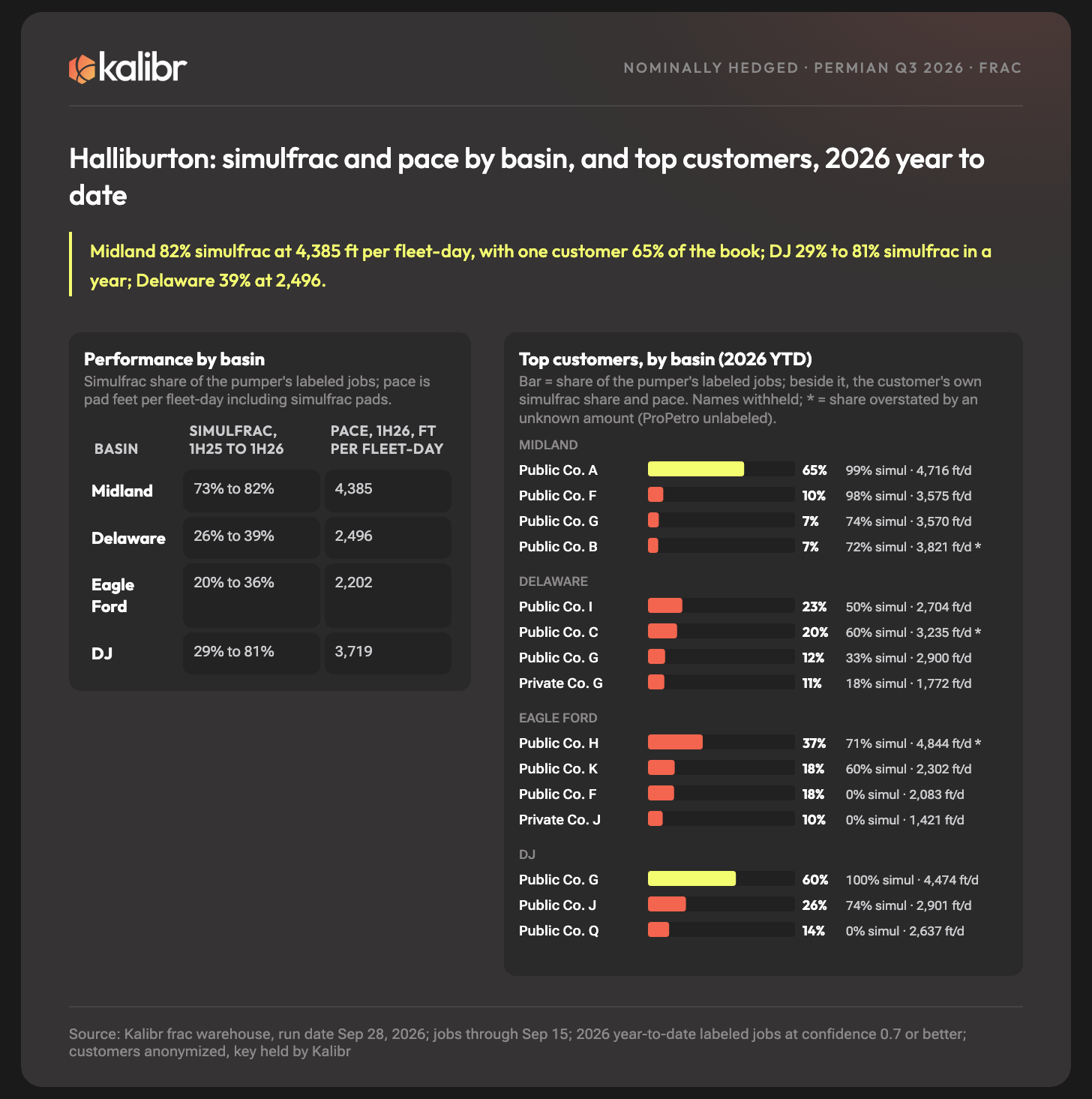
Four basins, four single-anchor books.
In the Midland the fleets run 82% simulfrac (73% in the first half of 2025) at 4,385 feet per fleet-day, index 56.1, the fastest book in the basin, and 65% of it is Public Company A: five electric simulfrac fleets all year with no white space, 99% simulfrac at 4,716 feet a day, footage flat at about 6.4 million feet for 2027, and a company that calls itself a service-cost price taker. The two majors behind it (10% and 7% of the book, at 98% and 74% simulfrac) bring maintenance demand: one is pulling Lower 48 capital toward Alaska, the other holds a Permian plateau with drilling and completion spend down 40% and cuts activity before it pays.
The DJ went from 29% to 81% simulfrac in a year and is 60% one major (100% simulfrac, 4,474 feet a day, a single-vendor program), 26% a mid-cap that credits $35 million of merger synergies to simulfrac and will have its own sand by mid-2027, and 14% a public with a guidance cut, a new production covenant and seasonal pauses, at 0% simulfrac (see a trend?).
The Eagle Ford is 37% Public Company H (71% simulfrac at 4,844 feet a day, all e-frac or dual fuel on field gas, half of its 2026 well costs locked by May, a record under $525 a foot), 18% a mid-cap whose parent has suspended buybacks and which went from two rigs to three in the quarter, and 18% a plateau major’s refrac work at 0% simulfrac.
The Delaware is the soft book: 39% simulfrac, 2,496 feet a day, index 39.0, fourth of four labeled majors, led by a scaled public at 23% (simulfrac above 70% of its 2026 completions, more than 40% of diesel displaced, about $800 a foot and a promise of a more aggressive cost structure for 2027), a flagged major at 20%, and an 11% sponsor-owned private in a $2 billion-plus sale process at 18% simulfrac.
The weakness is execution and concentration: two straight margin misses, and three books whose growth cannot come from the anchor because the anchor’s 2027 footage is flat or its capital is leaving. What Halliburton needs in 2027 is gap-free calendars that end the move downtime, e-fleet extensions at the new price and a second anchor in the Midland, the DJ and the Eagle Ford, which means scaled simulfrac operators with multi-pad, year-round calendars and the efficient privates with scale.
The play: offer a pre-sequenced, no-white-space calendar and price it against the downtime Halliburton just paid for; on electric, ask for crew priority, nonproductive-time credits and pumping-hour pricing before you ask for a rate. In the Delaware there is room, six other labeled vendors work the basin and Halliburton is the slowest of the majors. In the DJ, the vendor list is so short you could fit it on a Post-it note and still have room for a doodle. Halliburton’s CFO can count the competitors on one hand and still hold his coffee. That math is not encouraging.
Liberty: modest price, short of cash
Q3 reported October 21. Adjusted EBITDA margin 11.8%, the third straight decline, on $621.9 million of capital in the quarter, about $450 million of it power. Liberty prices with a ceiling it named itself, already knows the homes for most of its 2027 fleets, some placed without an RFP, and prices a gas fleet against the customer’s fuel saving: about $50 million a year per conversion, held to a payback under three years. Into year-end: modest, fuel-indexed increases, mostly settled.
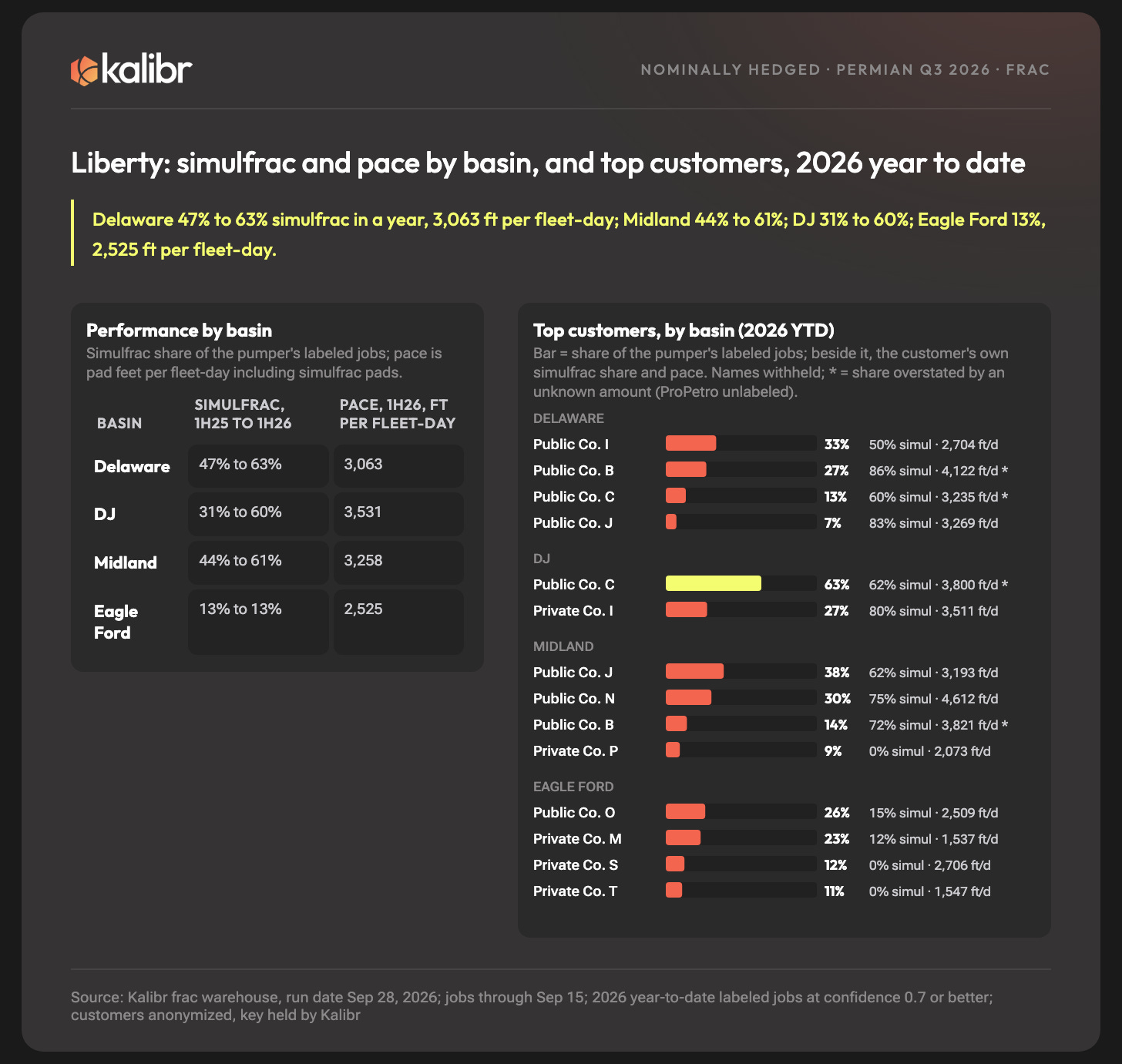
The Delaware is the core: 63% simulfrac (47% a year earlier), 3,063 feet per fleet-day, index 46.3. A third of the book is the same scaled public that leads Halliburton’s Delaware (Public Company I, 50% simulfrac, 2,704 feet a day); 27% is Public Company B (86% simulfrac at 4,122 feet a day, four-mile laterals and its own proppant, capex of $28 billion to $32 billion a year through 2030, and nothing to say about service costs); 13% is Public Company C; both of those carry the flag. Behind them sit a mid-cap at 83% simulfrac and a fourth-generation family running three rigs at 18%, which negotiates hard and keeps the pad-by-pad option.
The DJ is led by two customers: Public Company C at 63% (62% simulfrac, 3,800 feet a day, and shifting its Rockies capital north into a basin that runs 0% simulfrac) and the largest DJ private at 27% (15,000-foot laterals toward a public $500-a-foot all-in target, 80% simulfrac, a scrapped $3 billion sale and $600 million of new notes).
The Midland is led by two mid-caps: 38% a company with two Permian crews, SIMOPS shut-ins and a flat 2027 budget whose merger synergies inflation has already absorbed, and 30% a one-rig company that front-loaded 69% of its 2026 completions to lock frac pricing, took covenant relief in June and is refinancing, at 75% simulfrac and 4,612 feet a day.
The Eagle Ford runs 13% simulfrac at 2,525 feet a day on a mid-cap consolidator that says it has room to use more simulfrac (15% today) and is self-sourcing fuel, sand and chemicals, plus three slow privates buying at market.
The weakness is cash and margin, $1,006.8 million of nine-month capital against $364.3 million of operating cash flow, with anchors on the move outside the Delaware (the DJ major heading north, the Delaware public reportedly selling its Powder River acreage, a Midland mid-cap deferring with DUCs). It needs contracted, winter-through utilization, two years of line of sight before it builds a digiPrime, and Midland work that does not depend on a refinancing customer. The suppliers are efficient operators that sign a term: Delaware scale, new-owner privates that need cost certainty for their lenders, the family with the three-rig program that does not move, the largest DJ private.
The play: trade duration for rate, two years with the winter in it, and put the fuel saving on the table in writing, because Liberty prices against it. If you supply the field gas, the arbitrage is yours, and the premium should not be charged twice.
Patterson-UTI: the most aggressive ask
Q3 reported October 28. Completion Services adjusted gross margin 16.4% on $132.8 million of gross profit, $7.2 million short of the guide on nonproductive time and South Texas sand. The cleanest pricing evidence in the group: a mid-single-digit increase, mostly like for like, crews walked to higher bidders, a target of all of the 30% back (25% from here), Q4 guided to about $140 million on higher pricing, and horsepower held flat through the first half of 2027 by policy. Into year-end: the steepest ask, with most of the 2027 book already placed.
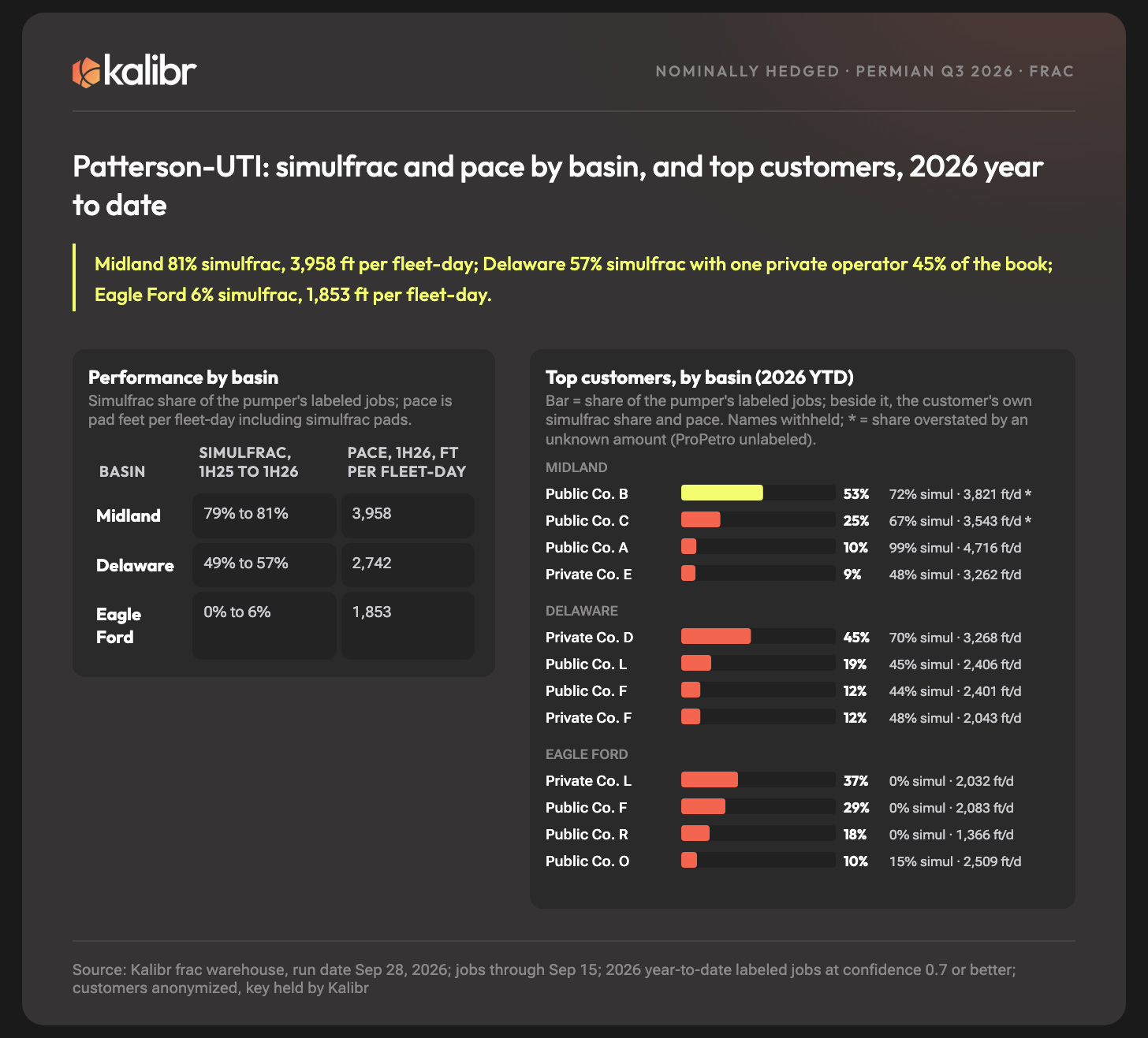
The Midland runs 81% simulfrac at 3,958 feet per fleet-day with an index of 66.6, the best of the four, and 78% of it is two majors: Public Company B at 53% and Public Company C at 25%, both shares flagged. Public Company A is another 10%, and 9% is a strategically owned private at 0.2x leverage running about 3,000 feet a day on grid power, a consolidator and a term signer.
The Delaware is 57% simulfrac at 2,742 feet a day and 45% one family-owned private that is not for sale, runs about 21 rigs at 70% simulfrac and sits across the table as an equal; then a mid-cap at 19% ($804 a foot, about 80% of its wells on field gas, deleveraging toward 1.0x, and the one operator that named a Patterson-owned pumper for 2027), the plateau major at 12%, and a private under new sponsor ownership after a $2.3 billion purchase at 12%, which needs cost certainty for its lenders and will likely re-tender after close.
The Eagle Ford is the slowest book of the four labeled pumpers, 6% simulfrac at 1,853 feet a day: a single-basin private at 37% and 0% simulfrac, the plateau major’s refrac work at 29%, and an 18-well campaign operator at 18% that released its rig in the first half.
The weakness (if there is one, this is the strongest hand in pressure pumping) is execution before it is price. The Q3 miss was logistics, and the Eagle Ford book is slow and shrinking. What it needs: pads ready on time, sand, water and gas staged, and homes for Emerald gas units whose lead times exceed a year; the suppliers are large, logistics-disciplined operators, the Delaware family first.
The play: answer the most aggressive ask with operations before price. Guaranteed pad readiness, staged sand and water and supplied field gas remove the nonproductive time that cost Patterson-UTI its guide; trade them for the increase. Read the standby language first, since some customers paid it in September. And the Delaware family shows what a scaled private can do at this table.
ProPetro: sold out, with a block to place
Q3 reported October 28. Thirteen active fleets, sold out by its own account, no fourteenth by policy; Hydraulic Fracturing margin 19.3% against 25.9% in Q4 2025 on rebuild costs; free cash flow negative $75.7 million while power took $128.0 million of $171.5 million of capital. A year ago ProPetro declined to recontract almost all of its electric fleet at trough prices, so more than two-thirds of its horsepower reprices in the first half of 2027 into a market it calls tightening, and the two-fleet electric block for Public Company B ends late 2026 with no named replacement. Into year-end: little change now, then the largest single repricing in the Midland.
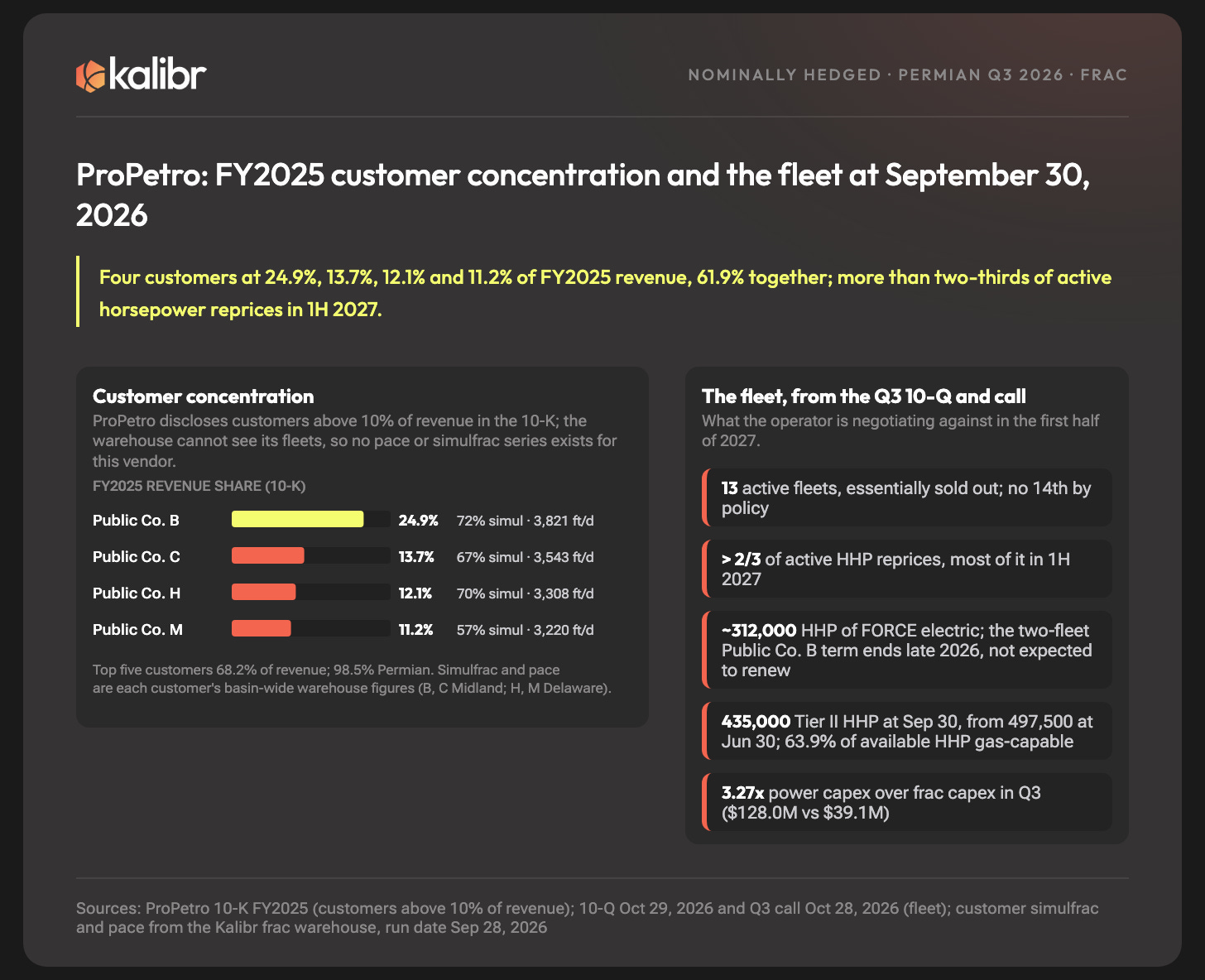
Four customers are 61.9% of revenue in a 98.5% Permian business. Public Company B at 24.9% (72% simulfrac and 3,821 feet a day across its Midland work, and nothing to say on service costs).
Public Company C at 13.7% (a flat 2027 starting point, three Permian rigs dropped in Q4 while adding wells, a Midland cost near $515 a foot with 12% more targeted by 2030). Public Company H at 12.1% (all e-frac or dual fuel, half of its 2026 well costs locked by May, sand in-house: the hardest customer in the Delaware to reprice). Public Company M at 11.2% ($685 a foot against a $675 target, diesel the only inflation it saw, and a budget it will flex to maintenance if service costs rise: it slows before it pays).
The weakness is cash and one contract. What it needs is 2027 homes for about 312,000 HHP of electric fleets, contracted cash flow and the lease buyouts closing. The suppliers are Midland operators that want electric and will commit: grid or field-gas programs, new owners who want cost certainty, and price-sensitive buyers whose only inflation is diesel.
The play: the largest electric block coming to market in the Midland in 2027 belongs to an owner burning cash. An operator that can take an electric fleet in the fourth quarter or the first is solving the vendor’s one placement problem and should be paid in term, scope and the fuel split; ask for the saving in writing and do not let the electric premium include it. Incumbents inside the wall should trade the multiyear commitment this vendor needs more than any other for the structure of the reset: a cap, a fuel split, a performance clause. About $16 million a quarter of electric-fleet lease expense rolls out of EBITDA as the buyouts close, and a 2027 ask that restores the old margin before counting that is counting it twice.
ProFrac: the have-nots’ pumper, with the only spare iron
Q3 reported November 5. Single-digit price improvement, hourly rates about 50% off the peak and 50% to 60% recovered, and stimulation revenue down 1.9% on September white space while price rose. Net debt $1,007.5 million at 4.03x, liquidity about $97 million, interest paid in kind since September, a cash sweep, and a twelve-month plan dated to activity improving in the second quarter of 2027. The 2027 ask is pricing, duration and pass-through. It will reactivate stacked diesel at the August price, 10% to 15% plus a commitment, and it is the one pumper offering a contracted new gas fleet for 2027.
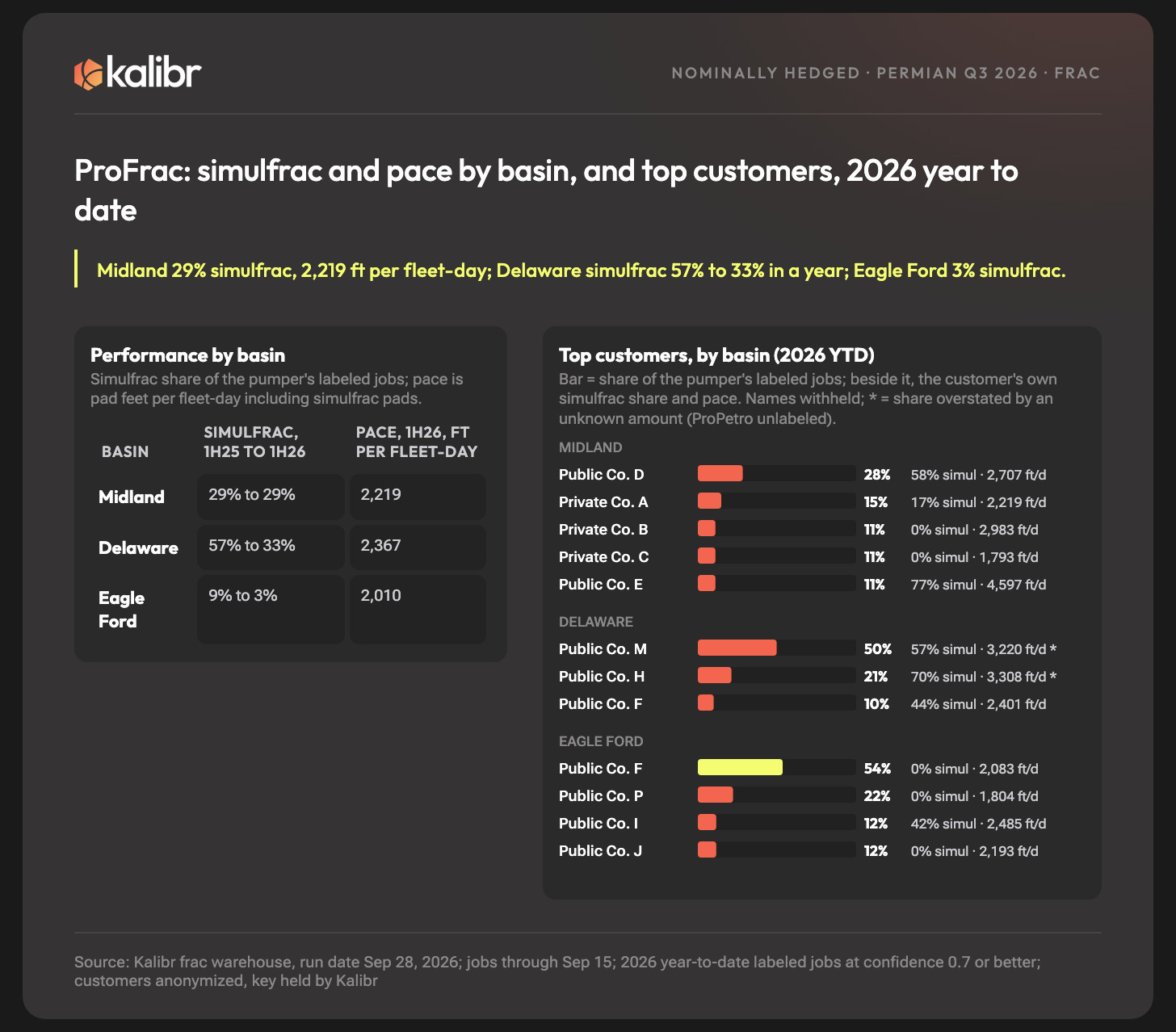
The Midland book is 29% simulfrac for the third straight half, 2,219 feet per fleet-day, index 31.8, fourth of four: 28% Public Company D (asking four rigs to deliver a five-rig well count, a flat Permian budget of $1.2 billion to $1.3 billion, and a $500 million savings program a reset would erode; 58% simulfrac, 2,707 feet a day), then three privates at 15%, 11% and 11% running 17%, 0% and 0% simulfrac, one of them a factory-pad operator with its own sand and water that will sign a term for price, one a century-old family with one rig and the balance sheet to wait the pumpers out, and 11% Public Company E (electric fleets and trimulfrac cubes, 2027 services locked earlier than usual, 77% simulfrac at 4,597 feet a day).
The Delaware is the opposite book: index 69.8, the group’s best, half of it Public Company M (57% simulfrac, 3,220 feet a day, the operator that slows before it pays) and a fifth Public Company H, both flagged, with two slow privates under 5% each, one an EnCap build-and-flip where every extra dollar a foot comes out of the exit multiple, the other a family partnership at 1,481 feet a day, the cleanest hit-twice case in the data.
The Eagle Ford is : 54% the plateau major’s refrac work, 22% a mid-cap that doubles its D&C budget in 2027 and needs two crews, with the rest a scaled public’s acreage that has since changed hands and a one-rig South Texas program that may not survive a reset.
The weakness is the balance sheet, two quarters of unplanned white space, and a book made of the operators that pay twice. It needs committed, gap-free calendars and duration with a pass-through on fleets it already owns, and a multiyear contract with money up front before it builds. The suppliers are the have-nots themselves, the Midland mid-cap protecting its savings program and the Eagle Ford mid-cap that needs two crews; ProFrac’s integrated sand and in-house build cost give them the lowest floor on offer.
The play: this is the one pumper with capacity to sell, so pay for it in duration and leave the hourly rate alone; cap the pass-through to third-party indices (two of its four inflation items are its own affiliates); write the performance clause on your own pad data, since this vendor is the slowest crew in the Midland and the best index in the Delaware; keep step-in rights and price sand separately, because the frac segment pays an affiliate’s shortfall charge when you self-source. The February line still holds: the most buyer leverage and the most continuity risk sit with the same vendor.
TL;DR: Conservation Law
Horsepower is not created in this story and it is barely destroyed. It is moved, repriced, and now and then scrapped, and scrapping is the one-way door.
Simulfrac took demand for iron out two wellheads at a time while the field-gas conversion took obsolete supply out at about the same velocity, and the pumpers collected both halves of that as margin without agreeing to anything, which is the elegant part: the customers built the cartel the vendors could not legally form.
So the price increase is not a forecast. It is arithmetic. What it is not is a signal to build. The capital that would have financed a fleet is sitting with Caterpillar as a deposit against a generator set that earns high teens unlevered on a fifteen-year contract, while a frac fleet earns 77.5 on a peak of 100 from a customer who ran a tender and intends to run another. The pricing power is real and it has a fuse measured in lead times, and everything downstream of the fuse is already visible: two populations of operators, one paying a rounding error and one paying twice; four of five vendors with better hands and a fifth whose lender reached the cash first; a bifurcation arriving just as inventory scarcity had already started consolidating the basin into champions. Physics does not care which operator wins. It only insists that the same heat be applied to everyone, and that a Tier II engine does not come back out of the scrap yard at the old rate.
This newsletter is research and commentary for informational purposes only. It is not investment advice and not a solicitation to buy or sell any security. Kalibr Partners is independent and is not affiliated with, endorsed by, or compensated by Halliburton, Liberty Energy, Patterson-UTI, ProPetro or ProFrac, or by any other company named here. The analysis draws on those companies’ public filings and earnings calls alongside Kalibr’s proprietary frac data (public completion records as of September 28, 2026, with jobs through September 15; the third quarter of 2026 is partial and shown as a floor) and Kalibr’s cost-per-foot model; figures are believed reliable but not guaranteed, several reflect modeling assumptions stated in the piece, and figures marked as calculations are Kalibr arithmetic on disclosed data. Operators are described by type and not named; customer shares for pumpers whose work is not labeled in the public record are flagged as overstated by an unknown amount. Company names and marks belong to their respective owners.