


Who we are, and why this is long
Kalibr Partners is a petroleum engineering consultancy of former operator engineers, data scientists and commercial experts. We ran the assets, built the data and run the negotiation. Four services, one purpose: a lower cost per barrel.
Nominally Hedged is moving to one issue every two weeks, and the issues will stay long. The age we are in assumes everything is solvable and fits in a tidy box: AI has the answer, the tweet holds it, the video explains it. We disagree, routinely. Almost everything in this business sits on a spectrum of paradox, and working through where a strategy fails, where it holds, and what happens two and three steps downstream is where thoughtful strategy gets formed. That takes room. So we take it.
Oil and gas loves logos. Not in the sense of obsessing over the design, look and branding impact of its own logo. This industry loves the logos of its customers. To verify this claim, pull up any deck recently sent by a service provider and I guarantee it has a slide of current client logos: 12 to 16 customer marks in a grid, usually near the back of the deck, under a header like Blue-Chip Customer Base, and you scroll past it because it is marketing and you are looking for the pricing slide or the “gotcha” fact that refutes the claim of superior people, service, etc.
It is in fact marketing (and an important marketing artifact in an industry as skeptical as oil and gas). It is also a schedule of collateral, and that schedule has become a lot more important given the financial trends the industry has experienced in 2026.
I have spent most of this year writing about those trends, which are the same trade from different angles, without ever naming the trade. When ONEOK needed money for a $4.425 billion pipeline system, it did not sell stock. It sold Apollo a $9.0 billion nonvoting interest that never matures and caps at a 7.0% return. When an operator wants to expand its production base, it does not sell stock. It sells the production into a bankruptcy-remote SPV and issues rated notes at 6.0% to 6.5% instead of borrowing at 8% to 10%. When a PE sponsor wants to sell a portfolio company but cannot generate enough competitive tension to maximize the take, it sells the thing into a continuation vehicle and pays the LPs something shaped like a coupon.
Different documents, different lawyers, the same move. Find a cash stream, wrap it so the money is priced off the stream instead of the borrower, and the money gets cheaper. Demand for risky debt is high, demand for risky equity is low, and almost every structure that has moved oil and gas this year is a company arranging itself around that.
All of these arrangements have a requirement. You need collateral. An ABS needs producing wells. An ABL needs equipment sitting on the ground with contract tenure. Apollo needed a gathering system with volumes already behind it. Every one of these is a way of borrowing against something that already exists and already produces.
Which brings us to behind-the-meter power, where nothing (ok, not quite nothing, but a minimal amount) exists yet.
A company building gas generation for a data center or hyperscaler has no producing asset to pledge. At best it has a contract, or the hope of a contract by some date. So the contract becomes the collateral, and because the project lenders underwrite the counterparty on that contract, not the developer, the credit rating on the other side of the contract (and its logo!) matters a lot. So we get logo slides, and having the right logo (say, a Microsoft) matters a great deal more than the wrong logo (say, a Kalibr). This is why Atlas, announcing its first behind-the-meter deal in April, declined to name the customer but insisted on calling it “a subsidiary of an investment-grade technology infrastructure provider.” That is how Atlas would put it. I would put it: a rating we can borrow against. The investment-grade is the part it wants you to have.
This creates a bit of a problem for the folks who want to compete in the BTM power space. To get the logo you need the equipment, because an investment-grade technology provider building a data center is buying a start date, and you can’t promise that date without a turbine slot. To get the turbine slot you need money, because the OEMs want a third down to give you a turbine (Atlas has signed an $840.0 million purchase obligation against which, per the Q2 10-Q, it has spent nothing yet). And to get the money at a price that allows you to be competitive, you need the logo.
This is the chicken-and-egg paradox of the BTM space: three things you need, each requiring the other two. And because the space is new and crowded, somebody has to go first, and going first costs real money.
Two orders of operations
If you read this newsletter, this story sounds familiar. BTM and compression are both supply-constrained. Both reserve OEM capacity years out. The difference in how the two markets operate comes down to what is most scarce. In compression, the vendor holds the scarce thing and the E&P needs the iron, so the vendor can demand a signed contract before spending (and that signed contract, ideally with an investment-grade counterparty, keeps fueling the cycle). In power, the data center or hyperscaler holds the scarce thing, an investment-grade balance sheet and a long-term load, while the vendor needs the reference, so the vendor pays to hold a place in line for the equipment and works extremely hard to land the best counterparty. Same constraints, opposite contracting behavior, because bargaining power follows scarcity and scarcity changed sides.
A big driver of scarcity is competition, and the outsourced compression market is an oligopoly. Three companies (KGS, AROC and USAC) hold about 75.0% of the outsourced market by operating horsepower, and the outsourced market is itself only about 30% of all the compression in the country. In that market the customer (an investment-grade logo) signs before the vendor spends, so the funding cycle is simple. The collateral exists before the money does.
Contrast that with the BTM power game, where a crowd of competitors is vying for a fixed set of investment-grade logos. Most of them have other credentials to flex. Some cite their ability to execute complex infrastructure projects (Atlas). Some cite their expertise at running reciprocating equipment (LBRT, KGS, ProPetro). But with so few gigawatt projects in execution, we are left watching two things: counterparty logos and capex (both the equipment secured and the ability to pay for it).
Which is why what happened in Q2 earnings season is so informative.
What Q2 settled, and what the tape missed
The largest debate of Q2 within the BTM power game was whether rising capex numbers meant the OEMs had raised prices or firms were merely pulling equipment deposits forward. The epicenter was Liberty, whose CFO, Michael Stock, stated plainly that “Costs are the same.” The OEMs, he said, “are sort of also looking for their own cash flow,” so early-year deposits came in higher than the January plan. The fine print in the Q2 guidance said the same thing, with $1.5 billion of 2026 capex “primarily reflecting an increase in deposit payments.” The payment schedule moved and the unit cost did not, and the sector spent a month arguing about a price that never changed.
The market took that answer with skepticism. Over the two weeks from August 17 (Piper Sandler’s count), Solaris was down 21%, Liberty down 17%, ProPetro down 17%, Kodiak down 9% and Atlas down 6%, against an S&P down 1%. The obvious first question when a group moves like that is whether the market is repricing the power story, and there is a simple test: if it is a repricing story, each stock should fall in proportion to how much of its price is the power story.
So let’s run the check. Take Piper’s legacy-business values against the traded prices and the power share of each stock comes out to about 88% for Solaris, 34% for Atlas, 25% to 34% for ProPetro, 22% for Kodiak and somewhere between 0% and 19% for Liberty. (My arithmetic, Piper’s values.)
At the extremes the beta story holds. Solaris, the purest expression of the BTM power trade, fell the most; Kodiak, which has the most legacy value from its compression business, cut its power capex guide and fell the least of the levered names.
The middle of the pack is where it breaks. Liberty carries close to zero power value in its stock and dropped 17%. ProPetro holds $784 million of cash (more than its entire 2026 capex budget) and dropped 17%. Atlas, which has the worst commitment coverage in the group at 3.58x, dropped only 6%, and my read is that this is mechanical: RBC’s price target had already ridden from $25.00 to $12.00 over the prior year, so there was less air left to let out.
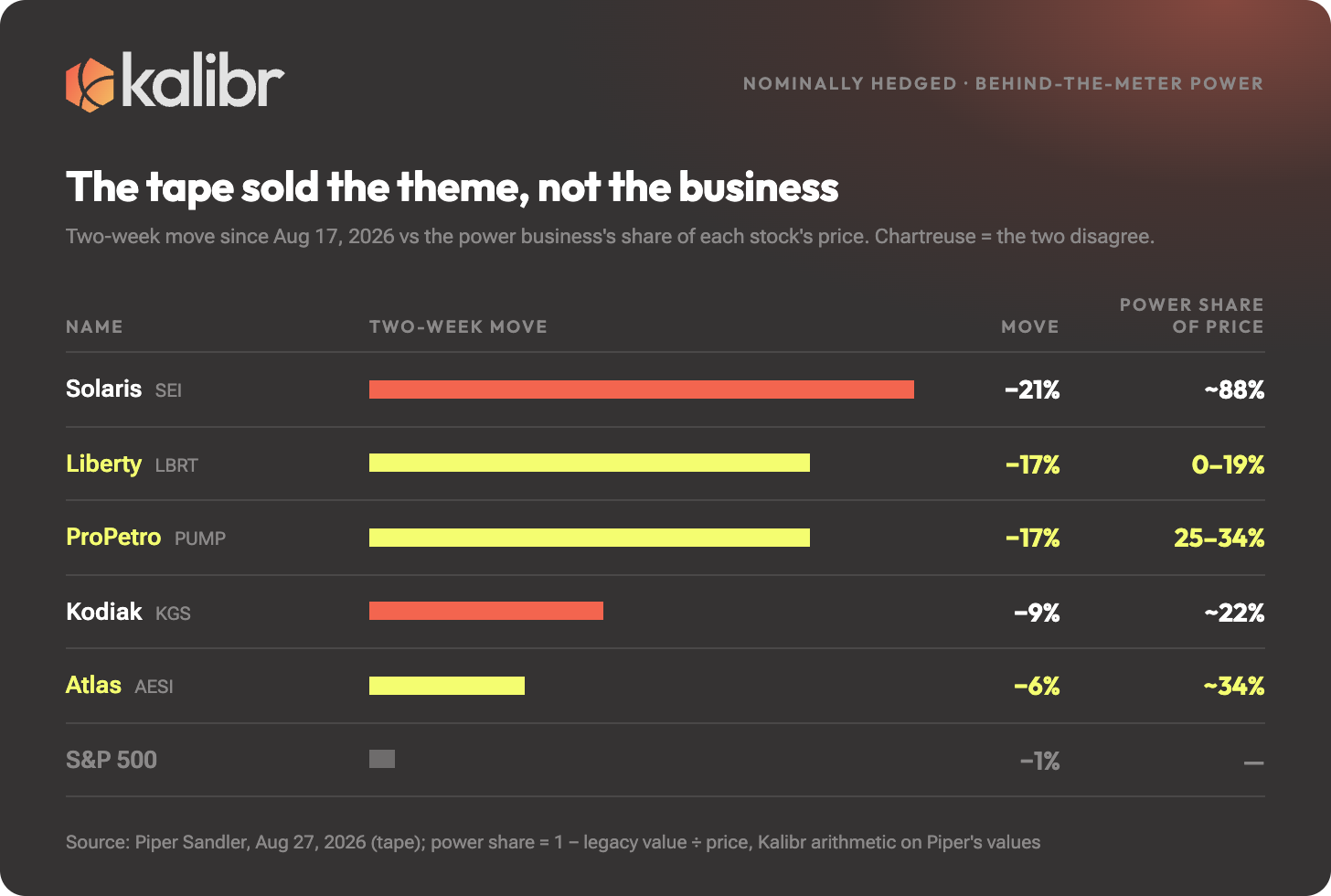
So the tape has a beta to the power story and none to the business. What deserves a deeper look is sorting these players on power exposure, balance-sheet capacity and conversion rate, which will determine the winners and losers of the category and, in turn, the second- and third-order effects on the legacy parts of the business. That is what the rest of this piece does.
The flywheel
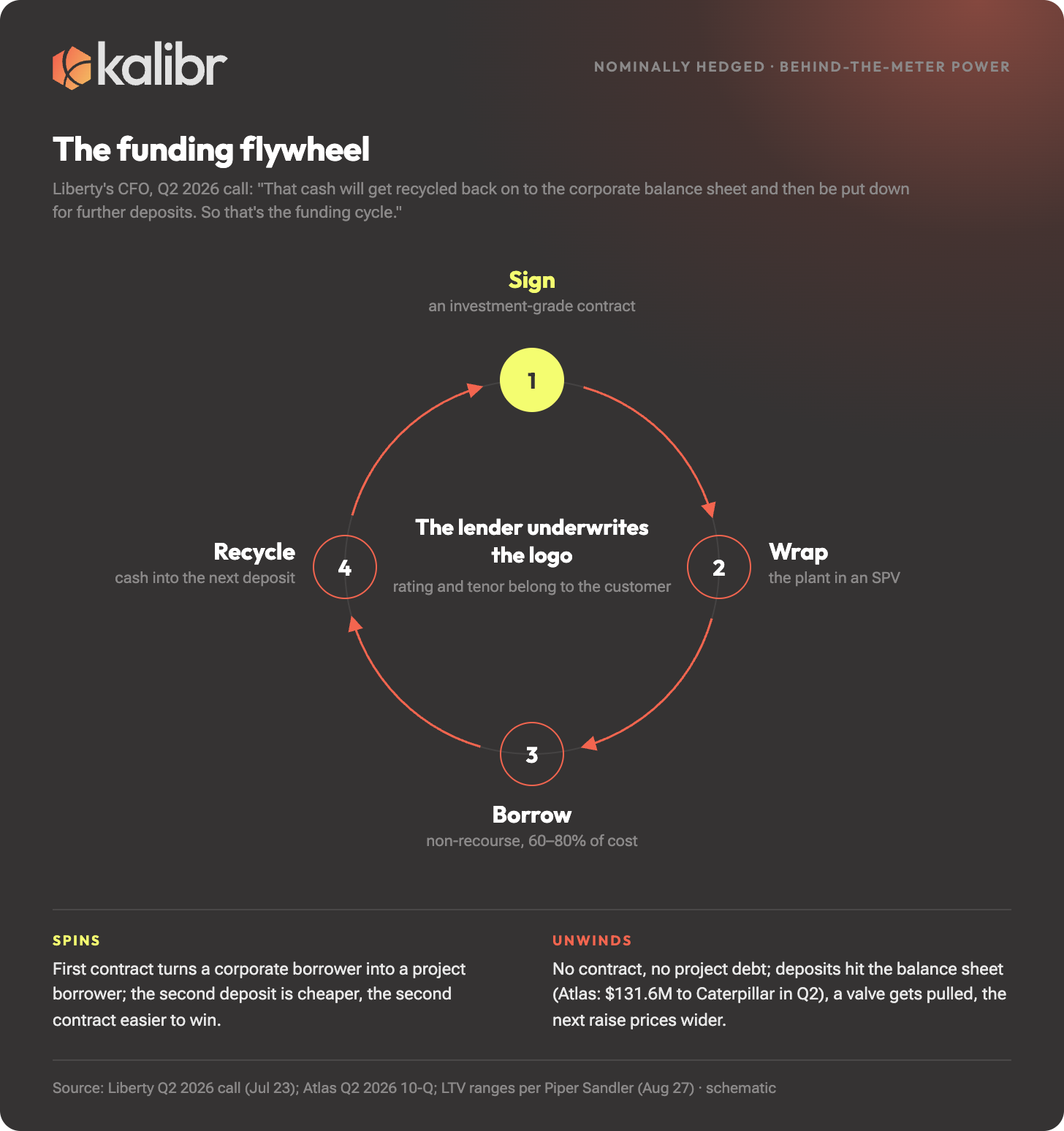
The winners and losers of the space are going to be the ones with the best handle on the capex conversion cycle (Q2 showed just how concerned the market is about capex efficiency). Part of mastering that cycle is having the ability to raise the capex at all, which comes down to the flywheel I outlined at the top of the article. Liberty’s CFO spelled it out on the Q2 call:
“These projects will be dropped into SPVs and then done with some version of project financing that will be nonrecourse back to the corporate balance sheet. That cash will get recycled back on to the corporate balance sheet and then be put down for further deposits. So that’s the funding cycle.”
Four steps, with a loop at the end:
1. Sign a contract with an investment-grade counterparty.
2. Drop the plant into a special-purpose vehicle (sound familiar?).
3. Borrow against it, non-recourse, at 70% to 80% of cost for an oilfield installation or 60% to 70% for a private grid with long-term paper.
4. Send the cash back to the CFO and put it down on the next Caterpillar or Baker Hughes deposit.
This is a positive feedback loop, and what sets how fast it spins is who the lender is underwriting. A project lender sizes to the offtaker’s rating and the contract’s tenor, both of which belong to the counterparty, not the developer. It compounds. The first signed contract converts a corporate borrower into a project borrower, which makes the second deposit cheaper than the first, which makes the second contract easier to win on price, which pushes spreads down on the second financing, and so on. That is why the first logo is worth more than the tenth, and why Atlas, which needs to get this process spinning more than anyone right now, “won’t be putting [debt] on the balance sheet until we have hard contracts with great counterparties in hand.”
The flywheel compounds in reverse too. No contract, so no project debt. Deposits come off the corporate balance sheet (Atlas paid Caterpillar $131.6 million in Q2 alone), liquidity thins, a release valve gets pulled (a dividend, a buyback, core-business capex), legacy cash flow softens and the next raise prices wider. There is no mean for either direction to revert to, which is why the competition within the space is so fierce, and why understanding how each competitor can pull the three levers (raise, convert, navigate) matters so much to the collateral (no pun intended) damage that could land on the capex and opex budgets of E&Ps.
Lever one: raise
The first lever is the ability to raise: who can get the money, at what price, and what the price difference does to the competitive dynamic after four years of compounding.
There is a first-mover advantage within the peer group on cost to raise, with costs running from zero to 9.51% across a menu of debt and equity structures. Liberty and ProPetro funded gigawatt programs with zero-coupon convertible notes (LBRT $770 million due 2031 and $525 million due 2032, ProPetro $690 million due 2031). Solaris placed $1.3 billion of 6.375% senior unsecured paper. VoltaGrid raised $2.0 billion of 7.375% second-lien notes on top of a $3.0 billion asset-based facility. Atlas borrowed $540.0 million from Stonebriar at 9.51%. And KGS raised $836.1 million in common stock.
A sector funding turbine deposits at a zero percent coupon is the risky-debt market saying “we like this market”, loudly. The race within the race is the spread paid to access that capital. A company paying 9.51% needs its plants to out-earn the company paying nothing by roughly the coupon, every year, before it can match the price on the next contract. (On $540 million that is $51.4 million a year, which is a lot of turbine to out-earn.)
Coverage is the other half of this dynamic, and it is the half Atlas can’t fix with a good quarter. Atlas has $1,047.7 million of purchase obligations against $292.9 million of liquidity (my sum from the 10-Q), which is 3.58x coverage. Solaris sits at 1.06x. ProPetro holds $784 million of cash, more than its entire 2026 capital program.
Atlas’s menu is even narrower than it looks, with its convertible in the red: the 2031 notes are struck at $14.51 with the stock around $12.07. The Stonebriar loan carries a 50% excess-cash-flow sweep that trips at 2.5x leverage, and the CFO is on the record that “the leverage ratios do start to blow out” on the front end of the build. Two covenants pointed at the same event. Since this is a flywheel, it compounds from there: RBC sized the next 450 MW contract at $500 to $700 million of additional financing, Atlas prefers debt, and the precedent for Atlas debt costs 9.51%.
Lever two: convert
Raising money is important. What a dollar buys you once you have raised it is more important. The metric for that is the build multiple (capex per MW over EBITDA per MW): what it costs to put a megawatt on the pad, divided by what the megawatt earns in a year. The way you improve it is to sell more of each plant, not necssairly more plants.
The cleanest parallel comes from service companies with expertise in reciprocating equipment. KGS said on the Q2 call that its number is in “that $1.5 million per megawatt range” all in, with “build multiples of roughly 5x EBITDA” and five-year paybacks. Piper Sandler has Solaris at about 3.1x. Same basic service, a large gap, all of it conversion.
The path to converting better is simple to state: sell more of the plant, and offer the higher-margin services around it. Solaris demonstrated the concept in Q2 with an amendment to its 660 MW Hatchbo agreement, taking it from a power capacity agreement to a capacity and operating agreement. The amendment handed Solaris the balance of plant, batteries and full operation and maintenance, and the term stretched from up to 15 years to up to 18. Needham puts the revised economics near $450,000 of EBITDA per MW against a $300,000 generation-only baseline. Solaris also bought GESA, roughly 600 people who install, commission and run plants in 30 countries, because commissioning labor is both an execution constraint (sometimes conversion is a hiring problem!) and a higher-margin offering.
The vertical integration push is as much a response to what customers want as it is a play for margin. Atlas’s CEO says prospective data-center customers “want to provide a load quantum with productive load swings and a reliability metric” and have someone “solve the entirety of the power problem.” A customer buying an outcome pays for every link of the chain that delivers it. And every link you own is margin that stays in the building and spins the flywheel a little faster.
Atlas isn’t the only one working on conversion. VoltaGrid bought its packager to delete the OEM’s slice. Solaris self-performs nearly the whole chain. Kodiak has more than half of its power fleet on Caterpillar 3500 series engines (the staple of oil and gas compression), the best AI and technicians in the game at running those units, preferred gas supply, O&M and OEM relationships, and partners out the switchgear, emissions control, storage and installation.
Lever three: navigate
Having served as COO of a Colorado oil and gas company at the height of SB-181, I know what it is to operate a business under intense public scrutiny and a public ethos of “Not In My Back Yard.” That battle has made its way to the power discussion quickly.
Two constituencies want opposite things, and both of them vote.
The first wants its power bill to stop rising, and the way a regulator serves it is to keep new load off the grid, which manufactures behind-the-meter demand. On August 3, Governor Abbott’s audit order froze progress on up to 474 gigawatts of ERCOT interconnection requests and pushed the Batch Zero study to December. Kodiak’s CEO, asked about it four days later on the earnings call, broke down the impact plainly: roughly 450 gigawatts of requests “on a system that has 95 gigawatts of capacity today, that does nothing but benefit behind-the-meter power solutions providers like ourselves.” The order has already reached Kodiak’s book: a West Texas project Kodiak had described as a grid-plus-generation hybrid “may shift more towards sole behind-the-meter.” KGS wasn’t the only one to comment. Atlas’s CEO said “we don’t agree with them” on the request to delay the 765-kV lines, and in the same answer, “this is a very big tailwind.” You are allowed to disagree with a policy and still invoice it. Atlas did both inside one answer, which is about right, since the audit order is a customer-acquisition program the state is running on its behalf, and the customers it produces are now signing for 15 to 20 years instead of five.
The second constituency wants the turbines and generators away from its town. Virginia’s H.B. 30 levies $0.011 per kilowatt-hour on all data-center electricity (purchased or self-generated behind the meter), capped at $600 million a year. Texas SB6 gives the PUCT curtailment authority over co-located loads, affirmed in the Crusoe/Ensign order in July. My great home state of Pennsylvania’s August 18 executive order makes developers pay full transmission upgrade costs and procure clean, firm capacity rising to 32% by 2035. More broadly, Gallup has 70% of the country opposed to a local AI data center. It turns out that while Americans want to use Claude to optimize their fantasy football lineups, they don’t want the infrastructure that decides which Philadelphia Eagles receiver to start (my recommendation is to bench them all) running in their back yard.
A split decision is a livable business. One constituency keeps manufacturing your customers and the other keeps taxing what you build for them, and the gap between the two is a cost you can put in a model. What you cannot model is the day they agree. Electricity is priced by the last plant the grid needs each hour, and in Texas and PJM that plant usually burns gas, so everyone’s bill moves with the gas price whether or not they ever buy a molecule. Right now the people who care about bills are on the side of behind-the-meter power, because a data center that stays off the wires doesn’t force a transmission build they pay for. Energy Innovation’s point is that off the wires is not off the system. A hundred gigawatts of turbines behind fences drink from the same pipe the grid’s gas plants use, and at that scale they add something like 18% to the country’s gas-fired capacity. Gas goes up, the marginal plant’s cost goes up, the household bill goes up, and the bills constituency switches sides. That’s the trapdoor: the one political force pulling for you flips, both now push against you, and a project lender who sizes a loan to the years of contract it can count on will notice before any legislature does. (My own view is that the odds of the bills constituency working this out and agreeing on it are thin.)
S&P and Brattle answer a different question. S&P found no link between data-center growth and residential rates across states, and Brattle showed that a data center willing to shed load at the peak can lower system costs. Both are about data centers connected to the grid, the arguments a utility makes to defend its own big customers, and neither touches the fuel channel. So they tell you about the political weather, not about whether the trapdoor is real. The honest doubt is about size, not mechanism: gas supply grows over five years, stranded Permian gas is often nearly free, and the two camps are mostly arguing over how much of the announced 100 gigawatts ever gets built.
All of this has pushed contract tenor longer. Atlas’s CFO says that “18, 24 months ago” customers were talking “5-, 7-year contracts. Now, we’re talking 15 to 20,” because end-use customers have concluded that the grid debate, coupled with a grid where you are “lucky if you get 98%,” is untenable. Tenor is what the lender sizes to (just look at compression’s push for longer contracts), which is how the policy fight feeds the financing flywheel we have detailed ad nauseam. Policy that lengthens tenor lowers the cost of capital; policy that taxes or curtails islanded plants raises it.
Handicapping the race
With the three levers set, we can handicap who is likely to succeed and falter in the BTM race and, in turn, what the second- and third-order effects are on the other parts of these businesses.
Start with Solaris. The company raises at 6.375%, converts at about 3.1x, carries 1.06x coverage and has named investment-grade status as the goal (which, I guess, is like my kids saying their goal is As, and I say of course it is). That puts the firm in the lead, it is the consensus among the brokers as the most de-risked name, and honestly it leaves me without much piffy commentary to add. VoltaGrid is private, holds $1.0 billion of equity backing from some of the biggest names in the space (Blackstone, Halliburton), owns its packager and has something near 7.5 GW contracted. Liberty raised cheaply and converts worst at 5.5x, with RBC modeling 2026 FCF at negative $908 million and liquidity to early 2027. The thing to watch, and the pressure point for the firm as a whole, is striking a year-end energy services agreement with a respected counterparty. ProPetro has the cash and the smallest contracted book, which is time without an anchor.
The competitors entering from adjacent OFS domains, KGS (compression) and Atlas (oilfield infrastructure), are the more interesting study. KGS can raise (it did so simply, on a common stock issuance) and has real domain expertise to flex in the space, but it has yet to convert on a counterparty contract: zero new long-term data-center megawatts signed since closing DPS.
Atlas is the mirror image. Its first contract, the 120 MW Socorro deal, is $190 million of capital for about $55 million of annualized FCF, a cash-on-cash payback under 3.5 years and the best single conversion number in the group. It also sits inside a company with 3.58x commitment coverage and a 9.51% marginal cost of debt.
KGS needs a contract that proves a rate. Atlas’s difficulty is funding, and the terms it can get. Those aren’t the same problem, and the market sold them within three points of each other after the Q2 calls.
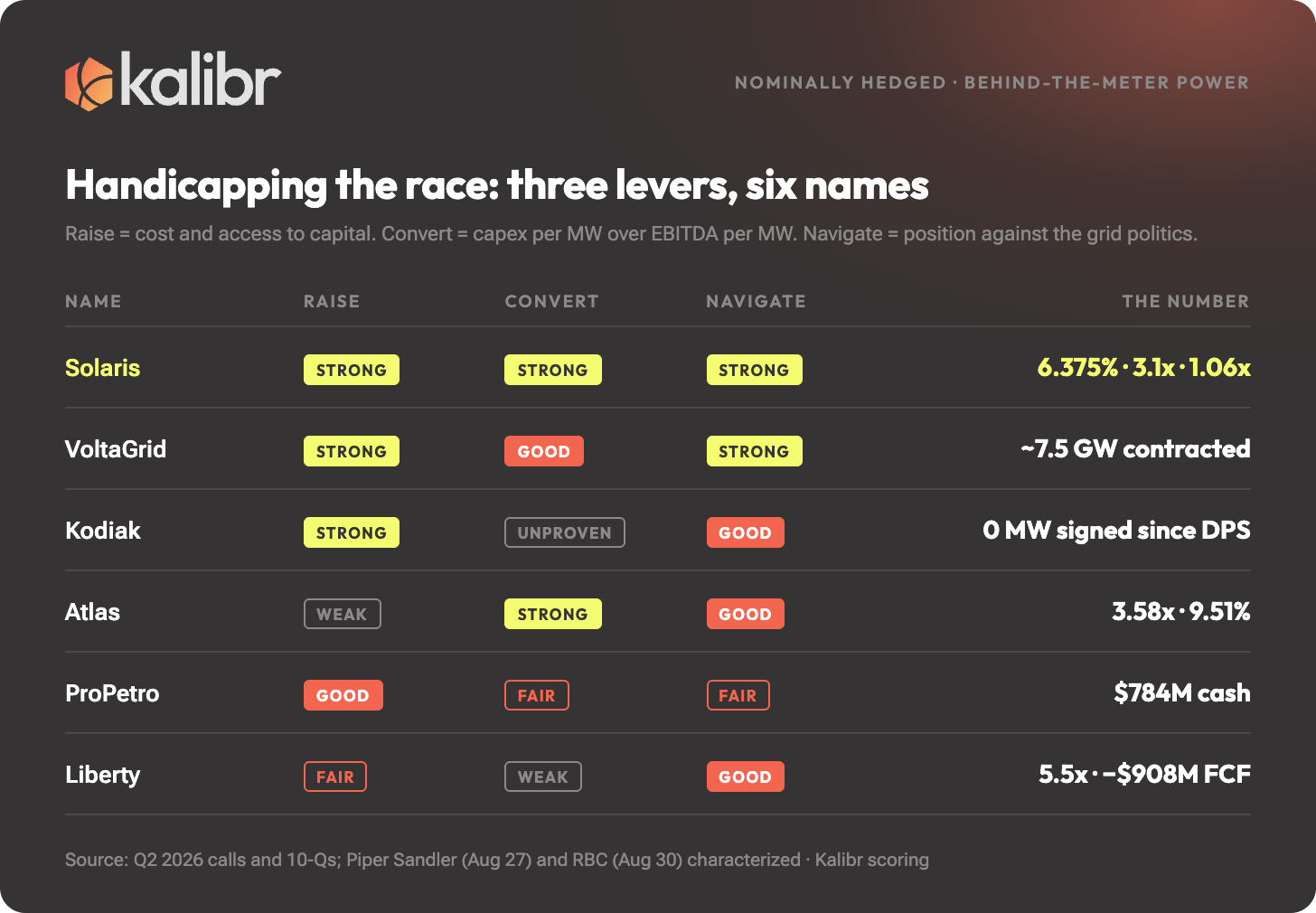
Solaris is leading this race. The next two quarters could re-sort the rankings. For KGS, the watch is a West Texas contract with an all-in figure under $1.5 million a MW and a tenor past 10 years. For Atlas, it is a PPA announced with its financing on competitive terms. The first would prove a build multiple, the second would prove the flywheel moving. Both are checkable over the next two earnings calls.
Second order: impacts to E&P capex and opex
I’ve spent about 3,000 words illustrating that BTM is a competitive and capex-intensive business. Who can find the money and convert it efficiently matters, because almost all of these firms sell core services that E&Ps depend on. It is compounded by the fact that almost all of them have stated obligations (leverage targets, dividend goals, etc.) that compete for the same money.
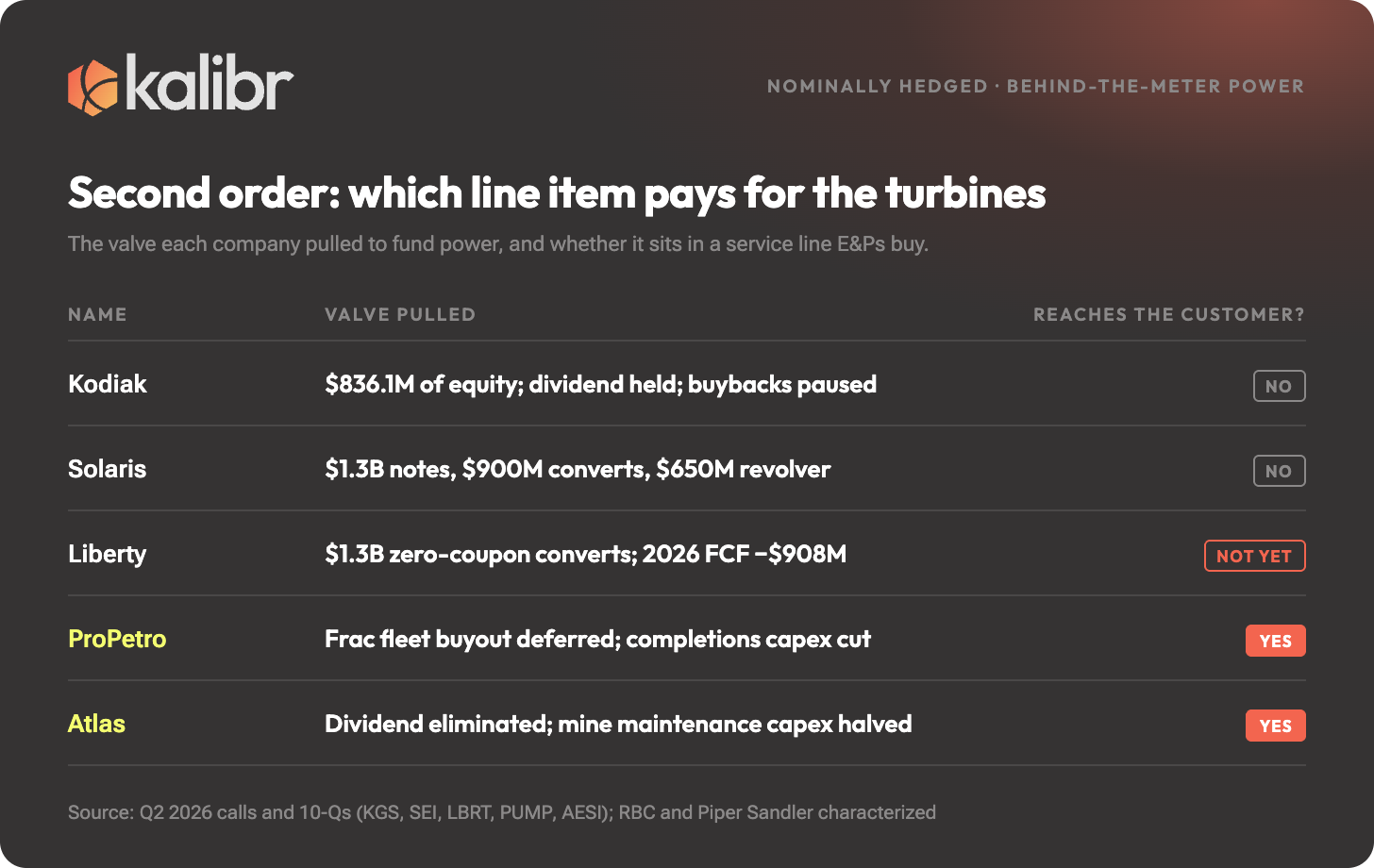
All of these firms have told the street where the money is coming from.
KGS has moved its dividend off the old 35% of DCF because “we can’t tie the DCF to the dividend anymore.” Buybacks, despite record-low leverage of 3.1x, are deprioritized to lean into power. Add the common stock offering and KGS has pulled three levers to fund the power build: $836.1 million of equity, a dividend severed from cash flow, and buybacks, while holding maintenance capex on the core compression business at $19.9 million for the quarter. The company has also kept investing in the AI program and the technicians that defend its uptime lead in compression. Equity might be the more expensive instrument in the current environment, but it bought something essential: the right to leave the core cash flow business alone.
The companies without that access pulled from the core business. ProPetro cut completions capex to $125 to $145 million (from $140 to $160 million), “primarily attributable to the timing of our planned FORCE electric fleet buyouts.” Compare that with the PROPWR capex guide of $400 to $450 million, nearly a 3-to-1 ratio. Management attributed it to timing, which I am sure is the case. It also lines up with a sector that has deliberately reduced capacity in its commodity fleets to get pricing power back, so the two are hard to separate. But one only needs to talk to an E&P searching for a Q4 frac fleet to see whether some of these decisions have started to reach the core business.
Atlas eliminated its dividend and guided sand and logistics maintenance capex to $5.0 to $7.5 million a quarter for the second half, from $14.6 million in Q2. And while guiding its own maintenance down by half, it argued on the same call that competitors’ plants are “held together with duct tape and bailing wire” and that “maintenance CapEx has been an afterthought to a broad swath of the market.” Both claims can be true, and together they paint a vivid picture of which line to watch as a capex relief valve while BTM competition heats up.
Third order: who (might) gain
Having watched the compression space closely over the years, the interesting competitive dynamic has been between the two largest providers, KGS and AROC.
AROC, through several acquisitions, made the bet that electric compression is the wave of the future. There was (and still is) good reason to: higher-margin compressors overall, less dependency on technician competency, and an industry whose consolidation has produced larger companies with public commitments to reduce emissions (and those aren’t changing regardless of which administration is in office).
KGS stayed fiercely in the gas-engine camp and doubled down on its core competency. That bet has largely been right so far, because the slow build-out of electrical capacity has stunted the ability to deploy electric drive.
What makes KGS’s purchase of DPS so interesting is that it ratchets up the bet against one of its largest competitors. As illustrated above, BTM success depends in large part on the acceleration (or lack thereof) of grid capacity, and that is the same variable that makes electric compression less or more attractive. AROC, of course, has chosen to abstain from the behind-the-meter game, which lets it decline to compete in the capex intensity documented above.
On August 5, Archrock raised its quarterly dividend to $0.23 from $0.22, “the fifth dividend increase in 2 years,” committed $1.4 to $1.6 billion of growth capital through 2030 “predominantly in large horsepower and electric motor drive new compression,” reported leverage of 2.6x, and, asked whether the program forces a change in capital allocation, said no: an “all-of-the-above approach.” On August 7, Kodiak severed its dividend from discretionary cash flow because power needs the money. Same industry, same week, same question.
On the frac side, the most interesting study is the behemoth that, forced to pick between getting into the BTM power game or abstaining, chose a third option. HAL took roughly 20% of VoltaGrid in October 2025 for about $345 million and came back to the table for the $1.0 billion round in May alongside Blackstone. HAL holds BTM upside as a financial asset. LBRT and PUMP hold it as an operating liability with deposits attached. If those two are capital-constrained in frac for the next 18 months, HAL takes core share and keeps the power exposure, which may be the best trade in the sector and required buying no turbine slots.
The rest of the compression cohort has the same view and said so. USA Compression expects data centers to add 4 to 6 Bcf a day of gas demand over the next several years, put its capital into J-W Power instead, and says it will stay disciplined and focused on M&A. NGS raised growth capex to $60 to $80 million, concentrated in large horsepower and electric motor-drive units, and told the market in March it hadn’t seen power opportunities with contract lengths comparable to compression. Their stated reason for staying home is tenor. The deeper reason is that all three run pre-contracted capital models, which is the right discipline for compression and a disqualifying one for a business that spends before it sells.
Electric motor drive compression needs the grid to arrive, and behind-the-meter power is a wager that it won’t. Archrock is committing $1.4 to $1.6 billion mostly to the first, NGS is growing into it, and Kodiak has committed to the second inside the same sector, and one PUCT ruling on the three 765-kV Permian lines resolves both, in opposite directions, on the same day.
Final thoughts
The logo grid is still marketing. Atlas will keep describing its counterparty as a subsidiary of an investment-grade technology infrastructure provider and leave the name out, because the rating is the part it needs you to have. What I can’t tell you is whether a business that has to spend for three years before it sells can live inside companies whose customers were sold the opposite discipline, the one where the contract comes first and the iron second. Kodiak says yes, and paid $836.1 million of dilution to be allowed to find out. Atlas says yes at 9.51%. Two prints from now, one of them will have put a number where the argument is. I don’t know which.
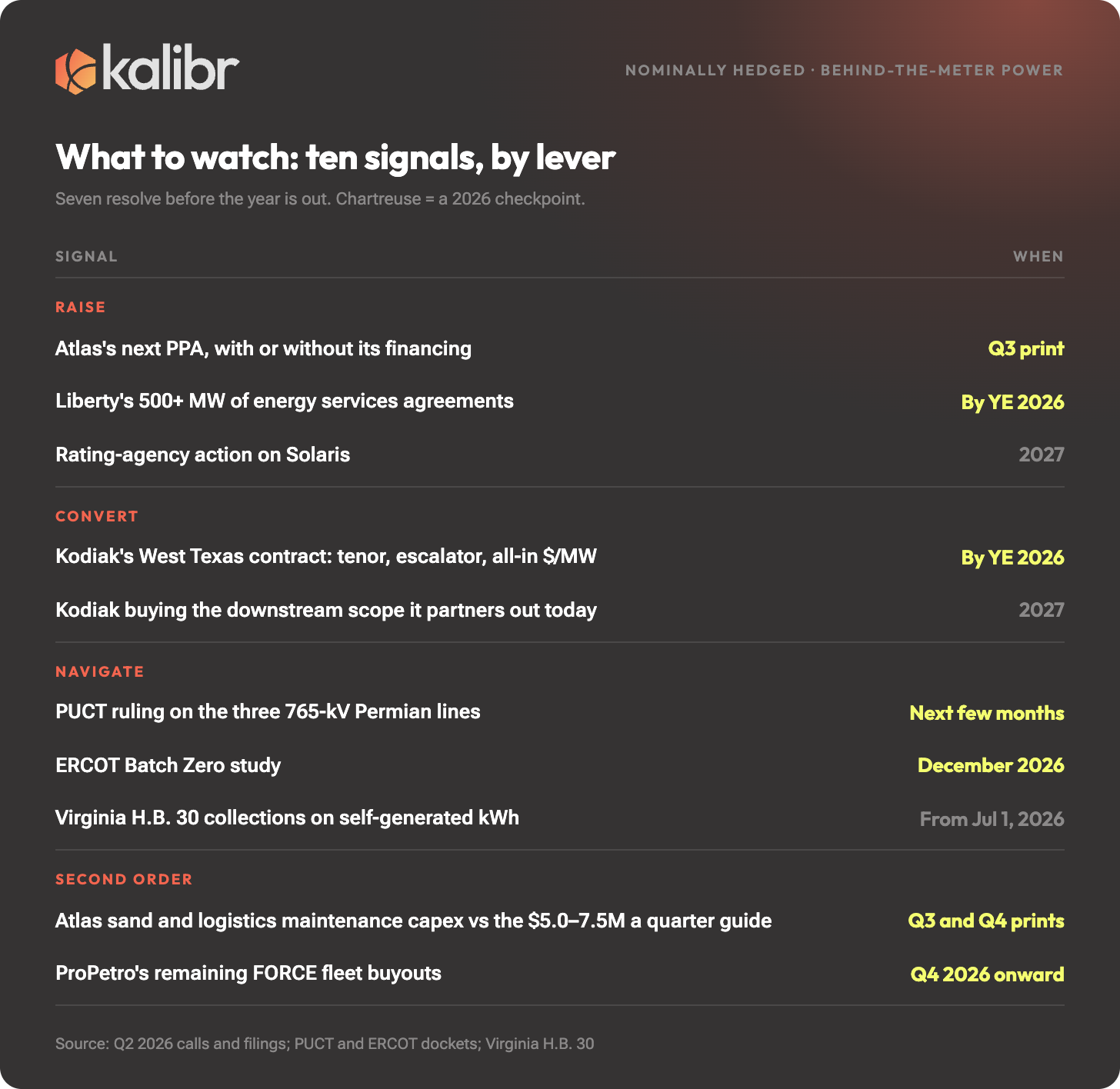
Things to watch
Ten signals, dated and sorted by lever, so you can score the race without me. Seven of them resolve before the year is out.
This newsletter is research and commentary for informational purposes only. It is not investment advice and not a solicitation to buy or sell any security. Kalibr Partners is independent and is not affiliated with, endorsed by, or compensated by Atlas Energy Solutions, Kodiak Gas Services, Solaris Energy Infrastructure, Liberty Energy, ProPetro, VoltaGrid, Halliburton, Blackstone, Archrock, USA Compression Partners, Natural Gas Services Group, ONEOK, Apollo, Caterpillar, Baker Hughes, or any other company named above. The analysis draws on public filings, earnings-call transcripts, press releases and broker research alongside Kalibr’s proprietary benchmarking; broker figures are characterized, not quoted, and management statements are quoted from the transcripts. Coverage ratios, power-share estimates and paybacks are Kalibr calculations on public inputs and are illustrative. Figures are believed reliable but not guaranteed. Company names and marks belong to their respective owners.