


Kalibr Partners is a petroleum engineering consultancy of former operator engineers, data scientists and commercial experts. We ran the assets, built the data and run the negotiation. Four services, one purpose: a lower cost per barrel.
My simple mental model of a North American gas company in 2026 is that it is a machine for turning rock into a twenty-ish year promise, and the rock is the easy part. Or, in typical Myers verbose fashion:
Everyone in the US who wants to find gas can find gas. Since 2019 the industry has replaced 126% of the gas it produced, the gas-weighted producers recycled at 179% over three years on $2.75 gas, and in 2025 they added proved developed reserves at $0.61 per mcfe.
Everyone in the US who does not want to find gas finds a lot of gas anyway. 57% of the gas reserves added in 2025 came from companies drilling for oil, for whom the gas is less a product and more of a waste.
This creates a strange dynamic where the wellhead price is set by the people who care about it least, and that price sits at what Kimmeridge calls “the point where it is most abundant.”
Therefore the only gas worth more than that is gas that has been promised to someone who settles against a different index: a power plant in PJM, a propane buyer in Asia, a liquefaction train.
A promise like that runs twenty years, and the lender behind the plant, the train or the propane buyer wants it from a counterparty with an investment-grade rating and, preferably, its own pipe to the site. The trade is less about the gas and more about the probability that the gas shows up in year 14.
A sub-investment-grade producer is not barred from a twenty-year contract, exactly. The lender just asks it to post credit support sized to the volume, which ties up liquidity, counts against the revolver and announces to everyone in the room that the lender was a little worried, and at that point the producer discovers it would rather sell the gas to the hub at $2.38 and tell investors nothing sits on its balance sheet.
The result sorts gas companies into buyers and sellers by the rating and the pipe. Which means a company with wonderful statistics by every historical measure (inventory, liquids mix, breakevens the neighbors would trade for) can go from buyer to seller without any of the statistics changing. This is the proverbial moving of the goal post problem in business.
If you read my article last week, you see there are clearly two theories of how to run a North American oil and gas company in 2026.
One is to vertically integrate: buy the pipe, buy the trading desk, sign the data center and the power plant, so that if the risk factor in some AI lab’s S-1 about ending humanity comes true, your molecules (and, I assume, your robots) are still earning a fee tied to somebody else’s value case (do AI agents have Venmo?).
The other is to look around your neighborhood, notice that inventory is scarce, and consolidate fast enough to be the basin champion, so that your buying power does the rest in a game that only has a few winners per basin.
Both theories are true.
They are true about different companies, which is the 2026 bifurcation between oil developers and gas developers, and the larger point is that the conditions that make you the winner under the first theory (if we define winning as running the combined company, which seems like a fine place to start) do not make you the winner under the second.
Thirty years of inventory makes you the acquirer in oil and the acquired in gas.
This is more than a neat observation, because it tells me what to do, both inside a company and when I am selling into one. Say I run a service company and I am building the sales plan for the year. For oil companies I pull up the recycle ratio by company and the plan basically writes itself: if I sell anything that improves recovery (a surfactant, an EOR package, whatever), the companies in the bottom quadrant need me much more than the companies in the top one (they might be out of a job soon!), so that is where my best people, my best plans and my value-based pricing go.
I can also think about term methodically. Suppose I already have most of the logos on the list. The bottom quadrant is the part of the list that gets bought, so that is where I should push for the longest contract I can get, because every month of term is a month before I have to renegotiate with the combined entity, and the combined entity will think the total is less than the sum of its parts. (I promised the last issue that the next one would go deeper on this. The news cycle had other plans. It is still coming.)
What both models agree on is that there is more consolidation coming, and the forces above decide who does the acquiring. Anyway:
On October 26 EQT agreed to buy Range for 0.987 of its own shares per Range share, a 20.6% premium: $12.83 billion of equity, $13.62 billion with Range’s debt, all stock, 73% to 27%, closing in the first quarter of 2027. Dennis Degner said “Range has never been in a stronger position than it is today,” which is both true and the reason the position belongs to someone else tomorrow.
Division is a choice of denominator
The number everyone printed on October 26 was $5,961 per flowing Mcfe per day, the richest mark on the gas comp list by a distance. Well, not quite, because Range printed its third quarter the next day, with no call, and the quarter had 2.50 Bcfe a day in it and $794 million of net debt. The same deal is $13.62 billion over 2,499 MMcfe a day, or $5,452: still the richest mark on the list, and 8.5% cheaper than it was the day before.
Except a Range Mcfe is not an EQT Mcfe. A third of what Range produces is NGLs, 126,674 barrels a day at $27.54, so a Range Mcfe earned $3.43 all-in while an EQT Mcfe earned $2.72. Weight the mark by what the molecule earns and $5,452 becomes about $4,323.
And the $2.19 billion premium is roughly what $325 million a year of cost savings is worth at 6.8x. So: a record, a fair price, or free, depending on how you divide.
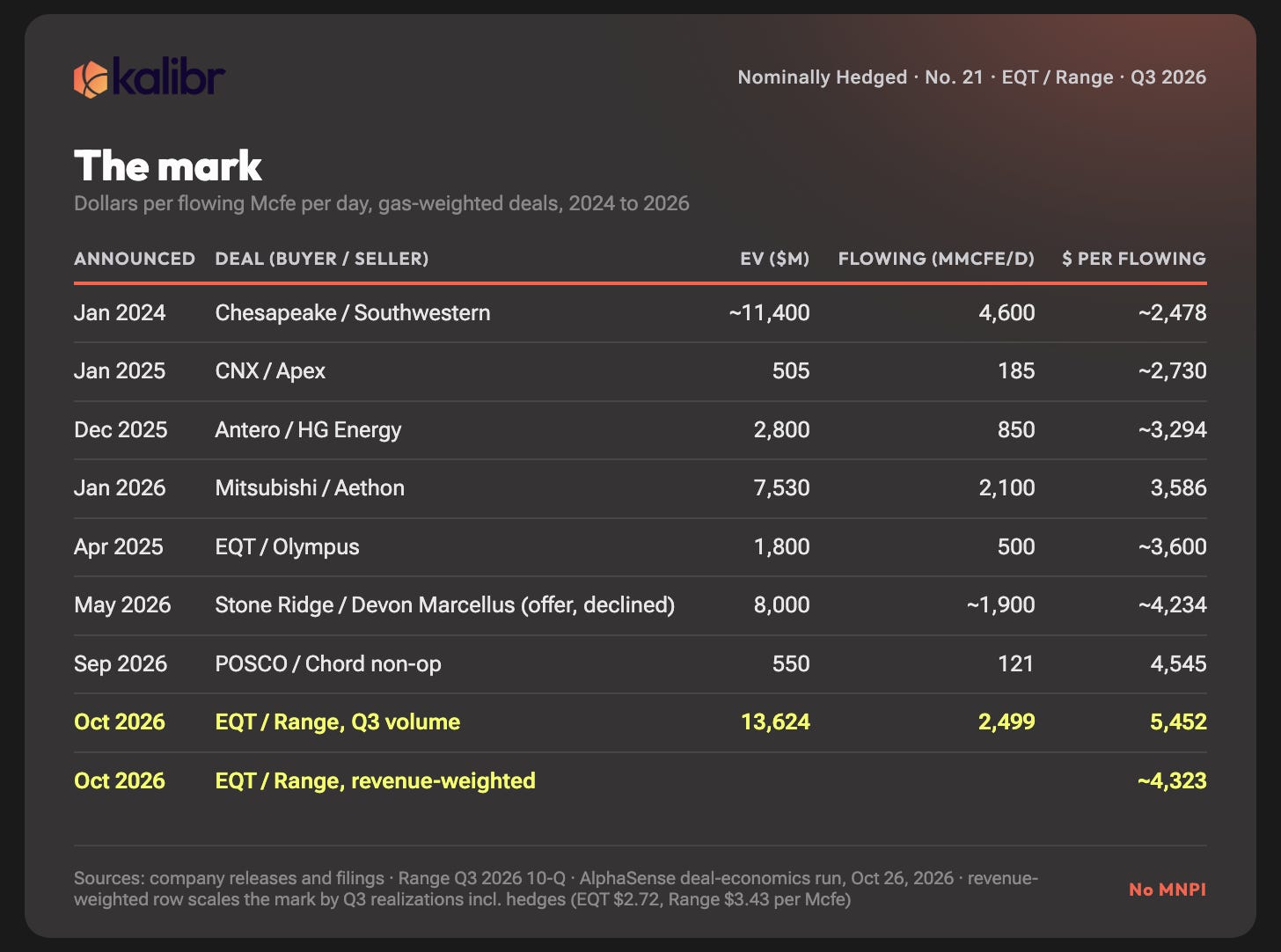
I don’t think any of those is how EQT decided. EQT is getting units it can promise to somebody, and a molecule promised to a power plant on a PJM netback is worth what the promise pays, and no bar on the comp list measures that. Rice, asked whether the liquids were a pillar of the deal or the cherry on top: “the real goal here is around the natural gas side.” (Half the revenue you just bought is the cherry. Sure. It is also the half the market has always multiplied half a turn lower than gas, and nobody who runs a gas company talks up the part of the sundae that trades at a discount. Rice is doing his job; the multiple is doing the rest.)
The prenup is the proposal
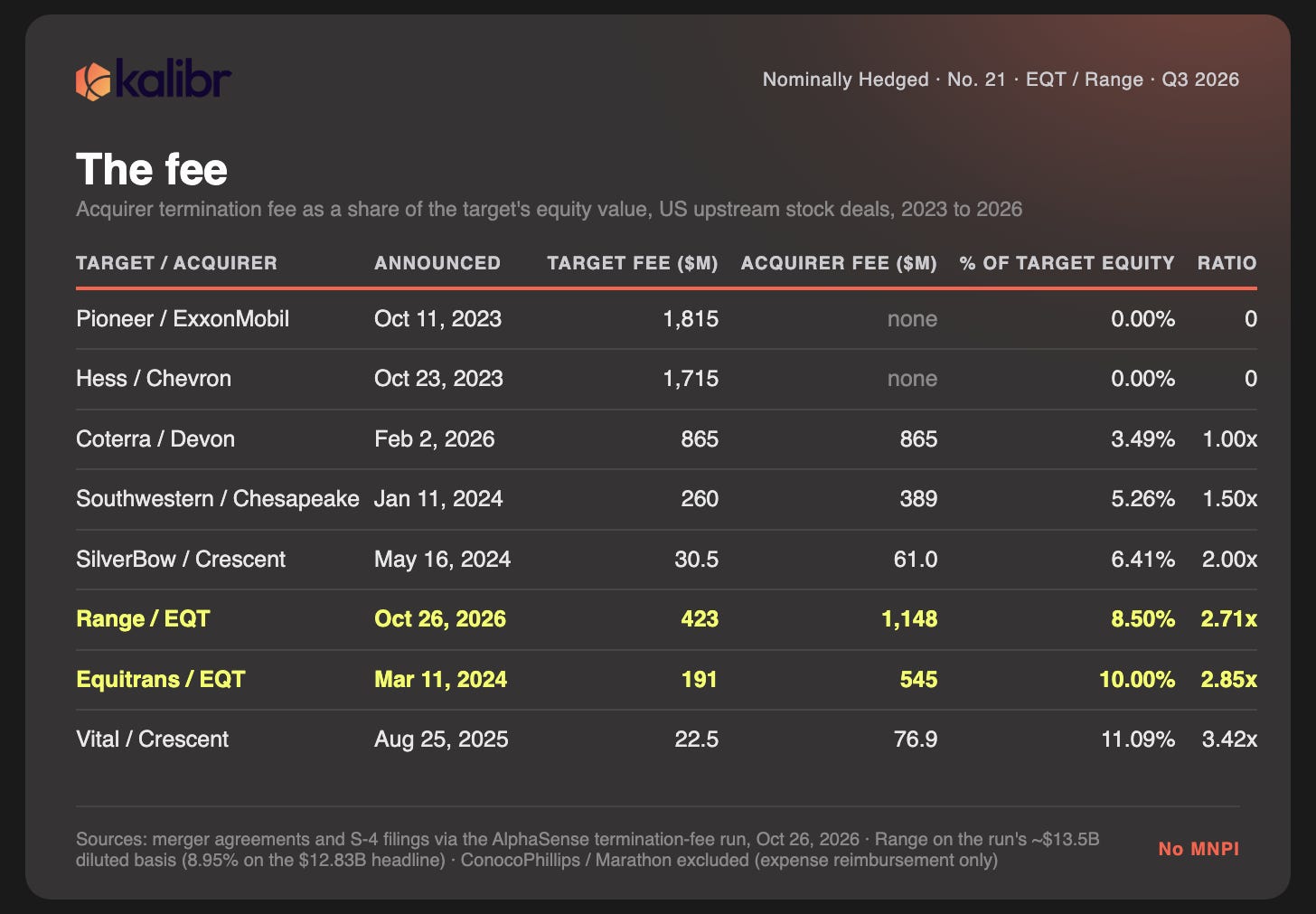
Section 7.4(h) of the merger agreement says that if EQT’s board changes its recommendation, “Parent shall pay to the Company within three (3) business days after the date of termination the Parent Breakup Fee.” The fee is $1,148 million. Range’s is $423 million.
Section 7.4(h) of the merger agreement says that if EQT’s board changes its recommendation, “Parent shall pay to the Company within three (3) business days after the date of termination the Parent Breakup Fee.” The fee is $1,148 million. Range’s is $423 million.
A reverse termination fee is a promise to write a check. Nothing is posted at signing, and the buyer pays only if it walks. A buyer that knows it will close can promise any amount, since the expected cost of a promise it never intends to trigger is zero, so a confident buyer promises a large number and the number tells the seller how confident the buyer is. EQT promised $1,148 million, and Range, running the other way, promised $423 million, which is why EQT’s fee is 2.71 times Range’s: Range was also fairly certain, and Range just had less to prove, because the only thing that could stop this deal was EQT’s board.
It helps that EQT has played this game before. It promised $545 million against Equitrans’s $191 million in March 2024, 2.85x, nobody made it, and a habit like that is visible: the next seller in the basin will ask for the EQT fee by name. It also helps that nobody else was in the room (presumably). Expand is digesting Twin Eagle, Antero is still paying for HG Energy, and Degner, asked on the call about other combinations, answered by describing this one.
Now sit on Range’s board. You took 0.987 EQT shares per Range share, fixed, with no collar, so every dollar EQT’s stock moves before close moves your price, and the only thing underneath you is the fee. A seller who wanted cash would have asked for a collar. Range took a bigger fee instead, which is a board that wanted EQT stock and was worried about exactly one thing, EQT getting cold feet. What neither board wrote down is antitrust: the termination for an injunction has no fee in either direction, and the only antitrust-shaped clause in the schedule is one extra day for every day a government shutdown idles the FTC. Rice, asked about the FTC: “No, we do not anticipate it.” The schedule agrees with him. I can’t help but wonder what this would look like in 2022 (probably not even feasible).
Buy a pipeline, get a multiple, buy a gas company
How does EQT get to be the only logical bidder? On July 22, 2024 it closed Equitrans, about $14 billion with the debt, and the market pays a pipeline multiple for pipeline, $17.32 billion of it on Scotiabank’s initiation. Texas Capital’s NAV model for Range has a midstream row, and the row says $0.00. On top of the pipe sit the promises (CPV Shay on a PJM netback, Homer City and Shippingport in principle, six million tonnes of LNG from 2030) and under all of it the rating, which is what makes EQT’s shares usable as money. An all-stock deal at a fixed ratio asks the seller to hold the buyer’s paper from signing through close and then as 27% of the combined company, and Range’s board took 0.987 EQT shares with no collar because EQT’s paper holds its value in a way Range’s own would not: investment-grade debt underneath it, a pipeline multiple inside it.
Price it on one named deck. Jefferies, at $3.15 gas, had Range at 6.47x 2027 EBITDAX on October 23 and EQT at 7.09x. The deal is 7.6x: half a turn over EQT’s own multiple, in its own stock. The pipe and the contracts gave EQT a multiple Range could not earn with the same rock, and the multiple is what bought Range. Which leaves the question the whole deal turns on: if the rock was this good and the price was this fair, what exactly could EQT sign that Range could not? Range was asked a version of that in July.
The exam only happens if you get to the exam
Nobody lends $2 billion against a plant; they lend it against the plant’s inputs. A liquefaction train, an aluminum smelter, a data center and a fertilizer plant are all the same object to a lender: a box that converts one contracted input into one contracted output for twenty years, with the debt sized to the gap between the two prices. The smelter’s lender wants the power contract before the first pour; the data center’s lender wants the PPA before the first rack; the fab’s lender wants the water and the power and the wafers. The gas producer is the input, which means the producer’s ability to deliver in year 14 is a line item in someone else’s credit memo, and the producer is graded by the standards of that memo, which were written by a lender.
The lender’s questions are short. “Will the gas be there in 2046?” Reserves longer than the tenor. “And if it isn’t?” An investment-grade rating, or a letter of credit from someone who has one. “How does it get to my plant?” Somebody’s pipe, ideally yours. “Have you done this before?” The rock answers the first question well, and only the first one, which is, I suspect, the meeting Range kept having.
Sit in the lender’s chair, with invented numbers. You are financing a $2 billion plant against a twenty-year supply contract, and the supplier is rated BB. You do not say no; you are a bank. You ask for a $300 million letter of credit until the rating shows up. On the supplier’s side of the table that letter is $300 million of revolver capacity gone for as long as it stands, a fee on it every year, and a line in the 10-Q that tells investors a lender was worried, at a company whose whole pitch is that nothing sits on its balance sheet. So the supplier goes away to think about it, and the conversation that was going to happen at the term sheet does not happen.
Which is how to read Mark Scucchi on July 22, asked whether Range’s sub-investment-grade rating was an issue: its balance sheet metrics are “higher than our investment-grade peers, meaning stronger,” and “in our commercial discussions the balance sheet and credit rating has never been a topic of discussion.” Both are true. The rating only comes up at the term sheet, and if it never came up, the discussions never got there.
It is hard to stay independent with a lender in the room
In the last issue I argued that an oil basin gets sorted by recycle ratio, with Crescent’s $4.22 billion purchase of Devon’s Eagle Ford as the worked example. The companies with the better ratios buy the ones treading water, use the buying power the combination just gave them to improve the ratio again, and use the improved ratio to buy the next one. The champion is whoever keeps that flywheel turning fastest. Gas has the same flywheel with a different thing at the hub. What inventory is to an oil company, a differentiated value case for the molecule is to a gas company. Build that platform and you buy the producers that did not; skip it and you are the one being bought, however much rock you are sitting on. So here is Appalachia sorted on the lender’s four questions, every gas-focused producer I could find, which took about as long as you would think.
Antero built the route and got most of the balance sheet: three quarters of its gas is piped to the LNG fairway on legacy firm transport, and S&P and Fitch rate it BBB-, which is three of the four items and more than Range had. What it lacks is the scaled trading platform and a pipe of its own. Moody’s held it at Ba1 in December when the HG Energy purchase went on with debt, and the gathering belongs to Antero Midstream, a separate public company, which is what Mizuho’s October 7 title, “Integrated Strategy, Disintegrated Capital Structure,” means. Mizuho and UBS both have Antero signing a supply agreement by December 31, and neither has it signing anything with a target’s name on it. That is the difference between a company that has qualified for the flywheel and a company that has qualified to feed it.
Expand has the rating from all three agencies and spent 2026 buying the desk: Twin Eagle, closed September 16 for $1.25 billion, 14 Bcf a day marketed. An investment-grade producer with the biggest desk in the country, holding production flat, is a buyer between purchases. (I am not saying Expand buys anyone. I am saying it has four of four items and nothing new to do with them yet, and that is a shape with a history.) CNX has the lowest firm transport in the group, hedges where its neighbors hold pipe, and has signed nothing, which makes CNX the purest index seller left in the basin. The lender’s list, applied mechanically, points at it next.
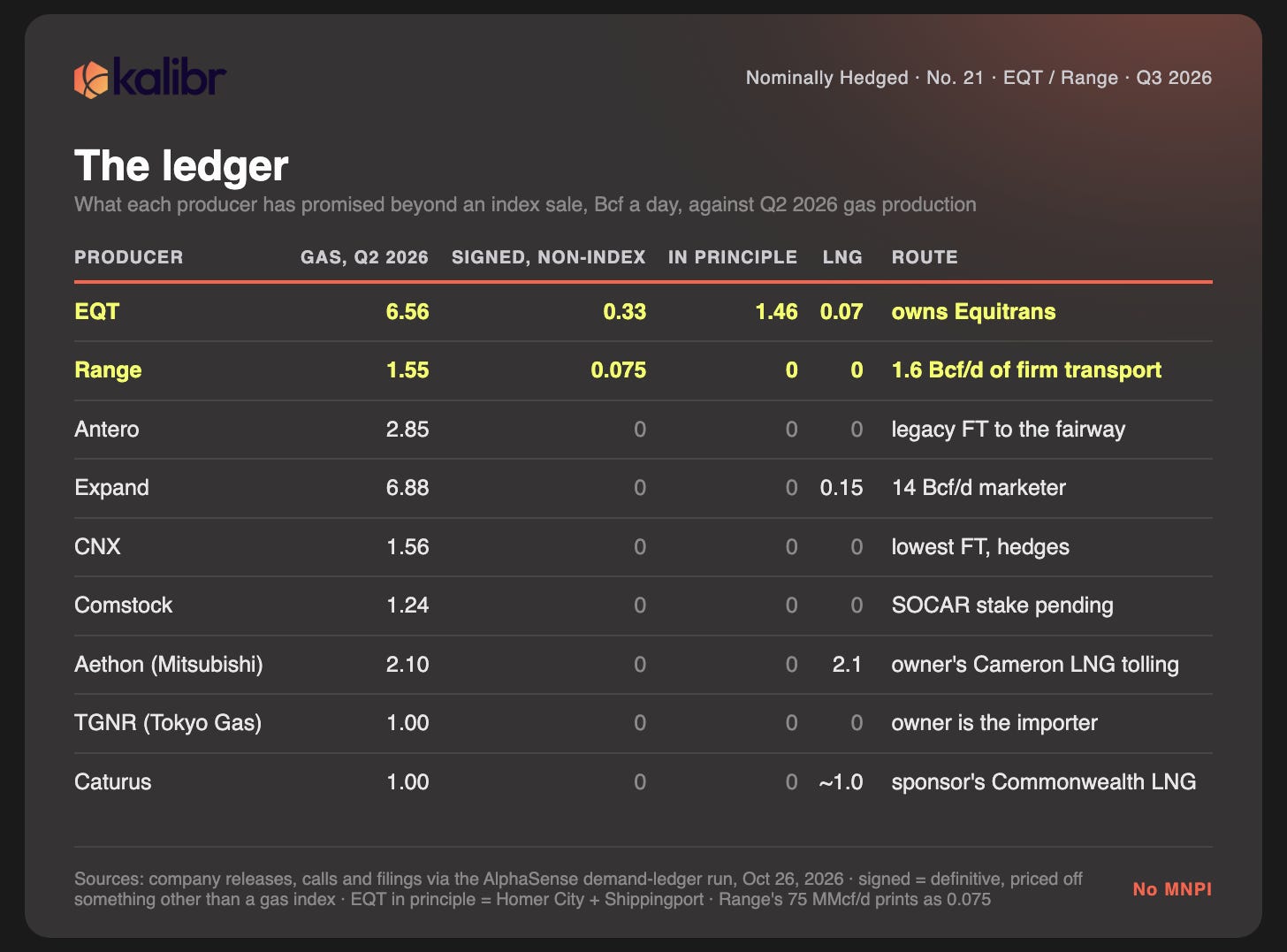
The Haynesville ran the same sort and got a different answer, because there the lender arrived from outside with the liquefaction in hand: Mitsubishi closed Aethon on July 14 beside its Cameron LNG tolling, and SOCAR’s September 28 agreement takes a fifth of Comstock’s legacy Haynesville for $1.65 billion. Each producer sold a piece of the molecule and kept the company. Caturus, Kimmeridge’s own vehicle, committed about 1 Bcf a day to its sponsor’s Commonwealth LNG, which is following the paper’s prescription by being its author.
If you run operations at a gas producer, or you sell into one, you may by now be wondering why I have spent this many words on one deal. The usual reasons to write about a merger are the stock and the acreage. The stock is somebody else’s job; the people at Novi Labs are better than I am on what the acreage is worth. I am interested in a third thing, which is what a deal like this does to the next five years of operating decisions and to every sales plan pointed at the companies in it, and the cleanest way I know to get there is a puzzle investment banks used to ask twenty-two-year-olds in interviews.
The other two players have plans too
You are in a duel with two other people, and the last one standing walks away. You hit one time in three. The second shooter hits two in three. The third never misses. You fire first, and the three of you take turns until one is left. Where do you aim?
Most people pick in about four seconds, and they pick the marksman. He never misses, he is the deadliest thing in the room, and a shot that removes him is the one shot that obviously improves your life. A smaller group picks the two-in-three shooter, on the theory that he is the one you might hit. Run the numbers and the marksman shot gets you out alive about 31% of the time; the other one, about 26%. Those are your two options, and the better of them has you dead two times in three, which is the kind of answer that makes an analyst go back and check the arithmetic.
The arithmetic is fine, and the menu it was run on was short by one move, the one almost nobody in the interview finds without a hint: fire into the air, hitting nobody on purpose. Do that and you walk away about 40% of the time, better than either shot you were agonizing over, and the reason is what the other two do with their own shots. Hit anyone and the survivor turns to you next, and the survivor is a better shot than you are. Miss on purpose and the two of them have each other to deal with first; the two-in-three shooter has to fire at the marksman, because otherwise he is dead next turn, and whoever is left standing, you get the first shot in the duel that remains.
Notice what you had to know to find that: very little about your own odds, which were fixed and bad, and a great deal about the other two, meaning what each of them would do after your move, given what they could see. The player who wins this game is the one who spends the least time on his own shot and the most on predicting everyone else’s, and the data you need for that is the other players’ odds, and you already had your own. The whole trick is to use what you know about them to see the move you had not considered.
What carries straight over to a gas basin is that the biggest threat in the room is everyone’s first target, and that the move that looks like doing nothing can be the only one that wins, provided you have worked out what the other players do next. (The memo above has three kinds of player in it, and I will leave the seating chart to you.)
Market intelligence is not a mental model
Nobody hands you the one-in-three odds though. In the game the odds arrive printed on the card. In a gas basin you buy them, and a producer in 2026 buys more of them than it ever has: Enverus, Rystad, a sell-side range on every name, the whole category I would file under market intelligence, bought to understand yourself, the others and the room. And the paradox I keep running into, company after company, is that the more of it a management team owns, the less sure it gets. Each subscription seems to add a reason to wait. That is not a data problem. The data is fine, and there is more of it every quarter. It is a problem with the mental model that is supposed to turn the data into the thing the duel runs on, which is a probability about what somebody else does next. That is the only reason to build a model of the oil business or a model of the gas business at all: so the data has somewhere to go.
The odds were the easy half of the duel, too. The hard half was sitting in the marksman’s chair and the two-in-three shooter’s chair and reasoning out what each of them would do, and that is easier to do with people than with companies, because people have faces and companies have press releases. A line usually credited to Alfred Adler is the way around that: “Trust only movement. Life happens at the level of events, not of words. Trust movement.” For a company, movement is money, which is why I spend an unreasonable share of my time on the financials and almost none on the prepared remarks. It is also why the fee section did not stop at the cost of the break-up fee. The $1,148 million is the event. The question it answers is what a fee 2.71 times the seller’s implies about where EQT thinks it stands, and what EQT thinks it stands to lose, and that is a probability about EQT’s next move, which is the thing you needed.
Put the model and the money together and the two pictures fall out on their own. The oil model is the recycle ratio and the race, which sent Devon out of the Eagle Ford and Crescent in. The gas model is the end use and the rating, and Range’s July told you how that one ends. Both force more consolidation, and neither cares how much inventory you have.
Sometimes the first shot is right
Hopefully no one interprets the above as me believing RRC didn’t see this coming. Scucchi’s July answer was the answer of a man who had read the memo and decided the rating could wait another year, which, at half a turn of leverage and bonds trading like investment grade, was a reasonable read of Range’s own data. What it may not have been was a read of EQT’s. EQT had spent three years on the trend this issue is about, gas that is plentiful and a use case that is not, and the price it paid reads like the output of a framework, with the bid as its last line: a producer with thirty years of rock and no rating will need somebody else’s balance sheet within a year or two, that producer will wait instead of buying its way there, and a board waiting on a rating cannot wait through a 20.6% premium in investment-grade stock with $1,148 million posted against the buyer’s own cold feet. An offer like that is one a board has a fiduciary duty to explain turning down, and Range, twelve months from something, had no explanation that beat it.
None of that was private information. The reserve data, the ratings, the contract ledger and the fee comps were available to EQT and Range at the same price. My guess is that one of them had a model of what the other would do next, and the deal terms are what that looks like from the outside.
The duel’s lesson is about sequence: the move depends on what the other two players do after it, and the only way to know that is to have reasoned your way into their chairs before you reached for the pistol. Sometimes the first shot is right, and EQT took it. Sometimes the air-shot is, and in July it may have been Range’s to take. The data in both cases was the same. What differed, as far as I can tell, was the interpretation, and nobody sells that by subscription.
This newsletter is research and commentary for informational purposes only. It is not investment advice and not a solicitation to buy or sell any security. Kalibr Partners is independent and is not affiliated with, endorsed by, or compensated by EQT Corporation, Range Resources, Equitrans Midstream, Antero Resources, Antero Midstream, CNX Resources, Expand Energy or Twin Eagle, Chesapeake Energy, Southwestern Energy, Apex Energy, Olympus Energy, HG Energy, Stone Ridge, Devon Energy, Crescent Energy, SilverBow Resources, Vital Energy, Coterra Energy, Chord Energy, POSCO, Pioneer Natural Resources, ExxonMobil, Hess, Chevron, ConocoPhillips, Marathon Oil, Comstock Resources, Aethon Energy, Mitsubishi Corporation, Cameron LNG, SOCAR, Tokyo Gas or TG Natural Resources, Caturus, Kimmeridge, Commonwealth LNG, Competitive Power Ventures, Homer City Redevelopment, Frontier Group, Imperial Land, Novi Labs, Enverus, Rystad, or the research firms and rating agencies cited (Jefferies, Mizuho, UBS, Scotiabank, Texas Capital, AlphaSense, Moody’s, S&P Global Ratings, Fitch Ratings). The analysis draws on those companies’ public filings, releases, merger agreements and earnings calls, sell-side research as cited, and Kalibr’s proprietary data; figures are believed reliable but not guaranteed, and several reflect modeling assumptions stated in the piece. Company names and marks belong to their respective owners.
If you want your book read the way the buyer read Range’s, or an operator’s book read from your side of the table, reply to this email or talk to us.